My first reaction to Milton Becerra’s work, on my first visit to his studio, was to try to explain from within, and treat as endogenous, what others would perhaps prefer to think of as alien to the spirit of Latin American art. My self-set task became more difficult when I realized that Becerra was not just a sculptor. That may be the main stream of his work, but his purely spatial ideas, in the form of ‘annotated’ landscapes, installations, and performances, are equally important. What they have in common is the ever-fresh and constant homage to the position of Man in the cosmos.
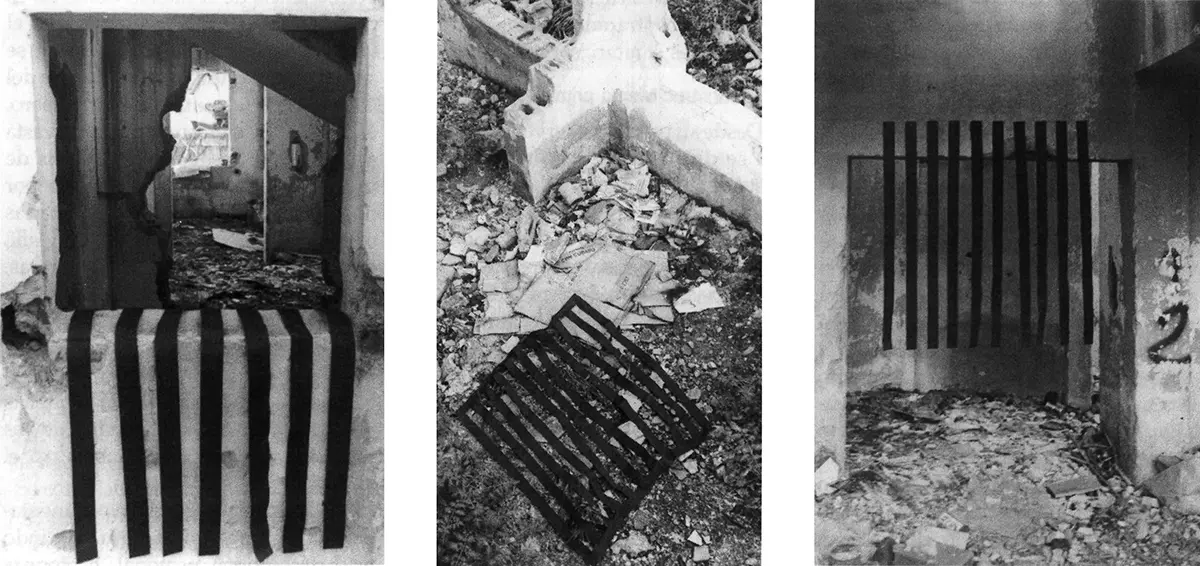
The first thing we should realize about Becerra is that he is Venezuelan, and like other young artists of his generation, he was bitten by kinetics and set out to paint with a ruler, compass, and T-square. The end result was tedious and repetitive, but it is a stage of his life we must remember since Becerra was attempting to inject new life into the dry geometrism that was stifling a young generation of artists at the very beginning of their careers. He succeeded, remaining faithful to his origins, through simplicity and the mime boom of his interest in conceptual art and land art. Paradoxically, perhaps, the desire to follow fashion rather than start his own style produced a work that proved germinal in Venezuelan art: Analysis of a process in time (1974). First exhibited in 1988, it consists of an intervention in an old, tumbledown house, of which only an eloquent photograph remains.
Becerra’s composition has two parts: the passive support —the tumbledown house— and the active element of intervention, in this case, the positive and negative of a picture on black canvas from which he cut and arranged in ten parallel alternating fringes. This might have been merely banal, but Becerra treats each of the elements of intervention as a cloak or curtain draped over a window or a door or laid out across a room without a ceiling, the floor covered with rubble.
At that moment, Becerra’s art came alive, boom, as a criticism of kinetics, while providing it with a vital form to continue. The deliber ate softness of a drooped or folded piece of cloth with the geometry of the intervention was a parody of kinetics. The black canvas was his rejection of the polychromes of Soto and Cruz Diez. And the continuity of the movement is suggested by the way in which Becerra allowed himself to be persuaded by a constructive structure, the human, and environmental events which aroused his passions. “In my work you will find part of life itself, capturing a moment, happening at the same time as its events.”1 He was constructing a new way of seeing, understanding, and practicing artistic expression, in particular, in contrast to the kinetic painters: while they were mainly interested in elegance and embellishment, Becerra wanted to inject sense or meaning. He chose to return to the prime function of art as practiced in primitive communities, and he established a philosophical base that later led him to contact the indigenous tribes of the Orinoco and Amazon basins.
According to the critic Luis Ángel Duque, it was this work that “loosed the chains that bound Venezuelan form from a list sculpture at a stroke."2 Indeed, the ‘active sign’ (the element of intervention) is a square containing empty and full sections. The scene around the square (and showing through it) is desolate. Here and there we see passers-by giving a human dimension to the walls which are about to disappear. In one of the photographs, we can see a group of tall buildings behind the condemned house. The architecture of the old settlement of Caracas is on its deathbed, and the architecture of the new metropolis of Caracas is booming. The new architecture is linked to Carlos Raúl Villanueva, and so, to kinetics. But with this note of protest, Milton Becerra moved into another stream of aesthetics, opening a new chapter in the history of contemporary Venezuelan art.
Latin America has seldom seen such a clear, deliberate, intelligent, and creative shift, in which the new generation does not bury the preceding one. The kinetic artists are and will continue to be a subject of admiration. At the same time, Becerra will represent the new avant-garde with his feet on the ground, a prophet in his own land who in the fullness of time was considered the equal of his mentors. Another work from 1974 is Within the Possibilities of the Imaginary. The intervention this time used a refuse dump on a road on the outskirts of the city, with geometrical figures laid out on the ground. He then used the retouched photograph to draw a series of ideal triangles in space, to make up structures that would be impossible to manufacture, a sort of ideal counterpoint to the filth around him.

Primordial constructivism
Since his first intervention, Becerra adopted a different kind of
constructivism, bordering on topology. Torres-García organized carefully measured structures, reflecting the importance he gave to
proportion or the relationship between distances. Becerra is more
interested in proximity, and his structures are organized in an order
rather like that of the weaver at his loom. This was the characteristic
I described in an essay on the last iron sculptures of Ramírez Villamizar.3 If the same principle can be applied to Becerra (although he works
in different materials), this would seem to be evidence that both
men take up and adapt certain expressions that plumb their
full depths and are not seduced by a form, a combination of
colors, or a line.
Becerra might well have started to produce series back in 1974, but he did not. From 1975 to 1980, he worked as an assistant to Cruz Diez and gave himself over to the restoration of contemporary masterpieces by such artists as Jesús Soto. In his spare time, he mulled over, planned, and set up his interventions. Since the documentary background had to involve photography, he learned how to use the camera and absorbed laboratory techniques. He patiently started to work on quite complex audiovisuals, which are still unknown to the public. From there, he acquired an interest in cine photography, using a simple Super-8, but that was always a secondary interest. Whatever the technique, the underlying principle was always the same: where? why? and how?
We have noted that the intervention in Analysis was in fact a sequence of fleeting events. Becerra went back to think about this, and his subsequent works show that he preferred his comment to be permanent. As one cannot offer a shabby comment on the splendors of a great city, studded with the statements of great builders and engineers, architects and advertisers, and the marks left every day by a mass of human beings many millions strong, he climbed the steep hills around Caracas, and there, where the vegetation grows uncon trolled, he selected a number of stones for their shape and position, and painted them where they lay. Some of the photographs from the series Painted Stones (1975) offer a curious contrast between their rectangular borders and the parallelepipeds of the skyscrapers in the valley below.
The idea of expressing meaning came from the first boom of a deeply rebellious attitude in Becerra. An ecologist at heart, he watched nature perish before the advance of the builders and roads and bridges the great metropolis demanded. When he found out that a number of streams had disappeared with the construction of the La Mariposa dam, he visited their dry beds, and used his art, without ceremony or cheap argument, to record his indignation. This was the setting for Tied Stone (1978), in which he first combined the round mass of a stone and a piece of rope tied around it. Becerra explained it to me as a means of “making the line travel from one element of interest and another in the landscape." His words seem to describe a poetic idea, but one which requires technique.
It was not long before Becerra began to think about how to introduce what had previously been in the open air into an enclosed space. He wanted to produce sculpture, which meant offering the public a tangible object, not the documentary expression of something that did not exist. After a number of interventions, he came to the conclusion that what he should do was superimpose a regular element (the line) on something irregular (the mass). One of his earliest attempts at sculpture was to drill a hole in a stone and push a wire through it, to stick out whichever way it happened to go. In this, as in previous experiences, two virtues are evident: first, the artist made use of random elements, and made free use of them; and second, he succeeded in being synthetic, so that the work was never overloaded with unnecessary extra elements.
Language and discourse
The use of the word ‘language’ in the field of the plastic arts produces the problem that a mere mention of it by a critic invites the unpleasant task of making a work of art more obscure and complex, instead of clearly bringing out its secret meanings. Becerra has created a ‘language’ since he has a precise message to communicate to us. He is concerned about pollution, the irreparable damage suffered by nature, and the abuse of indigenous communities, and his art is constructed around those subjects.
His respect for nature is reflected in his respect for a stone. In Painted Stone and Tied Stone, he leaves the stones where he originally found them. After painting the stones, he (the contemporary artist) imitates his prehistoric forebears who “consecrated” them with their petroglyphs. When Becerra drills a hole in the stone to let the wire pass through, he is violating one of the basic principles of his aesthetic. Not surprisingly, he never tried such an experiment again. The rope, which simultaneously ties up, links together, and lends meaning, became his way of expressing his concern from that time onwards.
On one important occasion, the meaning of this work was lost: at the 1980 Paris Biennale, Becerra set up Five Equidistant Points on the; pavement outside the Museum of Modern Art there. The work consisted of five large stones, with markers on them related to
each other by reciprocating vectors - the ropes. This was the same assembly he had successfully exhibited in Caracas, but the Parisian public did not understand it, and, sadly, the work was destroyed in a matter of days, without a peep of protest from the press.
Becerra was then a young artist, with no name or track record. His interventions were only known to and appreciated by a handful of Venezuelans, among them photographer Claudio Perna and the critics Luis Ángel Duque and Roberto Guevara. Becerra, like any good artist, decided to break out in the battle against incomprehension and went to live in France. He soon found out that his relationship with Paris was very different from that with Caracas, even if his interest in stone persisted. It was then that he started on the research that led him to produce the work we appreciate today. His studio was very small, and he had to work with small pieces of stone. This change of scale changed the way he looked for solutions, and plastics became his main line of thought, although he never lost the conceptual aspect.
In general, we can say that a Becerra sculpture is still an object that has been intervened. Stone is the material of which the universe is made, and is central to the work. Just as in primitive societies, there were stones that were worshipped as being the center of the world, by analogy we can say that each of Becerra’s works is a metaphor for such a mythical center. This is the essence of his language and his discourse. He later applied himself to the inherent technical problems of placing knots on very smooth surfaces, and of tying up irregular volumes. These were problems demanding a high degree of skill to ensure that the work did not go out of shape or loosen over time. Becerra retained his complete freedom of expression in large and small works, in rough stone, glass, or metal, standing on the ground or hanging in the air.
In light of Becerra’s motivation in the historical and social context of his native Venezuela, his philosophy, and his technique, we need only mention a few of his more recent works. They can be divided into two groups: the cosmic and the utilitarian. The cosmic works are those inspired by the stars and their constellations. There are usually permanent installations that consist of stones placed in parks, arranged by the artist to be an exact echo of one constellation or another. In 1984, he was inspired to place the constellation of the Eagle in the Albarregas Park in Merida, Venezuela, as a kind of homage to the towering, snow capped peaks of the Five White Eagles of the Venezuelan Andes. For the Jardins d'Amérique Latine in Paris, he chose three of the southern constellations (Centaurus, Vela, and Dorado). The size of each stone was determined by the size of the star it represented. The petroglyphs are drawn from the visual repertory of the American Indians. Unfortunately, the work has not yet been installed, and all the signs are that it never will be.
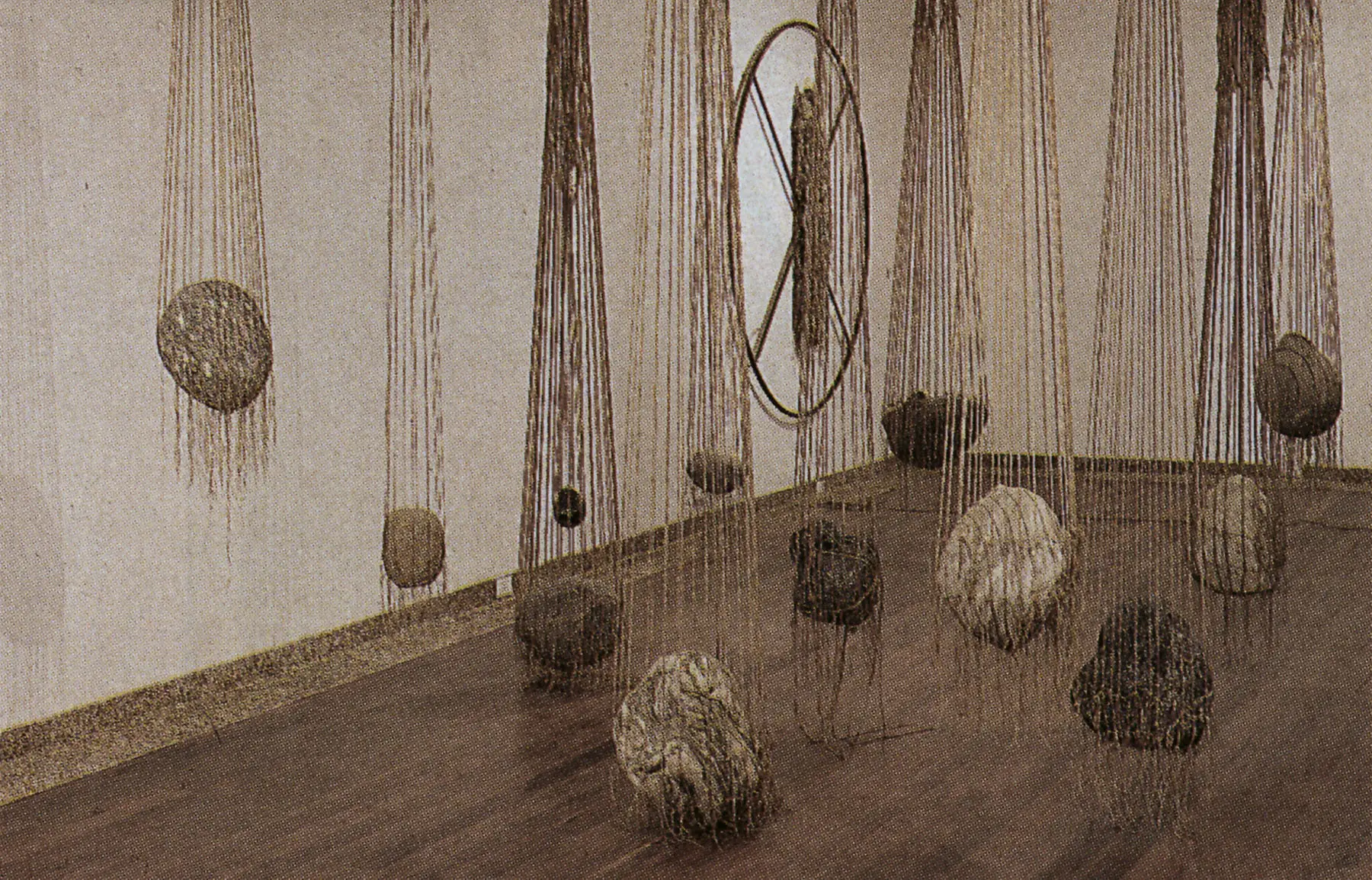
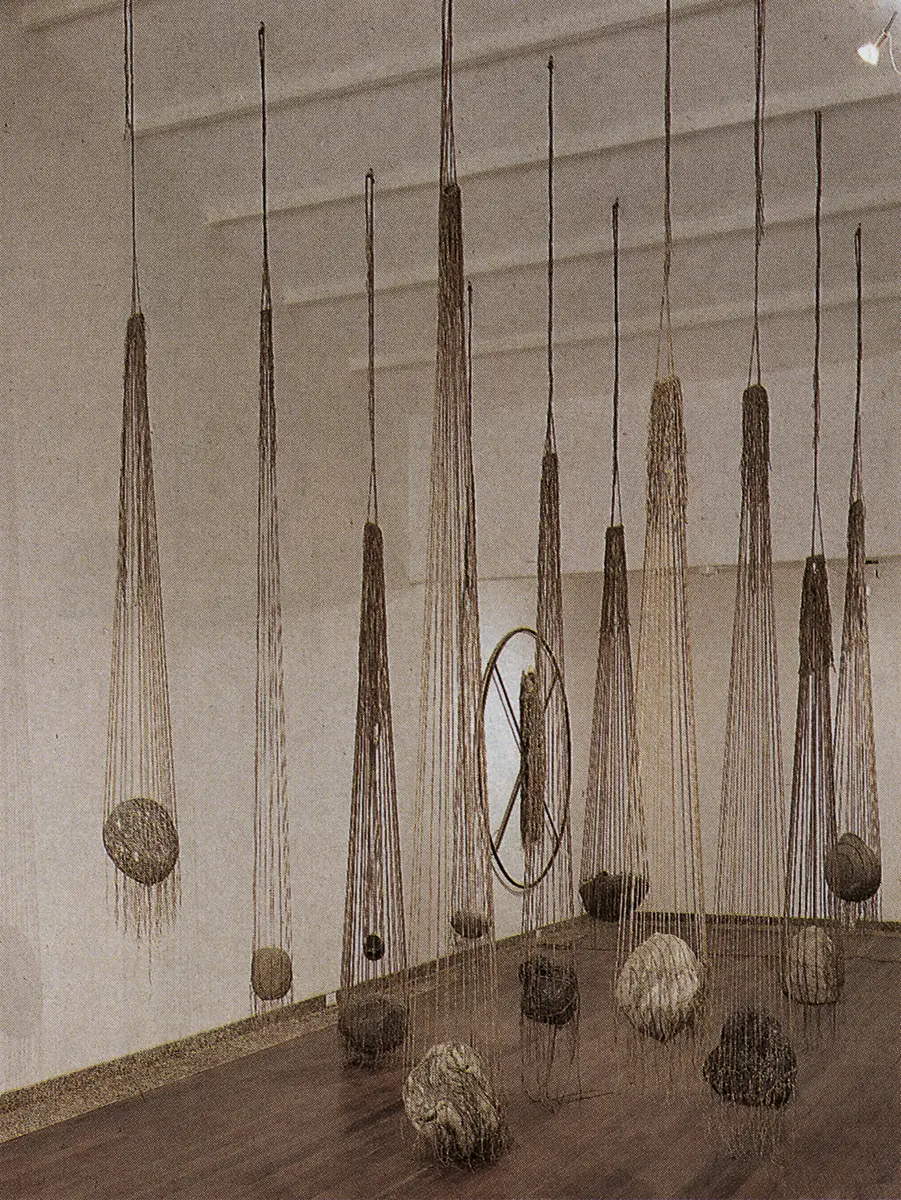
Supernova (1987) is inspired by the explosion and death of a star. It consists of a massive lump, out of which come dozens of undulating ropes that fall to the ground and spread out in all directions. In the same vein, he offered Meteorite at the São Pablo Biennial in 1985: a stone that threw off flames for days, in the middle of concentric circles of many colors, painted on the grass.
The ‘utilitarian’ works (as I call them) have been conceived in primitive terms, and give the impression that they are some kind of ritual ornaments. The structures, materials, and markings are carefully selected and produced to invest them with a sacred, supernatural power. The diversity and richness of the theme were plain in the exhibition, which he titled Objects for a Ceremony in the Phoenix Park in Caracas in 1991.4 The exhibition contained works such as Mantle Scepter, Shield, Mask, Necklace, Ring, Basket, and the like; this was also the first showing of Dropss hanging sculptures which can waft to and fro, an immediate precursor of the masterful installation inspired by a spider’s web and exhibited in the central garden of the National Gallery in Caracas from November 1991 to February 1992.
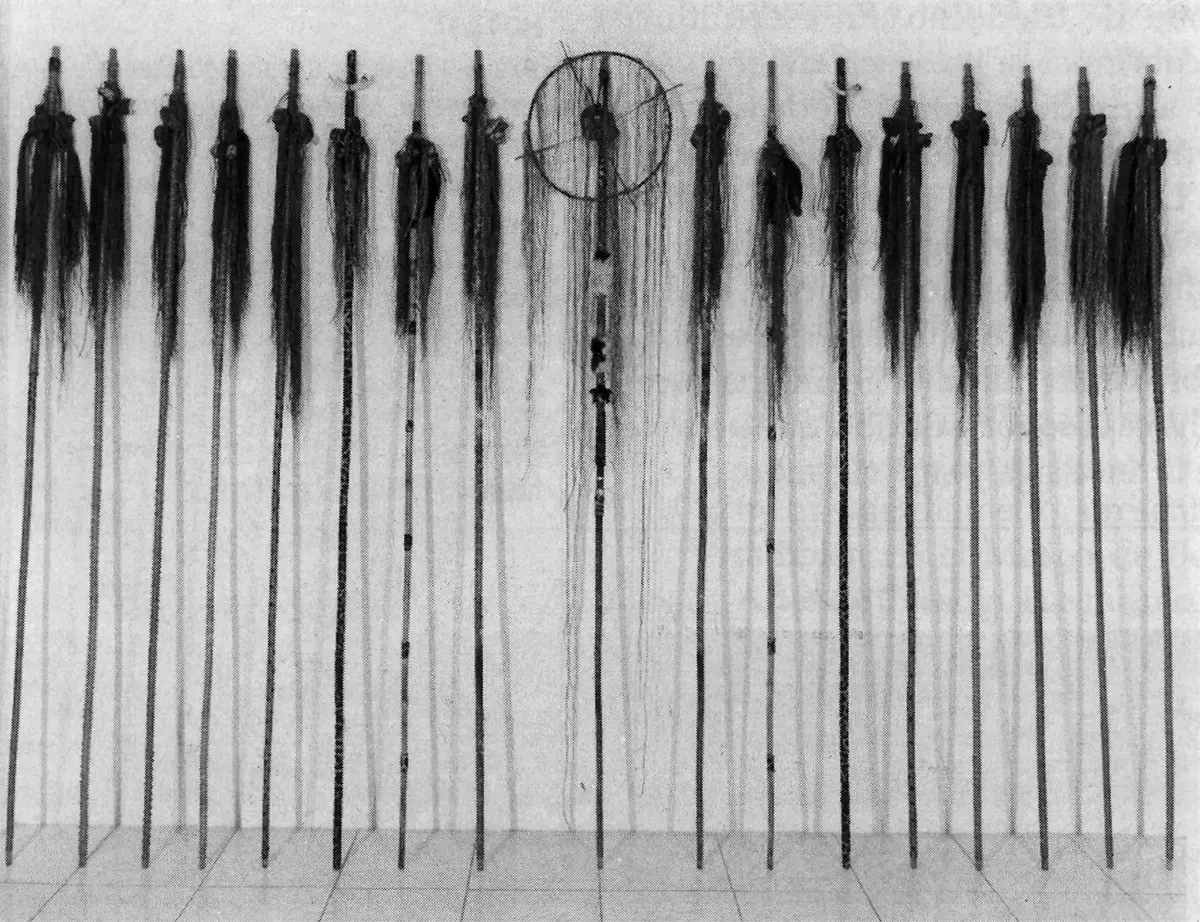
Where did Becerra find his inspiration for these ceremonial objects? In the 1980s, after a series of visits to Cuzco and Machu Picchu, Édgar Negret and Ramírez Villamizar set out with real enthusiasm to try to express similar types of symbols. With this contact with the pre-Columbian world, the two Colombian sculptors set aside the rigor of the engineer and gave themselves over to the pleasures of evoking themes related to the Incas. In 1983, Milton Becerra visited a number of indigenous tribes of the Orinoco basin, and his work immediately acquired a new dimension, to be found first in Section of guerrillas in 1985 and 1986: two series constructed with real lances arranged in ranks with the look of chessmen. They are warriors in battle, so there is no queen. One of the series has seventeen lances, the other eighteen. In the second, we can discern the presence of the king and his court, surrounded by knights and common soldiers. The hierarchy is established by markings which include stones, glass, rope, wax, leather, copper wire, feathers, and so on. Unhampered and free as ever, Becerra’s geometry is the flexible foundation for his line to travel and go on traveling.
NOTES
1. Untitled text in the catalog Biennale Internationale des Jeunes Artistes/ Dans le possible Imaginaire/ Milton Becerra, Musée d'Art Moderne de la Ville de Paris, September 20 to October 20, 1980, p.5.
2. Luis Ángel Duque, untitled text in Milton Becerra, Análisis de un proceso en el tiempo, IV Bienal Nacional de Escultura Francisco Narváez, Margarita, September 1988.
3. Álvaro Medina, "Eighteen notes to understand a sculptor," in Eduardo Ramírez Villamizar. Fondo Cultural Cafetero, Bogotá, 1992.
4. See in this regard the article titled "Milton Becerra y la magia del círculo" that Susana Benko published in the section Crónica de Arte en Colombia, No. 49/ArtNexus No. 3, Bogotá, January 1992.
ÁLVARO MEDINA
Colombian historian and art critic.
Contributor of Art Nexus/Arte en Colombia
since its founding. He lives in Paris.