
The 6th Banner Biennial, held last November in the city of Tijuana, became once again a space for the confrontation and revision of the work of artists from a variety of origins.
As happens every two years, the event's chief curator, Marta Palau—who recently received Mexico's National Arts Award—convoked a group of 37 artists mostly from Brazil, Cuba, Chile, the US, Nicaragua, Argentina, and Mexico, with special emphasis on artists residing in the border zone.
As a member of the jury for this edition, alongside Gerardo Mosquera and Yu Yeom Kin, I find that one of the most persistent characteristics across the board was the number of voices raised to comment on urgent topics currently capturing the attention of contemporary society.
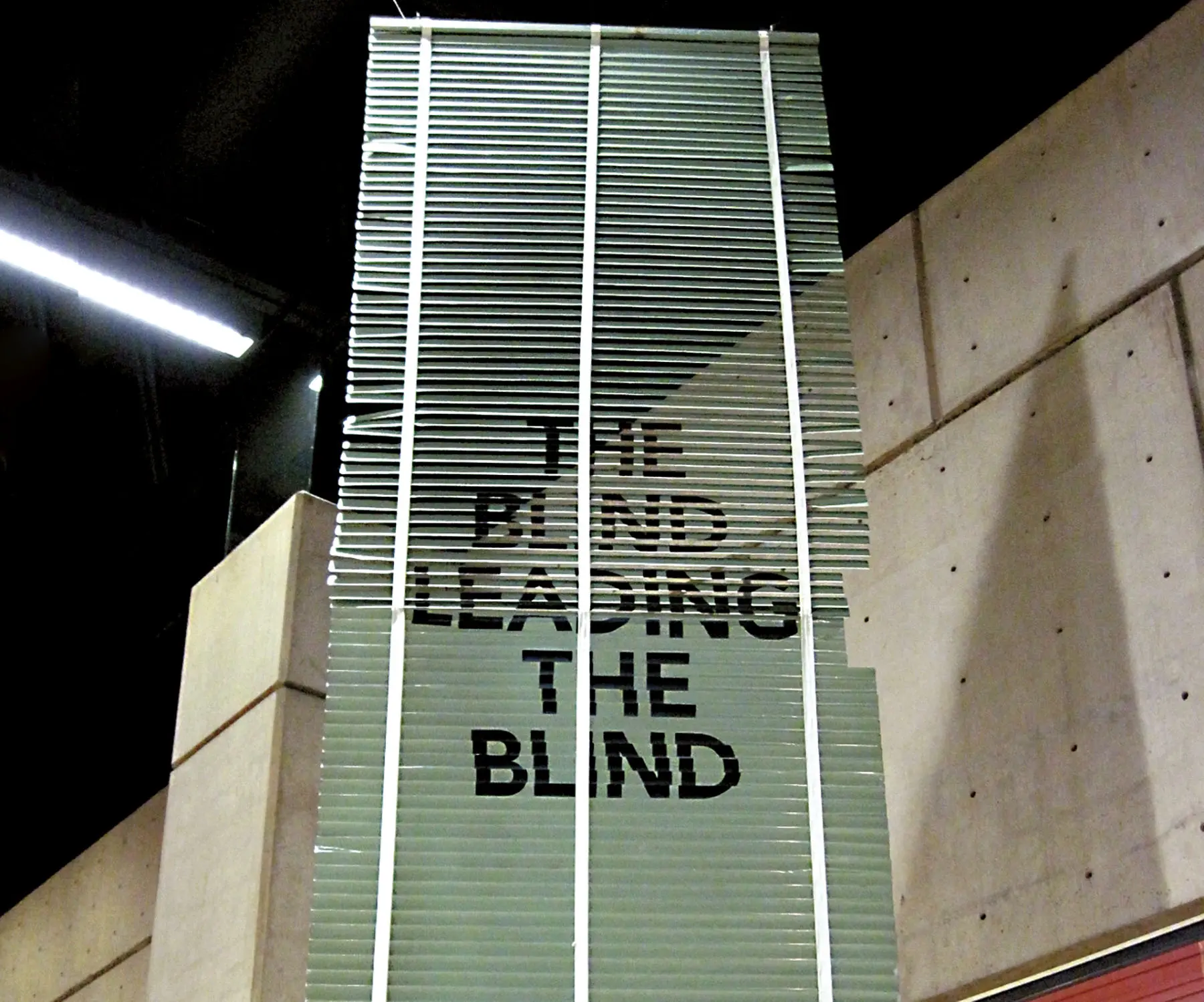
Ana Quiroz's The Blind Leading the Blind, which consists of an aluminum curtain with vinyl lettering and unanimously won recognition for the First Prize at the 6th Banner Biennial, is perhaps one of the most acute commentaries on issues of gender. The complexity of the work proposes multiple readings.
The curtains not only separate one space from another but at the same time cancel the vision of that which they hide. Their correct position on the issue of gender and political violence, as well as its splendid formal resolution, resulted in the award. The title of the work makes direct reference to an instance of wordplay, where "blind" is both a sightless person and a type of curtain.
On the opposite facet of the banner we see a Christian cross, and under it, we read the following sentence: "In Mexico all dreams are possible." This hopeful scream in one of the darkest moments in the country's recent history makes clear the social connection to issues of religion and faith ad the last bastion of hope for solutions that, it seems, will not come from this world but perhaps from an evoked deity.
On that note, works like the one presented by Beliz Iristay (Turkish-born, residing in Ensenada, Baja California), Bilquis Destiny, comment on the topic of capillarity and its significance in the culture of Turkey. The difference in the exercise of rights by men and women in Muslim societies is what gives origin to works like this.
Another work dealing with gender issues is International Thong Network, by Ivan Buenader, which consists of a tower of thongs mounted in the way they are usually presented in-store displays. The variety of styles, designs, and colors goes in parallel to sexual diversity, which in many countries still struggles for recognition.
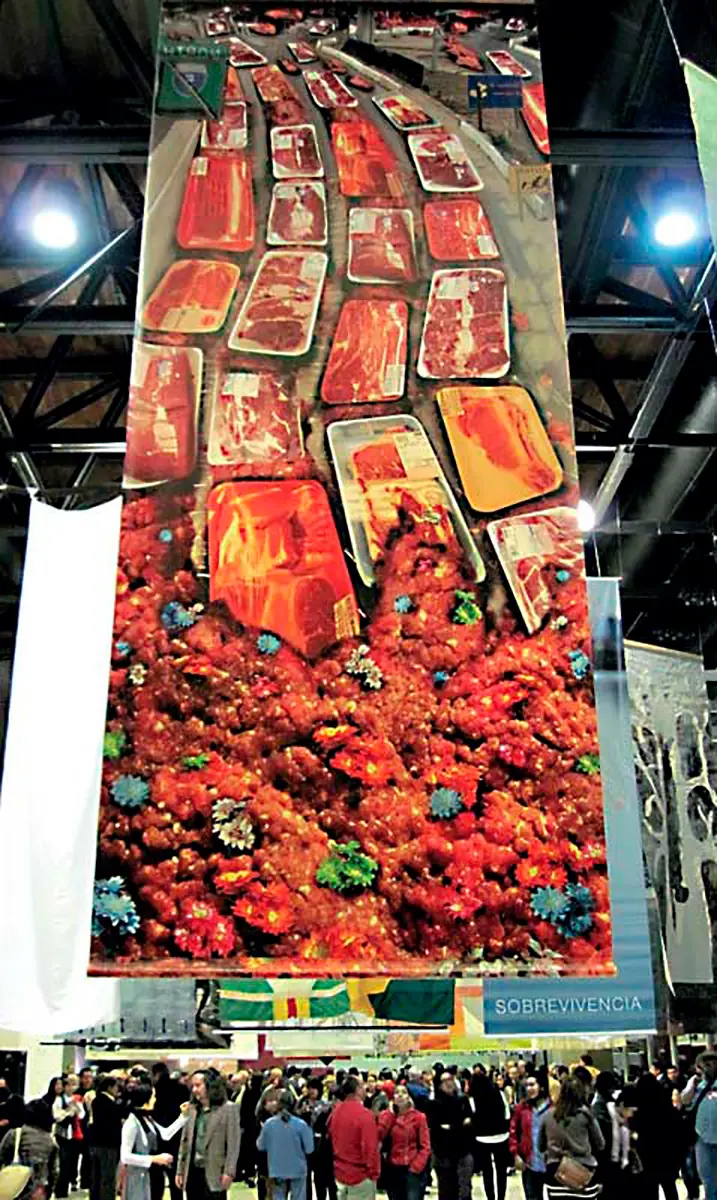
Another topic many artists engaged with was the topic of migration. Jamex and Einar de la Torre presented The Jungle, Second Prize winner for its acute view of the border as well as the author's sagacity in using contemporary technology in its composition. It is a large line of meat and viscera en route to the United States, which, once crossing the land border, becomes a line of elegant supermarket-type packages.
Ana Teresa Fernández, born in Mexico and a resident of San Francisco, California, presented Performance Documentation at Tijuana San Diego Border, where she appears wearing an elegant black dress and high heels, sweeping with her hair the water of the beach at the exact point where the international barrier wall enters the ocean and separates the US from Mexico.
In a commentary about La otra migración ("The Other Migration"), Francisco Buelna touches on the topic of animal species that travel freely from one side of the border to the other, and at the same time refers to US citizens who, moving north to south, resettle in the Mexican coast near the borderline, erecting houses and buildings that irreversibly alter the pristine landscape they were after in the first place.
In a more political tone, Gerardo Martínez deals with the topic of the Zarapes with a map of Arizona and the striped pajamas worn by prisoners in Identidades. Although highly dated and with a structure that is closer to graphic design, this work brings to the table debate about one of the most controversial legislation in the US in the last thirty years.
The issue of violence (engaged directly or tangentially) could not be left outside the proposals of a good number of artists present at this edition of the International Banner Biennial. With her Power to Kill: Man and His Ties—which reminds us of Claes Oldenburg with its magnification of everyday objects—Mely Barragán presents a monumental black tie that effectively comments on the topic of the inevitable grief and also, at the same time, on the issue of "white collar" criminal organizations.
With Globalifobia, Alvaro Blancarte goes back to the old expressive modes of posters from the 1970s (formally and thematically), to present a large fist ready to crush a small character. With a broader compositional range, Alejandro Osorio's Límite visual para habitar el interior places in front of our eyes an AK47 assault rifle, an emblematic object in the ongoing war between the Mexican state and the drug cartels.
Issues like the environment were also present. Emilia Sandoval offered Sumergidos, comprised of water containers cut at the center and assembled together to create a surface on which anthropomorphic blue figures were attached.
Gerda Gruber, with Proclamación 200, calls our attention to the topic of maize as Mexico's most important crop and what it has meant, not only scientifically but also in the symbolic field, for introduced transgenic seeds to displace traditional forms of cultivation and to modify the economy. To that end, Gruber uses black plastic as support (and conveyer) for two hundred small plastic bags that contain both native and modified corn seeds. This important artist, who lives in Merida, Yucatan, in southeastern Mexico, had long been a guiding light for new generations of creators, for whom she has opened new spaces and generously offered her work.
One important point in the jury's minutes was the opinion expressed by its members that these voices need to be heard and the work of this group of visual artists will have an impact on contemporary life in their countries and societies.
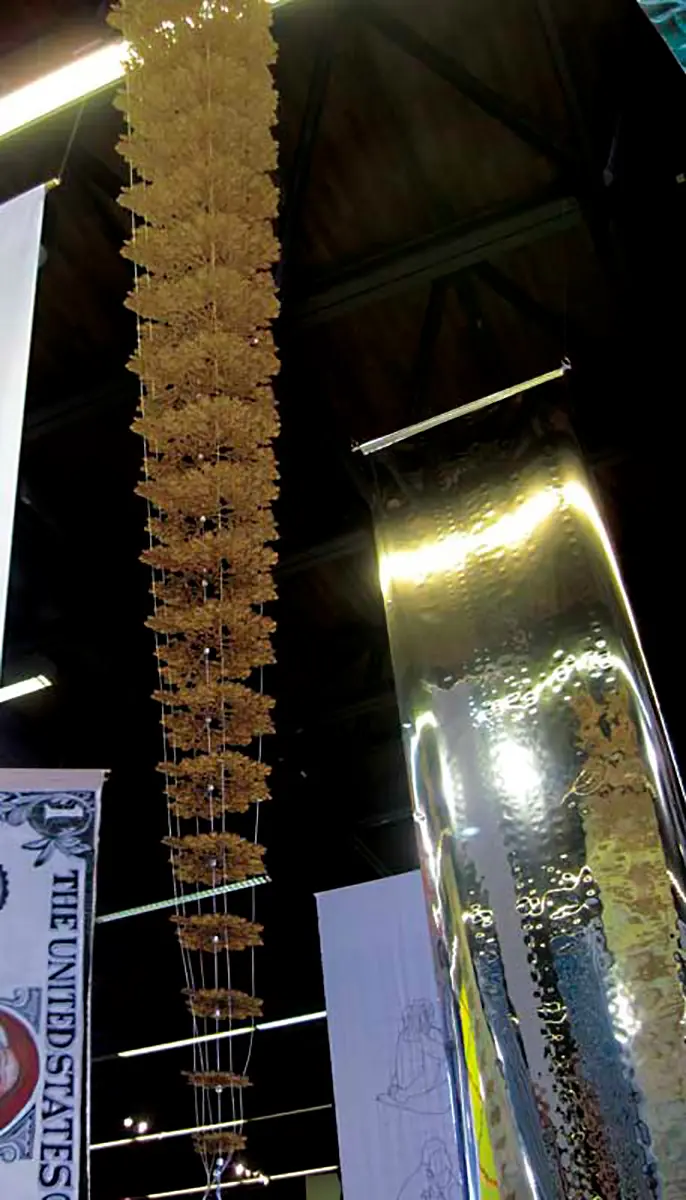
The only mention awarded went to Jan Hendrix for a three-dimensional work recognized for its spatial distribution and its congruence with a long career, as well as the formal use of a language that identifies this artist openly. In this case, an artist with a long career who has used the most diverse expressive resources and supports participated with an atypical work in the context of the other banners: comprised of carved circles in decreasing diameters as they descended, it generated a singular poetics that contrasted with the other selections, manifesting an exercise in visuality absent in most.
The 6th International Banner Biennial ES2010 was, like every version has been, a space for re-reading and for taking the pulse of artists selected by curator Marta Palau from many parts of the world. A salutary update of the roster is evident in each edition, which makes it possible for this biennial to play two important roles in the reading of contemporary art: inviting emerging artists, it opens an important forum for new generations, and it follows the work of others whose ages and careers have accumulated already important shows and languages.
In both cases, this vision especially enriches one of the few visual arts events (if not almost the only one) held regularly in the border region between the US and Mexico, with all that it implies at this point in history, and with all that it can contribute to creators in the area and other who continue to keep this event insight.
SANTIAGO ESPINOSA DE LOS MONTEROS