
This new exhibition by Ciro Beltrán brings together works extending previous lines of exploration with others that imply an innovation or shift. Beltrán's previous works were marked by the way in which this Chilean artist assumed the strategy of doing away with frames and allowing his paintings to invade the space around them. A remote precedent for this attitude was established by the MADI group, in 1940s Argentina, but it was Daniel Burén who blew up the frame and the boundaries of the exhibition space in a most radical fashion, spreading his paintings throughout the city. At first, he did so in the anonymous spaces of the Parisian banlieue, then in the Metro facilities, and finally, in the same museums and galleries, he had previously opposed so forcefully. Christo and Jeanne-Claude continued in this line in an extraordinary way with their Surround Islands, an impressive tribute to Monet's Water Lilies, presented in 1982. They used six and a half million square feet of plastic sheets to present passengers in airplanes flying over the city of Miami, Florida, with the spectacle of painting in never-before-seen dimensions, frameless, literally unhinged.
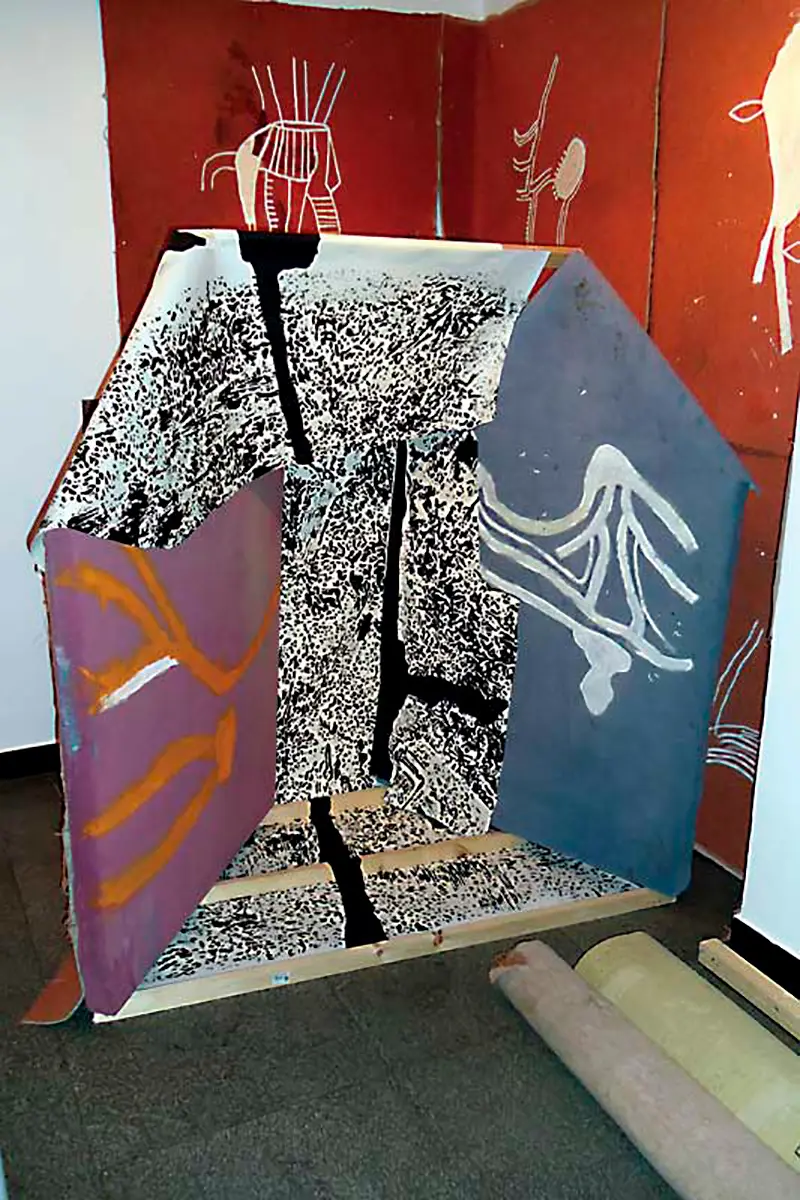
Ciro Beltrán learns of this legacy and transforms it by emphasizing the breakage of the regime that regulates the relationships between architecture and painting, which usually assigns the latter a subaltern role. The painting hanging on a wall, or a mural, usually underscores or complements the role of architecture as space, boundary, container, refuge, or a stage for the most diverse human activities. In Ciro Beltrán's work, however, painting takes command and boldly offers itself up as a veritable alternative to architecture itself. In the beginning, this shift proceeded with caution, for example in the works he presented in Refugio—his 2005 show at the Stadtische Galerie Iserlohn—a set of unexpected geometric sculptures made with canvas and canvas stretchers that could be interpreted as models at the scale of constructivist architecture. Later on, Beltrán's challenges to architecture became more audacious, resulting in the raising of true architectures with interiors that were sufficiently generous for the viewer to feel tempted to enter them. At that point, Beltrán started to produce works that evoke circus tents or those of desert nomads, works where the enveloping function is played by blue, gray, or red floormats on which the artist has created schematic, forceful drawings that bring to mind cave paintings from Africa or Australia. In some instances, as in the installation presented as part of the project Pinturas Habitables, in April of 2009 in Santiago de Chile, Beltrán joins one of his "tents" with a soccer goal; in others, as in Construcción Arquitectónica Ideal, presented in a retrospective of his work at the Museo de Bellas Artes in Santiago in 2005, Beltrán's ephemeral architecture presents itself as a potent physical and visual alternative to the museum's own architecture, which should be its container. And it should be added that Beltrán uses those mats to vindicate the central role played by the design and ornamentation of floors, something modern architecture has neglected or undervalued, relegating the floor to the indistinct function of any pavement. In his show Revestimientos / Recubrimientos, held in 2009 at the Centro de Arte Contemporáneo Medinacelli, in Spain, Beltrán covered the floor with one of his painted mats and invited the public to walk on them.
All these precedents come together masterfully in two of the works in this new show. The first one, titled Refugio - Haus, is one of those architectural model-like sculptures that project their parts onto the walls around them. The second one is titled, like the show, El Espesor del Tiempo, and it is an installation arranged along an entire wall and invading the gallery's floor and ceiling with painted tapestries held by wooden stakes. The shift in Beltrán's approach I mentioned before is represented by a series of drawings titled Dibujos Teóricos, composed on the basis of sentences taken from essays and articles by art critics and theorists. With them, Beltrán intends to close the loop that connects the work of art with its critical interpretation, which then projects itself onto the former and transforms it.
CARLOS JIMÉNEZ