
Claudio Vera-Coelho is an artist from a land that knows the value of materials in terms of their symbolism and conceptual referents. Educated with the principles of the Escuela del Sur and under the tutelage of teacher and friend Julio Alpuy, Claudio Vera-Coelho constructed a visual language in which respect for materials and surroundings are visibly some of the most admirable values of his work.
His work is a visual reflection that sets forth no political or violent arguments. His inquiry revolves around life, the passing of time, and the depths of thought. Therefore, there is a situational component to his work, handling of time and space by means of which territories play a leading role; the work by this artist presented at the Centro Colombo Americano in Bogotá and in Cali, at the Warehouse Art Gallery and, coming soon, at the new venue of the Centro Colombo Americano, is undoubtedly a reflection of this.
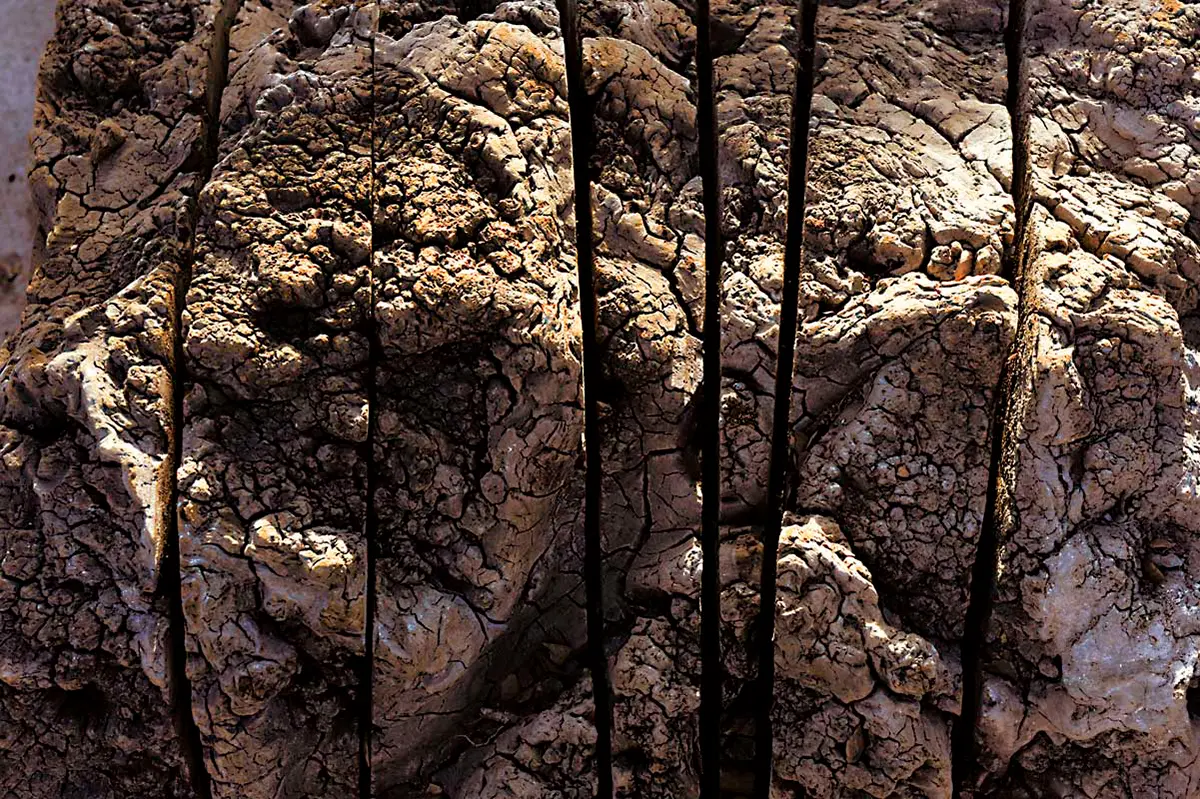
Created mainly in Peru—after ten years of research in New York—this work consists of more than twenty pieces created with wood carried by the river, and the stories of these. The material ends up within the grasp of the artist in the most unsuspected ways. He receives them openhandedly, allows them to mature, treats them with care, and then intervenes. In some cases, he burns, cuts separate, or hurts them. The actions that the artist takes with the material depend on the values they acquire in terms of their collectivity. This work speaks well of the roots and symbolisms that it projects, and Vera-Coelho resorts to prudence and equilibrium in developing both concepts and materials.
The forms of the pieces are inscribed within the borders of a title that did not come about by accident. Strange Structures presents works that propose a series of variables with respect to proportion, form, color, and size. These are the result of a deep understanding of the structures found in nature and of their organic qualities. A contradictory notion in the first place, it describes the system of understanding that Vera-Coelho utilizes to establish a stable relationship with the universe.
Strange Structures also refers to the formula used by the artist to achieve his assemblages. It is a mise-en-scène in which individual and collective readings possess different but complementary roots. Each piece on its own resolves a formal equation in geometric terms, almost as if it were a mathematical problem. Nonetheless, when the piece is regarded as one among many, the reading must then rely upon the principles of astronomy, invisible relationships, tensions, formations, and assemblages that, although scarcely evident, are definitely present before the spectator. If we then also consider that, in bringing the pleasing and familiar smell of the material from within its exterior, natural context into the white box that is the gallery, we recognize a familiar air, a very placid one that we had not perceived at first glance.
Being described as an artist of the land does not imply that his work is solely created with noble materials. Vera-Coelho has also demonstrated a passion for drawing, for the free brushstroke in front of the urban or rural landscape that accompanies his continuous geographic movement. He has worked in New York, Lima, Bogota, Uruguay, and Canada, among other places. His wandering spirit with no predetermined direction results in a win-win equation for his embellished tracings. The artist concentrates on apparently empty space, on the edges between mass and light. Precisely as occurs in his installations, his drawings—undoubtedly a very interesting complement to the remainder of his work—address the problem of proportion and the forms that caress the point at which the landscape vanishes.
Claudio Vera-Coelho transcends the territory that art occupies because he understands that the value of objects derives from nature and that it is substantiated by the spirit. He is an artist of the land who established his territory in geographic places that offers new flavors for his research.
ESTAFANÍA SOKOLOFF