
Many have seen the reincarnations of the surrealist object and much has been said about its transforming capacity. The first facet of the exhibition entitled Cinturón Rojo (Red Belt) at the Cámara de Comercio de Bogotá (The Bogota Chamber of Commerce), represents an idiosyncratic approach to the subject from a local context.
The most recent exhibition by Consuelo Gómez is based on field research centered on some of the most representative popular neighborhoods in Bogota; particularly, in the Perseverancia neighborhood, a place developed at the beginning of the 20th Century, mostly to house the workers of the Bavaria beer factory. Its peculiar looks—in terms of the architecture, with all the implications of self-building, and its decorative elements—served as the basis for the objects and sculptures included in the Cinturón Rojo.
The works presented in this exhibition curated by Eduardo Serrano, successfully address the history of the neighborhood and its inhabitants, and transport the viewer to that place in the city's memory through a series of carefully crafted and calculated forms that, nonetheless, contain traces of nostalgia; as exemplified in a ball printed on the fabric of a uniform kept in what appears to be both a display case and a water tower.
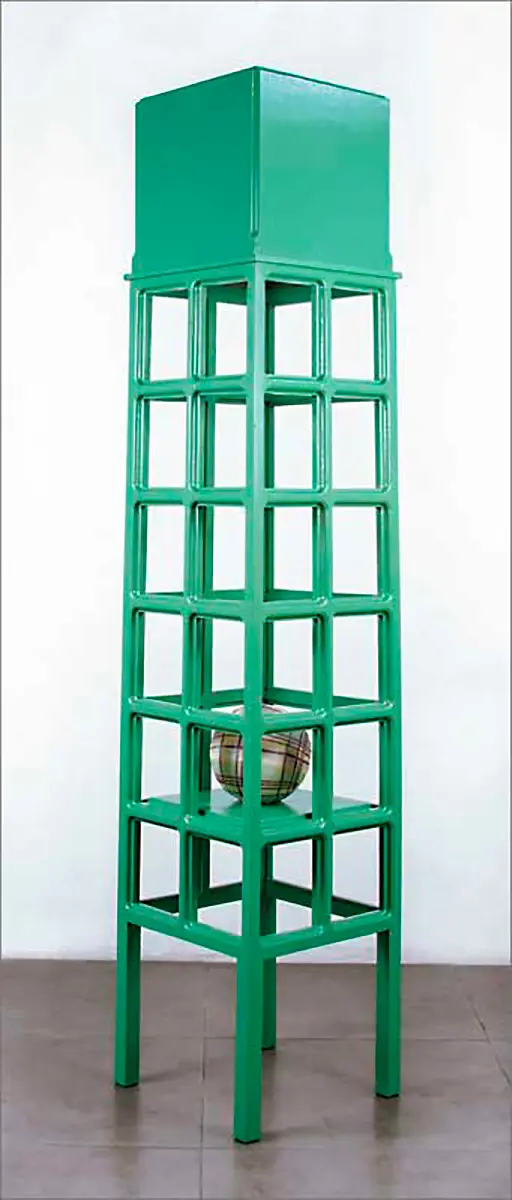
During the last decade, Bogota has experienced not only a radical transformation in its infrastructure but has also witnessed an unprecedented boom in the construction of residential buildings, erected after demolishing large residential homes in what used to be traditional neighborhoods of the city. Their steady disappearance also represents the disappearance of a great part of the city's history. The work by Consuelo Gómez sheds light on the traditional neighborhood life likely to be vanished due to the continuous construction of malls and large avenues.
Although the works are based on specific places, rather than representing detailed depictions of every house in the Perseverancia neighborhood, they try to convey the essence of the domestic and local flavors that are full of stories. The allusions to the neighborhood were thought about and created with an affective, and yet removed, gaze. An example of this is the use of the address numbers—of the homes that inspired each piece—as titles for the works. This way, the number 31-26, for instance, designates a metronome box that contains a glass column, and 02C-32, corresponds to a wooden folding screen with a steel mesh.
The communion between sculptural and handicraft approaches has characterized the work by Consuelo Gómez, and this exhibition is no exception. Her interest in handicraft techniques is evident in the blown-bottles that constitute hybrid between pots for Chicha—a traditional alcoholic beverage made from corn—pre-Colombian vessels, and beer bottles. Always closely connected to the history of the place, these objects are perhaps some of the most intriguing and poetic of the exhibition. Their forms convey the transition from indigenous traditions to European ones, from agricultural subsistence to an industrial one—and the transformations such subsistence generates in town and habits—while they also underscore the nature and historic relevance of the transformations that occurred at the beginning of the 20th Century.
This combination of sculptural and handicraft approaches achieves an interesting level of conversation on the surface of Juncal, a piece that may initially seem marginal, but one that indeed brings the exhibition together. It consists of a table with a surface relief that echoes the photographs that hang directly above the table of some rushes by the Bogota River. The installation is intimately linked to the history of Perseverancia, given that the rushes in the river were used to pack and protect the bottles of Bavaria beer.
Assembly is also another route one can take through the exhibition. The dysfunctional furniture pieces—in the traditional sense—are effective in their evocative capacity and invade the exhibition space as if they were the inhabitants of the neighborhood from which they emerged. The piece 31-20 shows the rhombus-shaped decorations that are so common across the working-class neighborhoods of Bogota, and so representative of the persistence of indigenous worldviews that point to the way life works: it begins at a certain point, it reaches a peak, and then it declines until it reaches the point of origin.
With great emotional force but without falling for sentimentalisms, Consuelo Gómez turns these places into monuments and central parts of our everyday life that, however, is gradually disappearing under the city's drive for progress.
MARÍA CLARA BERNAL