
In 2008 Darío Escobar was invited to participate in a show organized by Argentinean curator Irma Arestizábal for Rome’s Istituto Italo-Latino Americano (IILA). Titled Mundus Novus – Arte Contemporáneo de América Latina, the exhibition was presented in the Latin American pavilion at the 53rd Venice Biennale in 2009, in consonance with the event’s overall theme, “Fare Mondi/Making Worlds.” The Artiglierie dell’Arsenale —a long, high-walled corridor with cement floors where ships were built in the past— was the venue for the display of works by a diverse group of Latin American artists, including Escobar (Guatemala), Alberto Baraya and Luis Roldán (Colombia), Fernando Falconí (Ecuador), Sandra Gamarra (Peru), Federico Herrero (Costa Rica), Ramsés Larzábal and Carlos Garaicoa (Cuba), Nils Nova (El Salvador), Raquel Paiewonsky (Dominican Republic), Paul Ramírez Jonas (Honduras), and Gastón Ugalde (Bolivia). Beyond the fact that there were only two female artists (Raquel Paiewonsky and Sandra Gamarra), the work of these twelve artists stood out for their maturity and garnered significant attention both from critics and the general public.
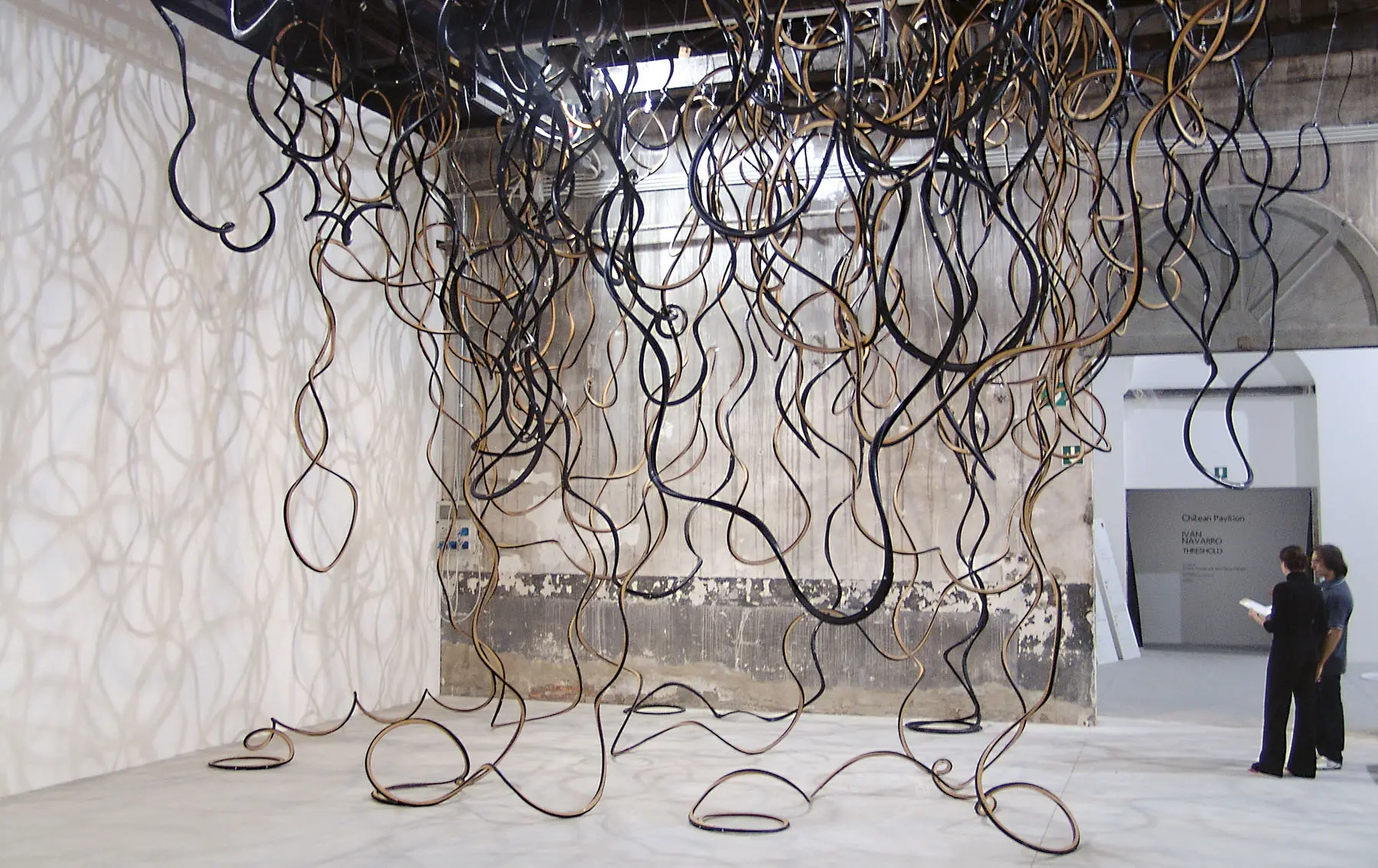
The opportunity to participate in today’s most important contemporary art biennial is a high achievement for any artist, whether they come from the center or the periphery. Escobar chose to be represented by his work titled Kukulkán (2009), a rather ambitious piece both in scale and conception: covering twenty-nine feet of the ground and standing twenty-three feet tall, the title of the piece refers to the feathered serpent found in Mayan mythology. This incarnation of the work, with its veritable jungle of copious tentacles snaking from ceiling to floor, is made from 950 bicycle tires of a brand commonly found in Guatemala City (where Escobar is based) and manufactured in Taiwan of rubber from the Peten and Chiapas forests. It took the artist eight months to create it. Unlike other works using the same materials, the Kukulkán of Venice did not include pulleys and weights for support but was mounted in a fixed position to facilitate the public’s movement around it. (The Biennale was visited by 375,000 people). This version resembles Venezuelan artist Jesús Rafael Soto’s penetrables 1; although Escobar’s work, with its organic form, is less participatory, it is no less experiential. (Kukulkán is now part of a private European collection). The Kukulkán of Venice is the culmination of an idea first developed in 2005 and crystallized by Escobar in previous work with the same title that was on view at the Centre d’Art de Neuchâtel (Switzerland), that same year. Kukulkán marks a turning point in Escobar’s work towards a more frequent use of installation (even though the artist does continue to create individual objects).
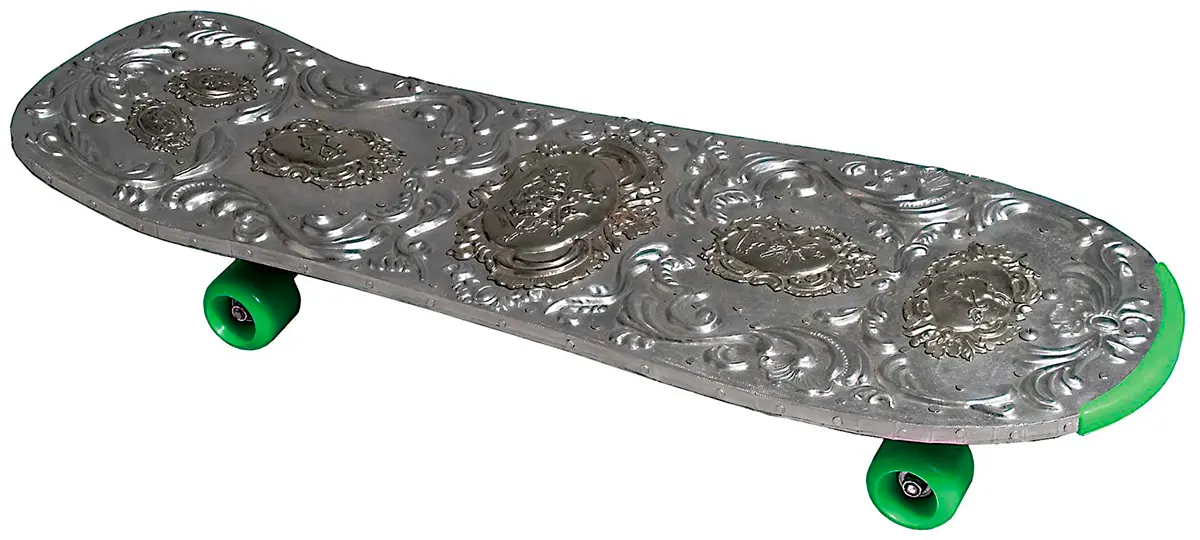
Escobar’s desire to bring together Guatemala’s past and present first came to the fore in the 2000s in a series of works exploring the country’s Baroque past and the enthusiasm for sports that predominates among its population today; these well-known pieces include skateboards and other sports equipment that have been covered in silver painstakingly worked with religious symbols in the seventeenth-century Baroque style. Examples of such handicrafts are still found in Guatemalan churches in the form of altarpieces and a multitude of objects used in Catholic rituals. With his 2009 Kukulkán and the works that precede it, which carry titles such as Serpiente No. 1, Kukulkán, Quetzalcóatl, Quetzalcóatl II, Quetzalcóatl III, Serpiente, Serpentario, etc., Escobar continues his conversation with the region’s history. He returns to Guatemala’s past —this time focusing on the country’s indigenous (and specifically, Maya) roots— and integrates it into objects such as bicycle tires and soccer balls used in a variety of sports.
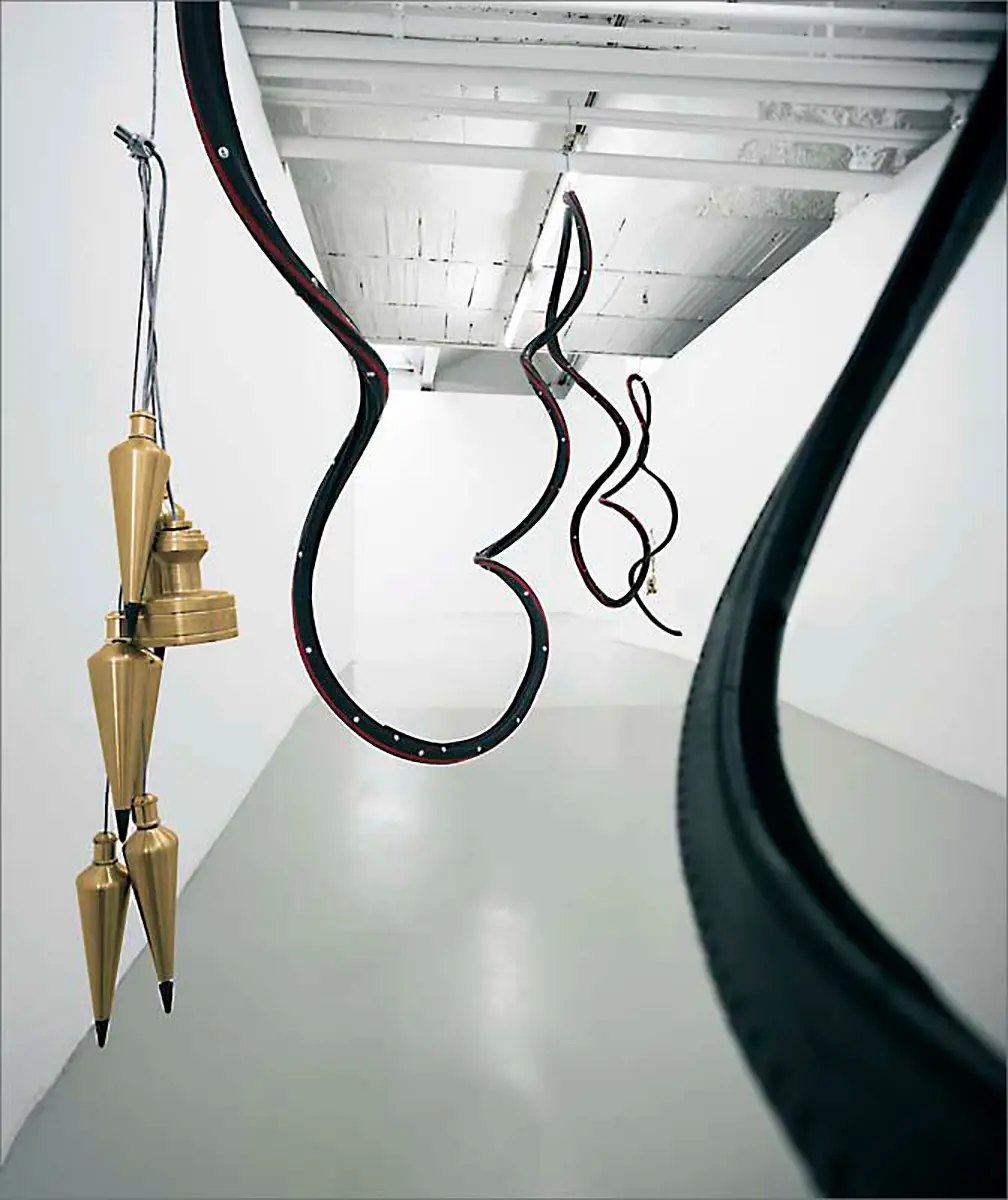
The 2005 Kukulkán is a deceptively simple work comprising a single strip of tire material traversing the gallery in a perpendicular direction. Its curvature, determined by the tire’s circular shape, gives the work a graceful outline in space, one that mimics the sinuous movements of a snake as it slides along a surface; heightening the allusion to a serpent, the rubber material’s colors and ridges resemble the dark hues of the animal’s back and the yellow of its scaly underside. To support it, Escobar designed a series of pulleys and weights that allowed it to seemingly levitate within the space. The snake image of the pre-Hispanic deity related to the Q’uq’umatz of the K’iche’ Maya and the Aztec’s Quetzalcoatl is found at the base of the North Stairs in the El Castillo pyramid in Chichen Itza (built by the Maya between 900 and 1200 CE), where two giant snakes with raised heads and open mouths descend from the top of the pyramid towards the base. The imposing representation of Mesoamerica’s serpent myth served as the history-based starting point for a new series of works that together with his interest in drawing and the function of the line (on a real or virtual surface) led Escobar to develop a new group of works that although following a similar conceptual foundation has emerged in a variety of forms, including sculpture and drawing or a combination of both; this hybrid form already explored by Escobar as well as by others, notably Lucio Fontana with his neon sculptures of the 1950s and Gego in her metallic sculptures of the 1970s.
With the number of rubber strips increased to ninety in order to fill a medium-sized gallery in the Centro Cultural de España Guatemala (CCEG), in this incarnation, Kukulkán became a serpentarium (indeed, this work was titled Serpentario, 2005). Criss-crossing the gallery in a variety of directions, the snake-like shapes, appearing as dense lines drawn against a white backdrop, emphasized one’s physical perception of the space. The material’s false appearance of softness, formed capricious waves in the air, making them even more similar to a gesture —a drawing, a line— controlled by the artist’s hand (in truth, they happen because the rubber’s memory forces it to try to return to the tire’s circular shape). With lines that intertwine within the frame of the canvas or paper, the paintings and drawings created since the 1980s by American artist Brice Marden are perhaps a significant parallel to Escobar’s sculptures, given their similar shapes and composition. Marden’s 1971 visit to the Greek island of Hydra marked a new period in the artist’s professional life, one that has continued over the past several decades. The serpentine shape of his lines can be connected to the Hydra of Greek mythology, with her many snakeheads. 2 Writing about Marden’s work of this period, critic Klaus Kertess tells us that the Greek landscape, with its blue seas, incited the artist to “a deeper dialogue with nature and the art of the past.” 3 Escobar’s approach to nature and his dialogue with the art of the past are similarly influenced by a specific place, in this case, the country of his birth (where he still resides). While Guatemala’s pre-Hispanic and colonial history is not widely known, it is nonetheless rich and deep, and Escobar has found it a profound influence on his art since the beginning of his career in the late 1990s.
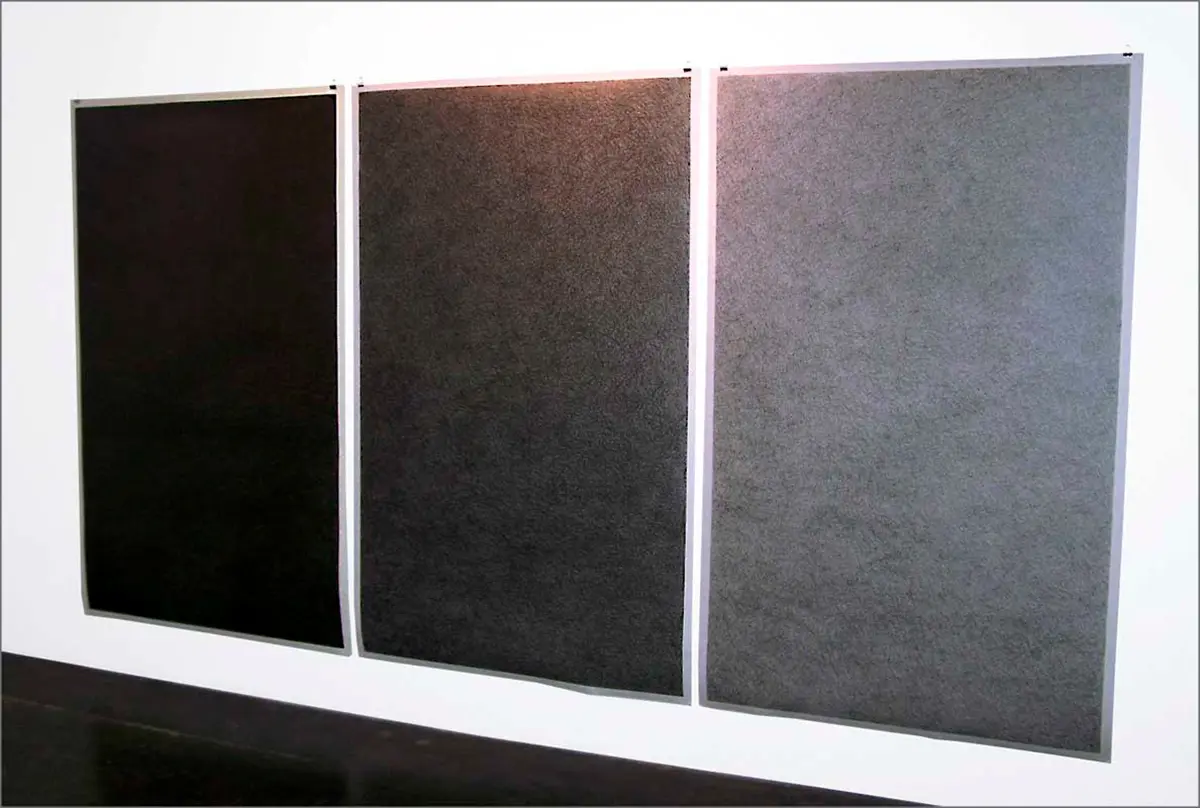
Marden’s changed style, which became more intuitive in his use of the line, was consolidated in an exhibition of paintings shown at the Mary Boone Gallery in New York in 1987. According to Kertess, this shift was the result of a five-year period (1980–1985) in which Marden focused almost exclusively on drawing 4 and took a special interest in calligraphy.5 Similarly, Escobar’s bicycle tire sculptures were created during a period in which the artist also increased his production of drawings. Although they are not at all like his sculptures, Escobar’s drawings have helped him navigate a more complex exploration of structure and space. One series of drawings entitled Espejos negros, alludes to ancient Maya mirrors made with polished black obsidian and capable of reflecting the image of a person or object. Escobar’s black minimalist “mirrors” are large (5.5 x 3.4 feet) and rectangular, and with complete control, the artist fills the entire plane of paper with graphite. In contrast, his sculptures feature a free, active, and more organic line. Because the rigor evident in the drawings is less apparent in his sculptures, it is logical to assume that these two practices are completely separate. In reality, Escobar alternates them continually: he asserts that drawing is integral to the development of his sculptures, and vice versa.

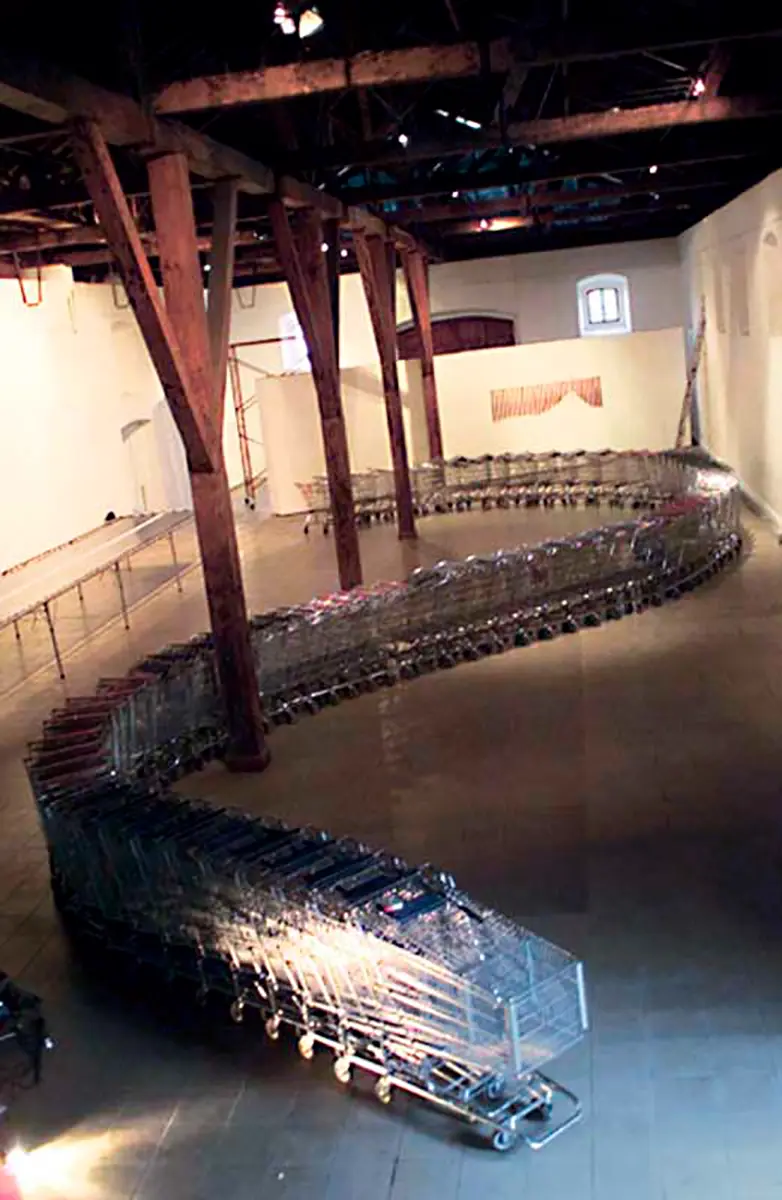
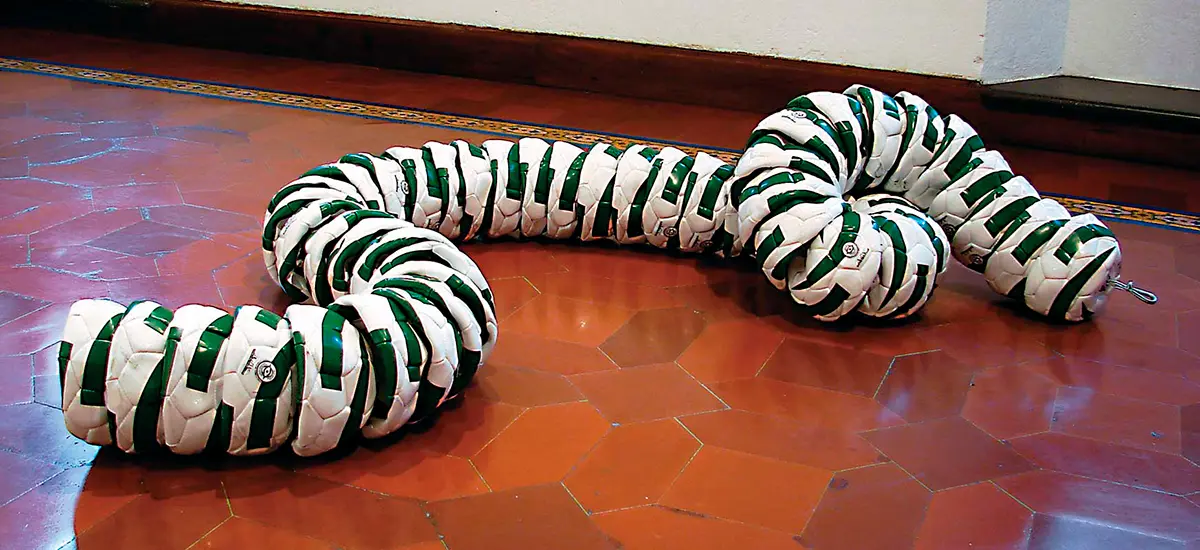
In addition to bicycle tires, Escobar has used soccer balls to articulate the shape of a snake. In Kukulkán II (2007), now in the Jumex Foundation Collection, Escobar assembled approximately fifty white-and-green soccer balls to form a long, tubular strip; unlike the 2005 Kukulkán, which was suspended in the air by pulleys and weights, Kukulkán II was placed directly on the ground. For Serpiente No. 1 (2003), Escobar used yet another material, in this case, metal supermarket carts. This work was on display at the Museo de Arte y Diseño Contemporáneo (MADC) in San José, Costa Rica, and as he did with the Venice Kukulkán, the artist made careful use of the gallery’s architecture: the metal snake, approximately 147.6 feet in length and formed by more than 250 carts on loan from a local store, moved sensuously between the columns that support the museum’s ample gallery space, seemingly searching for an opening to continue forward.
Escobar’s interest in the line as reflected in his variations of the feathered serpent form is combined with his exploration of the tridimensionality of objects. All of these works can be defined as drawing sculptures: they are neither one nor the other, but an amalgam of both. This way of working, rather common in the field of contemporary art, has always been the process best suited for the expression of Escobar’s ideas. The combination of several media —such as painting and sculpture, or drawing and sculpture— in his projects gives Escobar the necessary freedom to create works that are not subject to the limitations of any single genre. It also has occasionally made it possible for him not to have to manufacture them himself. Like many artists working today —Maurizio Cattelan and Gabriel Orozco, for example— Escobar organizes the production of one work (or several) by selecting the scale, color, and materials and then leaving the execution of the piece to a number of assistants. Here the artist acts as a project director, guiding a team of workers who faithfully execute his instructions; the purpose is not to hide the artist’s hand but rather to use any available means to make his thoughts concrete. In Escobar’s sculptures, color is usually provided by the materials —the metallic silver of the supermarket carts, the black hue of the rubber combined with yellow in the bicycle tires, and the white and green of the soccer balls. While the artist adds nothing, he does select his materials carefully, realizing that these found objects will undergo a metamorphosis in their form and meaning, as they become works of art.
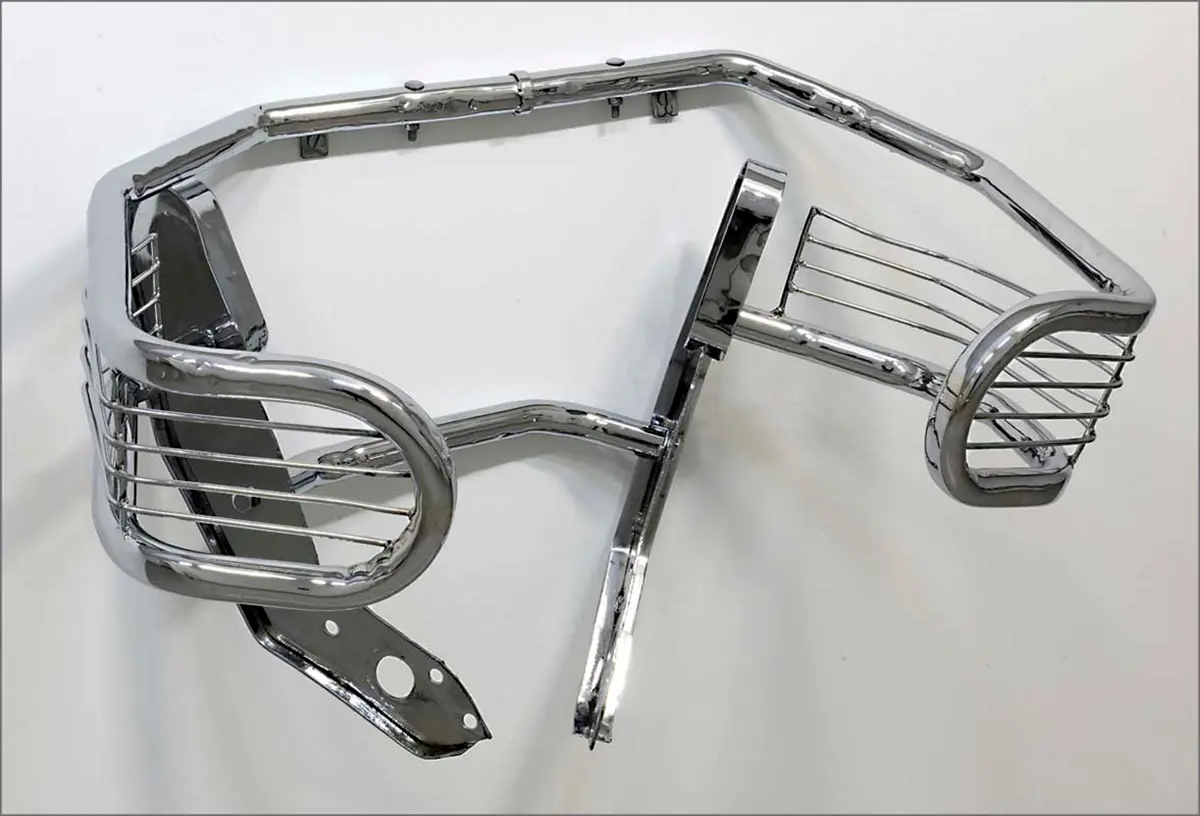
The recontextualization of the object is an inherent part of Escobar’s work. A more recent example of this process can be seen in the series Crash (2009), which debuted with three works (I, IV, and V) at Galerie Kamel Mennour in Paris in early 2010. The twelve remaining works were included in the Bienal de Arte Paiz in Guatemala City in April of the same year. All fifteen works in the series are made of chromed iron and steel; there are small variations in size, but they all measure approximately 39.3 x 27.6 x 25.5 inches, and as is usual with Escobar’s work, some are placed on the wall and some on the floor. Although they are perhaps less spectacular than Escobar’s room-sized installations, their twisting, anatomical shapes are immediately impressive. They are reminiscent of the orthopedic corsets worn by Frida Kahlo as a result of her injuries in a traffic accident. Their relationship to suffering and death is expressed not only through their contorted shapes —the concrete result of an accident—6 but also in their title. Suffering and death, so present in pre-Hispanic cultures, are also an important part of Guatemala’s Catholic colonial past.
Although these references are important, they are secondary in Escobar’s work (or perhaps complementary) because for the artist the primary concern is the line. Surely Escobar would concur with Lucio Fontana when he said, “It does not matter to us if a gesture, once completed, lives but a moment or a millennium, because we are truly convinced that, once completed, it is eternal.”
NOTES
1. Soto’s penetrables are made up of hundreds of nylon tubes hanging from the ceiling or from a metallic structure. The public enters or “penetrates” the work, thus subverting the traditional relationship between viewer and object, which now can be entered and touched.
2. According to the tale, it was impossible to defeat the Hydra because every time one of her heads was cut off, two grew in its place. The Hydra was finally defeated by the Greek hero Hercules, in one of the twelve labors imposed on him by Hera.
3. Klauss, Kertess. Brice Marden: Paintings and Drawings (New York: H. N. Abrams, 1992) p10.
4. Ibid, p.31.
5. Ibid, p.33.
6. In reality, they are automotive front bumpers, designed to lessen the impact of a direct hit against the vehicle. Escobar finds these objects in junkyards.
ALMA RUIZ