
The exhibit Siqueiros: Landscape Painter, at the Museum of Latin American Art in Long Beach, which is the first of its kind anywhere, shines a light on a dazzling but little known aspect of Siqueiros' work. This careful and thorough exploration of Siqueiros' landscapes brings to the fore his diversified take on the intensities of human existence on earth; establishes his original place within the tradition of landscape painting and revisits with a new clarity some of the discrepancies that separate his work from the purist avant-garde painting he inspired in the early decades of the 20th century.
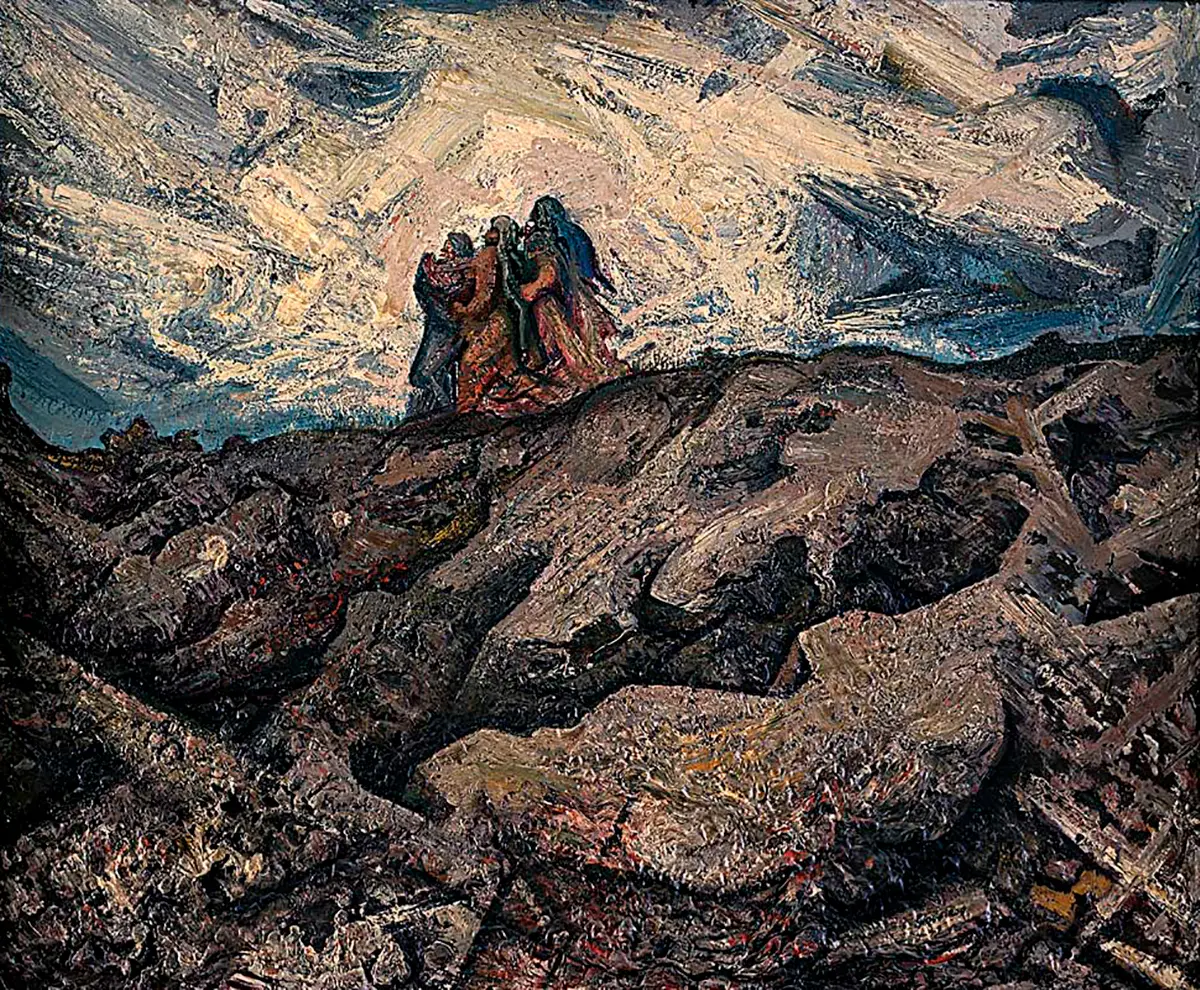
The dynamic paintings are arranged in thematic groups rather than in chronological order. Among the thematic clusters, there are aerial and stratospheric views; works dominated by allegorical depictions of trees; paintings that depict crisp mountains "with their veins exposed" (Siqueiros's words), and a series of allegories of specific events and historical figures.
A mandala-like painting called Abstraction from 1934 dominates the first bend of the exhibit and sets the tone. Made in Piroxyline, a synthetic, enduring paint used for cars that Siqueiros adopted in his first trip to the States, Abstraction is dominated by a luminous disc of dense white paint that appears to physically displace an assortment of dark, smaller blobs to the edges of the rectangle. Although the dense spread of Piroxiline recreates the painting's process and establishes its actual surface, the image retains its illusionistic depth and local tonality. No formal purism, high regard for plastic autonomy, or reverence for the internal logic of the piece restrain the feeling that this abstraction could in fact be a treasured object on a shelf.
Not far from Abstraction, and greatly contrasting with its intimate feeling, the exhibition offers several landscapes dramatically view-pointed from out of space. In Stratospheric Antennas, (1949), painted on a concave board, several volcanoes communicate with astronomical space via gigantic antennae that, like natural formations, shoot up from their craters against a vibrant firmament of dynamic abstract forms. In Atomic Spacecraft, also rendered on a curved board, Siqueiros imagined an enormous biomorphic space vessel with metallic pseudo-pods dotted by thousands of windows. The group displays in unambiguous terms Siqueiros's awe-stricken enthusiasm for the cosmos, technology, and progress. And just like Abstraction did not need its autonomy to be an abstraction in Siqueiros's eyes, the earth, and its celestial neighborhood don't need to be free of imagined future contraptions to retain their fascination. This contrasts greatly with the attitude of traditional landscape painters, who tended to exclude urban and technological elements from their parenthetical encounters with nature.
The place of encounter with nature was not an adventurous future but an archaic, idealized past.
The paintings depicting allegories of events and historical figures feature single entities placed in or made out of intense geographic elements. They include a colossal, spectral mountain-like indigenous woman who occupies the totality of the painting and motherly embraces oil-rigs and compact groups of people who are, compared to her, as small as ants (allegory of the nationalization of petroleum, 1945).
In another grouping, set on earth, there are colossal trees that, like emissaries or extensions of universal vastness, make evident the smallness of human existence, represented by sparse groups of two or three almost invisible ant-size humans.
By presenting the works in thematic clusters, by not constraining them to a narrative historical coherence, the curators have created enjoyable ambits of poetic resonance for each of Siqueiros's many approaches to landscape. This same attention to and respect for the diversified resonances of the work is reflected in the disciplinary breadth of the catalog, which includes essays by ten very capable and very diverse essayists. Siqueiros has sent a welcomed, unexpected package. Siqueiros: Landscape Painter has carefully started to unpack it.
FABIÁN CEREIJIDO