
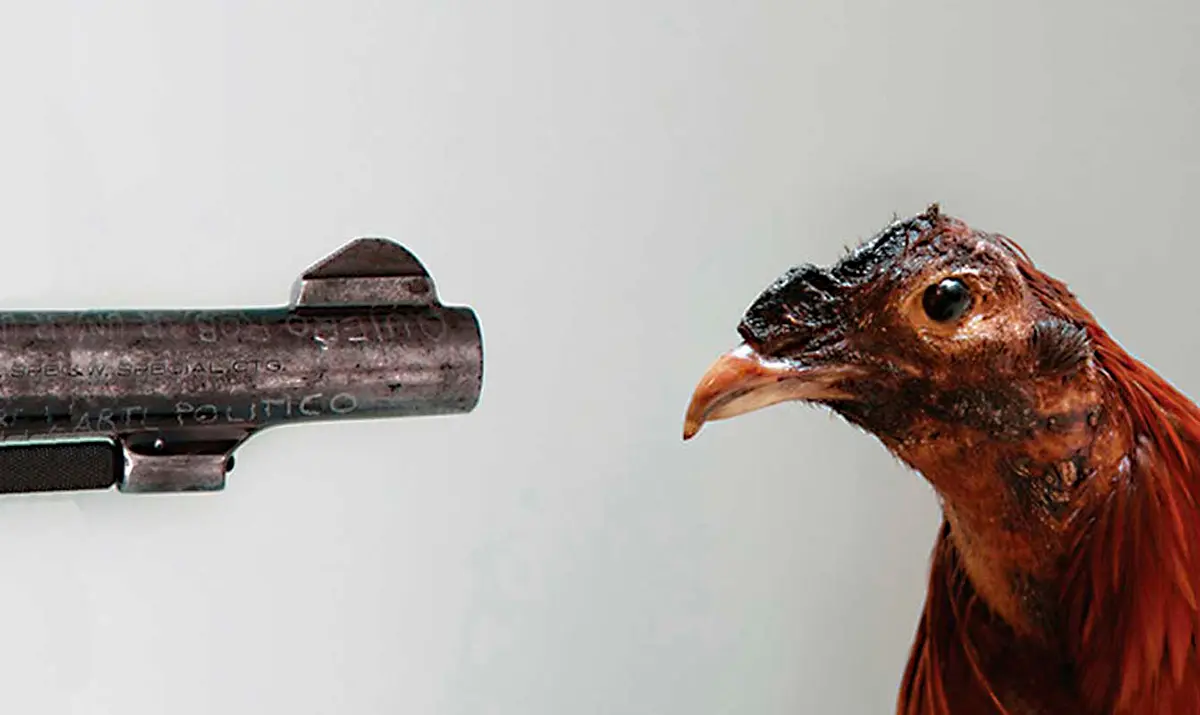
This exhibition succeeds in materializing the relationship between art and society. A good part of Edwin Sánchez's work involves the appropriation and interventions of reality. Such artistic strategies are practical and emphatic. On the first floor of the exhibition, we find a piece that makes reference to the illegal trafficking of firearms. A photograph hangs on one of the walls—practically a portrait—of a gun that has been subtly intervened with phrases such as artista político (political artist), quiero ganar una beca (I want to win a scholarship), quiero vender todas mis obras (I want to sell all my works), quiero violar a una menor (I want to rape a minor) etc. This grammar of desire—that very well could represent the yearnings of many contemporary artists immersed in a world in which reality permeates their creativeness—turns the revolver into an essential object in a circuit of urban violence.
On the opposite wall, we find a sound device that contains a recording of somebody who works in a firearms store. This person relates the way in which the firearms trade impacts the geography of urban violence. We can observe a map of Bogota displayed on a table. A route marked in red on the map points to the oscillating movement, from the La Macarena neighborhood in the city's downtown area to Ciudad Bolívar in the southern section of the city. The map also enlists the sale of firearms and their eventual resale in the hillsides of eastern Bogota. There, youth gangs buy and sell weapons that originally belonged to the police force. This work effectively questions the role firearms trade plays in the increase in urban violence.
On the second floor, we encounter a visual reflection on an exhibition presented many years back: Puntos de Cruce (Crossing Points). We find here a catalog of that exhibition, in which several Colombian contemporary artists are referenced. As we enter the space intervened with scaffoldings, we observe a series of screens of various sizes and a video projection on the wall about the arms conflict in the countryside. One of the videos shows a guerrilla truck stuck in the mud while insurgents attempt unsuccessfully to free it. Another video depicts an offensive attack by a guerrilla poised to occupy a town as they attack it with gas cylinders. Yet another video describes the pedagogy of violence. Here, an insurgent's hand demonstrates the proper way to attack a town. His hand moves over a mock-up—that looks like it was created by a child; it includes the main street, a church, and a police station, among other important buildings. The instructor's voiceover describes the steps for the successful occupation of a town. The last video projected on the wall shows a group of guerrilla fighters as they count money after an assault. From the radio that belongs to one of the insurgents, the voice of an art expert can be heard speaking about the exhibition Puntos de Cruce. At the present time, the reality of Colombia is unquestionably aligned with an artistic reality that, despite everything, is still able to generate enigmatic readings.
Lastly, on the third floor, there is a projection that illustrates through the use of "child" drawings, the recount of a paramilitary man about the proper manner of dismembering the bodies of victims into pieces. We can also observe two real-size sculptures on either extreme of the exhibition room. One sculpture is of a woman with her abdomen ripped open and a rooster inserted in it, and the other represents a dismembered body that has been reassembled. These two pieces materialize atrocious acts that were committed during our long history of violence. Last, there is a photograph on one of the walls that depict a confrontation between the barrel of the revolver that we first saw on the first floor and the face—animals also have faces—of a fighting rooster whose comb has been ripped off. This hard-to-look-at image summarizes the essential elements of Edwin Sánchez's project. This artist is willing and able to shed very critical light on a history of violence fought on two fronts; the rural and urban environments of a country at war, in which the arms trade is one of the invisible reasons behind the extreme violence suffered in Colombia.
RICARDO ARCOS PALMA