
Sheltered by the immediate implications of its title, Gabriel Valansi's Babel presents a group of unpublished artworks that confirm him as one of our finest artists. For some time now, Valansi (Buenos Aires, 1956) has expanded an artistic proposal—initially conveyed through photography—that now includes installations. The results of his approach to space are always fascinating. They are nourished by the photographer's gaze and address the complex possibilities of three-dimensionality. Valansi's themes are characterized by a certain kind of obscurity, a certain lacking of pop euphoria that places his work in a category not often seen. He tries to avoid labyrinthine conceptualisms and dense theoretical appoggiaturas, but when he must resort to these, he is careful to ensure that his images speak for themselves and are compelling in their own right, so they can be understood without the need of guiding texts. Valansi's recent exhibition is presented at the Repsol-YPF tower, a new space in Buenos Aires whose insertion into the artistic circuit has been somehow difficult because of the business environment that surrounds it and that cannot fully adapt to the requirements of the art world in which it wishes to operate. Nonetheless—and despite some hurdles that are not worth mentioning and that presumably will be eventually corrected—the appropriation of the space by Valansi is strikingly imposing, incites reflection, and proposes a close—and yet inconceivable—landscape.
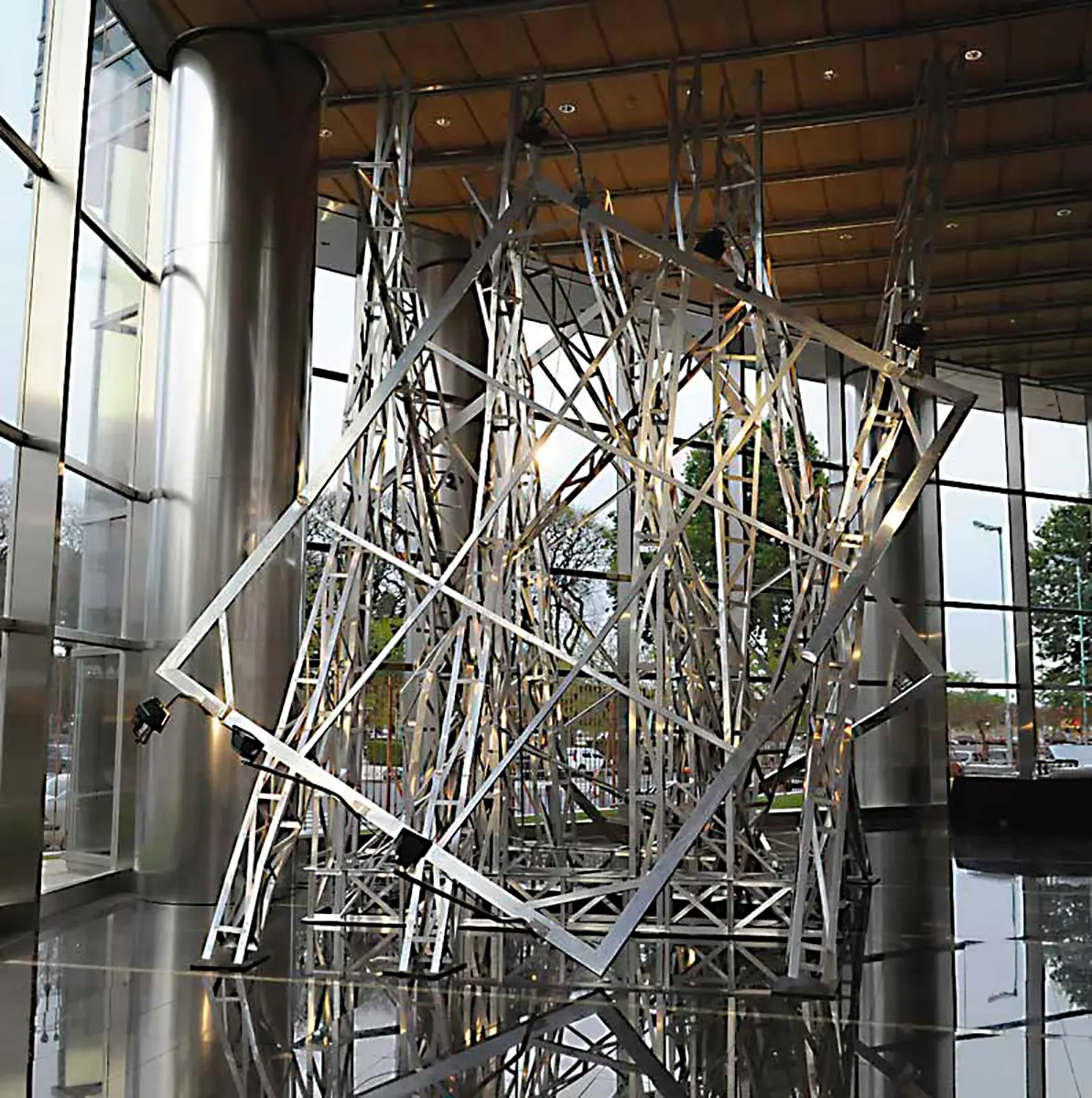
Valansi installed three monumental pieces: an aluminum structure that could pass for the remnants of a billboard after a cyclone; a mountain of ruins that, upon closer inspection, is revealed as an elevation made of thousands of keys from computer keyboards; and lastly, a long black surface full of small elevations and paths that were constructed only with hundreds of painted computer boards to render the gloomy and apocalyptic view of a ghost city of sorts. This third piece is the most unsettling of the three. Its effect is enhanced by the use of a viewer—rusted on the outside but with digital technology inside that allows visitors to transition from a pixelated vision into a truly sharp one—which is too inviting to be ignored. This type of gesture that decisively directs the visitors to a specific point of view, reveals Valansi's use of his photographic background for the public's benefit. The viewing device allows us to observe details that would otherwise be impossible to see from a distance, and in doing so, it confronts us with the rigidity that is found in any system; one with a rational outline and the implicit assumption that, if it were to actually be a city, it would be a terrifying and empty one.
Many before Gabriel Valansi have envisioned "a land without human beings," and many yet have also pointed to the inherent dangers of technology. But it is the way Valansi approaches these two imaginaries—present also in some of his earlier works but imbued with other timely preoccupations—by combining them into proposals that convey a physical, palpable, quality hard to erase from our minds. Following the same emphatic and moving tone of Cildo Meireles's Babel—another work difficult to forget if one has seen it in person—the Babel by Valansi confirms that great stories continue to be the preferred nourishment of great artists.
EVA GRINSTEIN