
This exhibition of works by Graciela Olio and Marcela Cabutti brings together two artists whose works have been conceived and executed independently of each other. Upon entering the ample gallery at the OSDE—in La Plata, Buenos Aires province—the visitor finds installations, wall works, and works on pedestals. The two artists conjugated their presence through different aesthetics and materials, yet with a subtle common element: Cabutti and Olio coincide in connecting industrial processes, the visual arts, and a commentary on contemporary society. In some of Cabutti's works, it is possible to discern a utilitarian/scientific point of reference, but this is just an initial reading, as these elements are reconfigured into the artistic. Olio, in turn, uses industrial ceramics to create vigorously neo-conceptual relieves and sculptures.
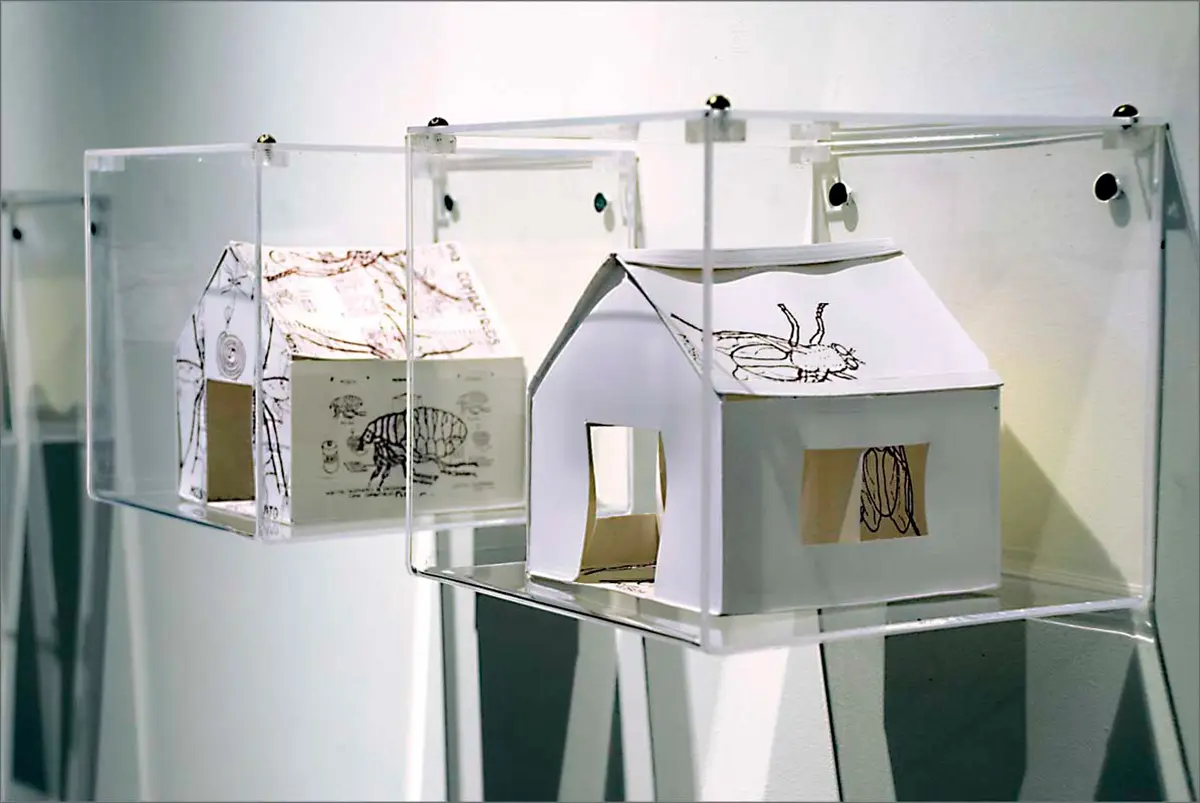
Graciela Olio is a neo-conceptual artist always attentive to the contemporary social and political context; a constant in her work is the innovative use of ceramics. The ceramic object Olio has proposed from the beginnings of her career has been the industrial kind, which she brings to the level of auteurism. Here, she continues with her Proyecto Sur, now presented as a work in progress in a series titled Home, with plates of keraflex porcelain, a German material she has been using since 2009. Onto those plates, Olio transfers images from notebooks of a kind used in Argentine schools between 1960 and 1980. Olio has been developing a critical, bold, satire-tinged language all her own since her earliest work. The viewer is confronted with the seemingly naïve use of familiar images. This is the entrance into the world Olio is seeking to reference: the situation in the Southern Cone, her situation, the situation that worries and makes her conflicted, which Olio intends to bear witness to, documenting, and, as much as possible, helping us understand and transform it. Something that has been noted as a sign of modern colonialism in Latin America, the use of English to refer to situations or things, acquires here a kind of ricochet effect. The artist says about this series: "The ironic use of the word Home implies an almost comical move in this context of poverty. The simplicity of the habitable spaces, put together from printed cardboard, reveals a sad reality that has long been ours. There are roofless homes, homes on the edge of catastrophe, homes that are falling apart, and hanging precariously by a thread. It is a series in permanent construction and its metaphorical development is expressed as a symbol of resistance."
When Olio says "cardboard," she is talking about the real homes of the poor. In the exhibition, an attentive gaze seems to be looking at artworks resolved on paper, but in practice "my 3D constructions are resolved by cutting the plates from patterns, using a knife or scissors, and then gluing them together and setting them up. Usually, the printing technique involves a photo-ceramic process with bi-chromatic rubber, direct transfer of photocopies, and vitrifiable digital decals; on occasion, I also work smooth shapes with enamels and metallic varnishes, or simply with the naked material, emphasizing its features."
On the left side of the gallery, visitors encountered a set of ten lamps by Marcela Cabutti, turned on, shadow-playing, suspended from the walls despite their table-lamp bases. The transparency of the glass—with applications of red, white, and black dots—ritually emphasized three parameters of the global process experienced in our times: intervention, originality, and alteration. The artist alternates between highly divergent media: drawing, three-dimensional synthetic material, and glass, among others. She has been creating glass since 1997, in Murano, Ohio, and, in the case of the glass used for this exhibition, in San Carlos. Besides the lamps, there were some transparent works combined with three opaque ones—in black blown glass in the shape of a pagoda, which the artist titled "small houses," with different subtitles. The height and the lightness of these supports were positively within the framework set for the show, although the color should have been modified to avoid having it become too salient in the context of the general subtlety.
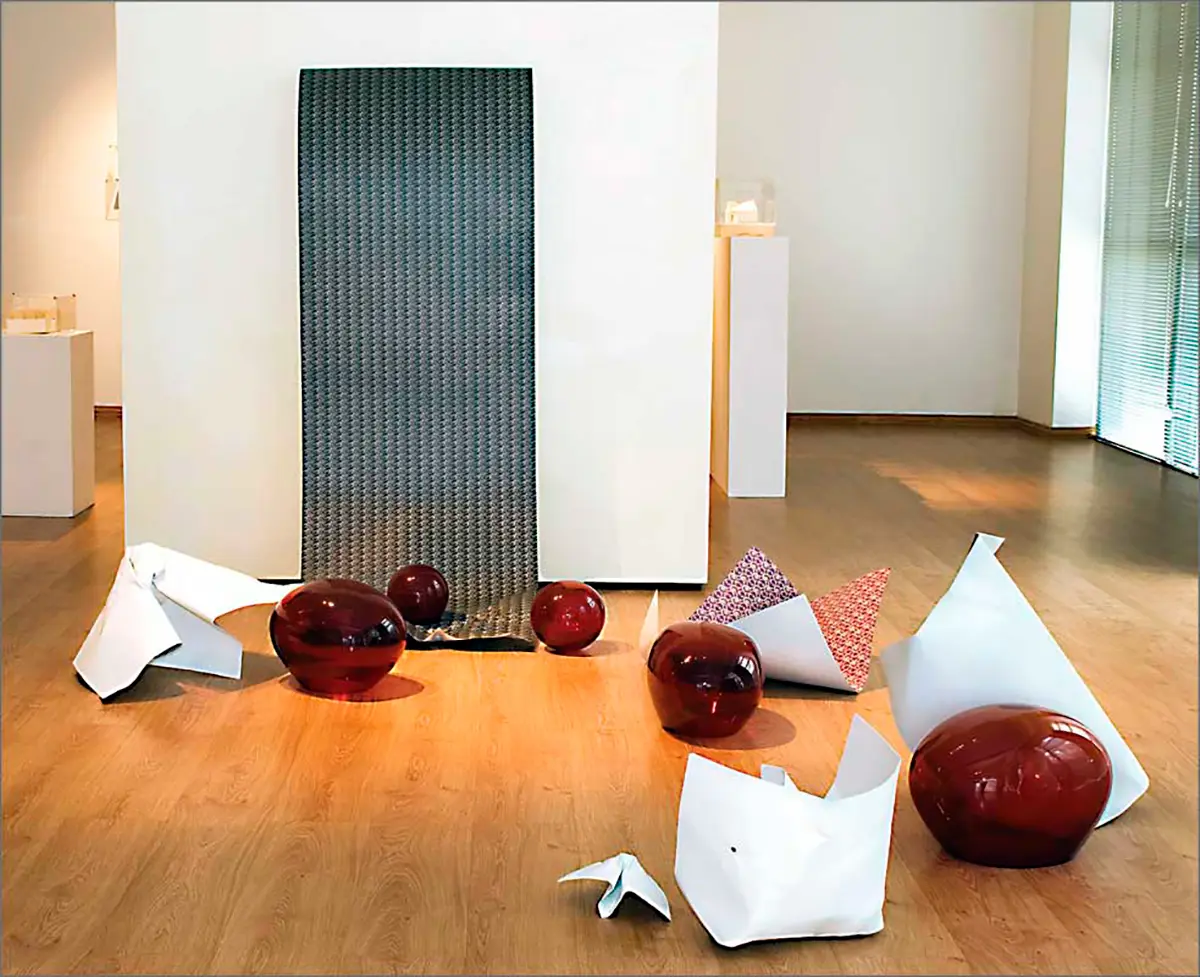
Also, and above all else, a work by Cabutti definitely stood out: an installation on printed galvanized sheet metal and red blown glass. Using Japanese techniques and underlining the attraction of opposites, this work could comprise an entire exhibition all by itself, without any company.
Graciela Olio used Plexiglas as support for most of her little homes, and in some, she also included light as part of the referential semantics. The set of six "urban" plates with yellow accents, and the deconstructive wall installation with white, blue, and reddish-brown plates, extends her use of images into an interplay of confirmations: the beauty of the fractured shapes makes it possible to amplify the viewer's perceptual capacity and to impress movement on our reading of the works displayed on the wall. In conclusion: the show demonstrates the importance of experimentalism, and of knowing how to present it as a finished work of art.
GRACIELA KARTOFEL