
The Fundação Iberê Camargo has adopted an interesting way of mounting the exhibitions of its collection. A variety of curators are invited to organize shows centered on the works by Camargo, the central figure giving purpose to the curatorial efforts of the museum. The foundation is projected as a monographic museum and centers its efforts on activating the different possible gazes at Camargo's work, as it also incentivizes research and debate. Such dynamic brings about a multiplicity of approaches that offer the public the possibility of a continuous and diversified dialogue, through the artist's production and in the framework of the times in which he created it
Thus, exhibitions of the collection appear like a space for critical postulates that reveal many meanders in the work by Iberê Camargo, and become a place for visitors to make new discoveries and gain knowledge, as they learn new ways of approaching this artist. The work by Camargo is rendered uninterruptedly relevant as a result of the various and different readings proposed by the mediators. The Exhibition Iberê Camargo: The Meanders of Memory was inaugurated on October 2nd of 2010, and will remain open until April 3rd, 2011. Curated by Jacques Leenhardt, it presents the public with the opportunity to reflect on many topics that have not been covered in other curatorial efforts about this artist. The curator inquires about the melancholy that permeates Camargo's images, while addressing the relationship between the Brazilian artist and Giorgio De Chirico, who became his teacher during 1944, when Camargo went to live in Rome for a year, after having won an award to study abroad from the Salão Nacional de Belas Artes. In that opportunity, not only did Camargo study with the Italian master, but he also had the chance to meet personalities from the Italian art scene associated with De Chirico.
In an interview given to the Associação Brasileira de Críticos de Arte (ABCA)1 periodical, Leenhardt said the following in connection to the purpose that guided the organization of the exhibition: "To prepare an exhibition, one often chooses the works that one believes to be the most powerful, the canvases that mark the people's imaginary, the stones that point to the artist's trajectory. The Fundação Iberê Camargo had already organized exhibitions that showcased excellent works. My challenge became then, to avoid repeating what was already done in the past." The curator decided to find a new perspective by exploring the drawings—there are 3,200 drawings by Camargo in the collection—as he established a relationship with the artist's other artistic production in the fields of painting and engraving. Leenhardt considered the drawings to be important because they convey "the minimum attempts, the fantasies just as these emerge from the mind, without imposed filters, as it occurs with the transcription of ideas on the canvas." Leenhardt decided to explore "this open door into the artist's creative process." He also explored connections with texts, written by the artist or stated in interviews. Memory and melancholy are built in the articulation premises found in the discourse of the exhibition.
Melancholy is expressed as the very powerful existential dimension that permeates Iberê Camargo's entire body of work. According to Leenhardt, memory—namely the relationship with the past—is evident throughout the entirety of Camargo's work. The art critic also looked to establish another connection in the formulation of the exhibition: the one between the formal logic of the works and the themes employed by the artist. In such a way that, by addressing a fundamental point of inflection—the connections between Camargo and De Chirico—the curator brings to the forefront the issue of form/thematic. Spectators are lead to a new understanding of the presence of formal elaborations and thematic approximations, such as the ones found in the posters and mannequins created by the artist. Likewise, the latent question in the theme related to movement (the cyclist's theme), acquires new meaning in the work as a whole.
The exhibition introduces visitors to the works in chronological order. The curatorship emphasizes the relationship with the past, Camargo's birthplace, his childhood, family, and the events in his life that are always present in his work throughout a career whose artistic evolution appears to go in circles. The memories emerge through drawings created in different moments of Camargo's career, and also appear in the canvases created during the 1940s and in later periods; these are works colored by remembrances that allude to landscapes in the limits between the countryside and the city (Porto Alegre). As we walk through the exhibition he can observe the other phases that followed. An intriguing period is the one that alludes to the human figure and the mannequins. Leenhardt addressed this in the introductory text he wrote for the exhibition: "The mannequin is pure otherness, an empty and inanimate form that, nonetheless, and perhaps—or maybe because of it—it is fascinating. This artificial being is the absolute 'other' of our bodies that lives and suffers our miseries."
Camargo also went through an abstract period that began after the prize he was awarded, in the São Paulo Art Biennial in 1957, an approach that he continued to develop throughout the 1960s and 1970s. During this phase, the artistic inquiries turned formal, with the selection of objects with geometrical structures (like the reel). To this respect Leenhardt has said, "this period of formal research naturally leads to the selection of an object with strong geometrical structures: the reel." The art critic refers to Freud's analysis of the games children play with fishing line and reel. Leenhardt goes on to address the use De Chirico gave to this game, and to other toys, in his metaphysical paintings. On the other hand, the critic points out that during Camargo's childhood, sewing at home was a much more common activity compared to today. Therefore, aside from being an attractive object in terms of form, the reel is a strong element memory-wise.
At some point, the artist's interest in matter becomes evident, as the paintings are rendered with generous and gestural brushstrokes that describe the presence of signs always stemming from memories. Pushing the boundaries of abstraction, Camargo also examines other simple forms aside from the reel, such as dices and prisms, like it can be observed in a canvas from 1982. Aside from the formal objects, the human figure is another element that has a strong presence in his work, as he presents us with solitary or anguished individuals.
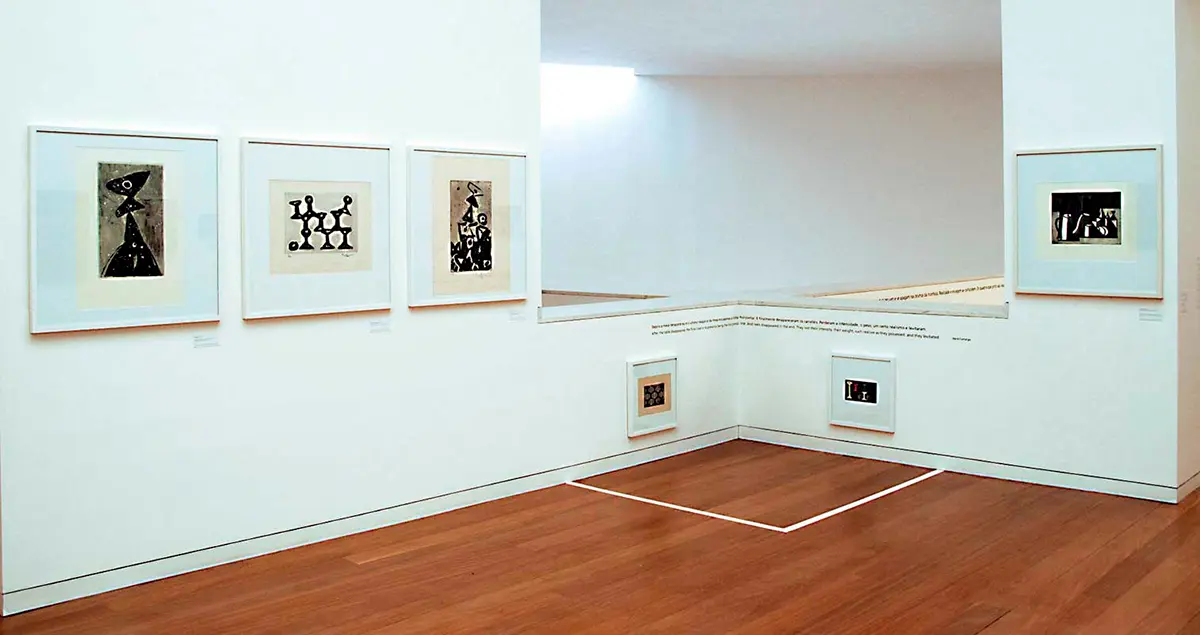
Leendhardt also innovates in another field: in the montage of the exhibition, in that sometimes—in some of the exhibition rooms and corridors—he uses the lower section of the walls to align the works to floor level. In some sections of the exhibition, visitors encounter phrases extracted from writings by the artist that guide the process of contact with the works exhibited. Iberê Camargo's voice is articulated through Jacques Leenhardt's discourse.
NOTE
Interview with art critic Alessandra Simões, ABCA periodical, year VIII, N. 24, December 2010.
LISBETH REBOLLO