
To address the visibility of art appears to be something that is common these days. Rejection of a visual hegemony supported by the strength of the chromatic density of painting and the volumetric nature of sculpture has led to a search for an artistic identity expressed in the deconstruction of the visual space and in the fascination for virtual performances that arouse emotions in the viewer that are tied to his/her own affective self, while also establishing connections with the realities of contemporary individuals. The subject of deconstruction has been, in many instances, resolved through both artistic and philosophical proposals that answer to a correspondence between the time and space inherent in the work itself. In addition, there is the potential of a "void" capable of generating virtual movement as a result of the interaction between lights and shadows, and of the "metaphysical" environments generated by the rich translucencies—created by the connection between intangible and material optical elements. Surrounding this concept—thoroughly researched by conceptual art throughout the Twentieth Century—the contemporary artist has tended to favor the autonomy of the visual form by rejecting academic norms. And Jonidel Mendoza has inherited these groundbreaking formal approaches developed in the last few decades.
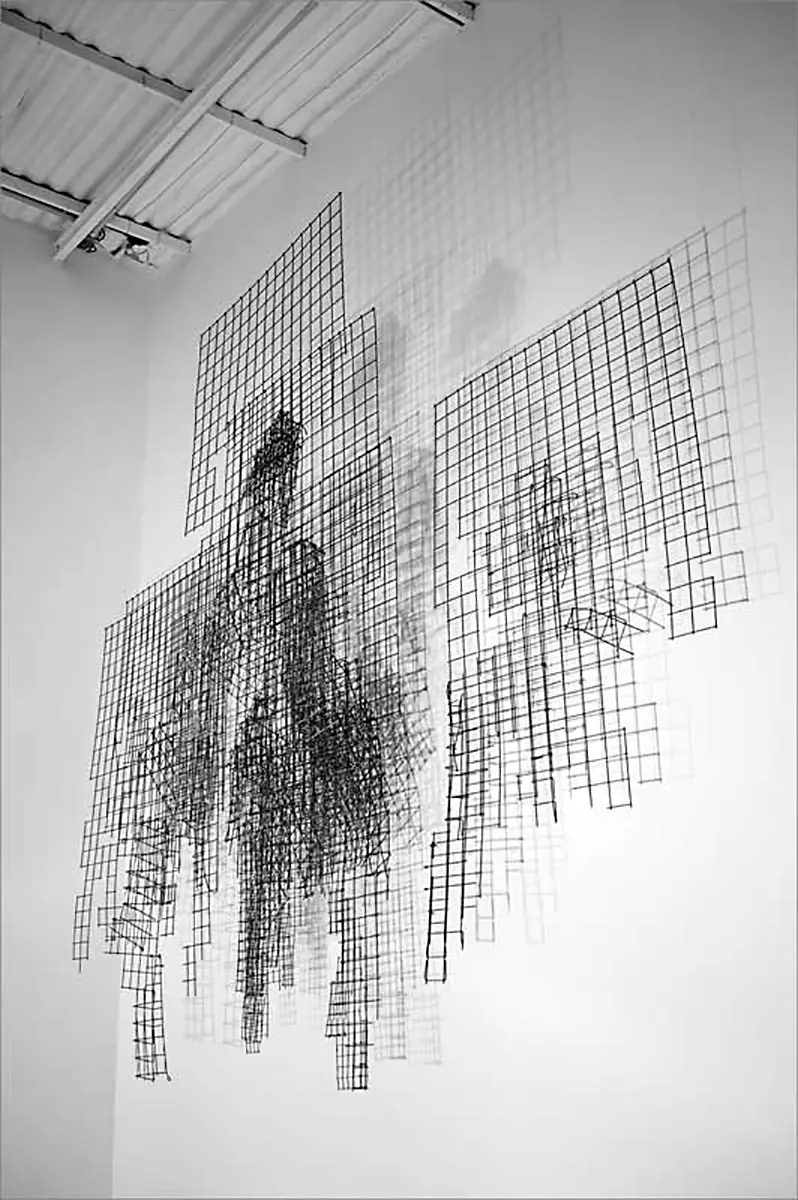
Mendoza's recent exhibition reveals the continuity of a history of the "non-form." From an optical-physical point of view, it is evident that he achieves dematerialization in terms of the representational aspects of the human figure. His production involves rigorously working—nearly as if he were a goldsmith—with specific materials, electrically-welded, nylon, or fiberglass meshes, steel cable for electricity, among other construction materials. The nature of his work is removed from the more conventional academic practices—but not from rigorous artistic creation—that exhibit the tendency to emphasize certain aspects, such as the importance of color. Mendoza frees the "materiality" of chiaroscuro through the impact of light and the interior movement of the superimposed planes that exist between the wall and the viewer. At this point, it is important to name some of the leading creators of the Twentieth Century: Jesús Rafael Soto and kinetic art, and Naum Gabo and constructivism, both of these visual storytellers with a poetic of translucencies, lightness, and immateriality—all of which are attributes at the center of Mendoza's conceptual approach. This young Venezuelan artist (1957) creates substantive images that are supported by an aerial space, which he extracts from reality to turn them into "ever-changing, always truthful and real [works] as long as they are being used (Gabo)." This is how Mendoza constructs artworks that are optically pure and convincing in their physical concretion and how the artist, in the process, has found a new way to conceive of the art of installation.
The other visual motivation in Mendoza's work refers to the image without support, a visual proposal that establishes the expansion of the visible and invisible across the horizon in a simultaneous perspective. Drawing within the space is a sensorial and spatial proposal defined by the succession of images on a two-dimensional plane that will always be the wall, which serves as their intangible support or as a mirror that projects them onto the exterior. The works—all large-size pieces—included in the exhibition entitled Chiaroscuro, showcase the most compelling elements of the history of visual beauty. They justify the transformation of a studio into a large laboratory where the artist explores the behavior of the visual, the mind, and knowledge to conceive "figurative images" from a new visual universe in which the immaterial, the ethereal, is guided by the equilibrium between ritual and emotional factors. With measurable visual codices, Mendoza is able to concretize his work as "art" by relying on the artistic logic of combining the academic elements of execution with his non-academic experience, in order to transfer the visual space into the infinitude of virtuality. Through this principle, he establishes the double game of integrating the "representational" system of the figures' hierarchical values with the technical basis and the utilized materials, as the work is divided into a succession of sensorial and normative values directed by several focal points that are perceptible in the visual discourse. Chiaroscuro represents a paradigmatic example of this. It was constructed in accordance with an unconventional perception of art as a "representation." Mendoza's proposal is convincing. The theme leads to the pleasure of "seeing" the staging of an imaginarium as oscillation among nothing, the being, and art.
BÉLGICA RODRIGUEZ