
Julio Le Parc is considered one of the pioneers of kinetic art. He has been consistently working and experimenting with this art tendency since the 1950s. Still today his work gravitates towards kinetics, showing the same freshness and innovative sense that made it stand apart so many years ago.
Alchemist is his first solo exhibition in Miami and comprises pieces from 1967 to 2010, mostly paintings. There are also examples of his mobiles and pieces made with light because no exhibition of his work would be complete without examples of these kinds of works.
The central piece of the show is Mobil Transparent Theme, originally from 1960, but the artist made a version this year especially for this exhibition. It is strategically placed at the center of the main room, allowing the viewer to walk around and see all the different angles reflected on a mirror positioned on the floor, right under the piece. Mobil Transparent Theme is made up of small pieces of plexiglass joined together like a translucent cascade flowing from the ceiling.
Light is one of the main elements that kinetic artists work with and Le Parc has done his share of pieces with it. One of the most intriguing pieces in the exhibition is Cellule Avec Lumière en Vibration, from 1968. It consists of a projector that emits light on a wall, changing the pattern in a rhythmical way. By positioning this piece in a separate room by itself the viewer can enjoy the sensorial experience of light and sound, isolated from the rest of the world.
Le Parc is one of those artists who develop a theme and explores it until he feels exhausted. In 1970 he began a series of paintings titled Alchemy and Modulation. He has been consistently working on it since the '70s. Part of this series is included in this exhibition, especially large-format paintings. This series can be divided into two groups based on their titles: some are titled Modulation and a number, and others Alchemy and a number, indicating the order in which it was created.
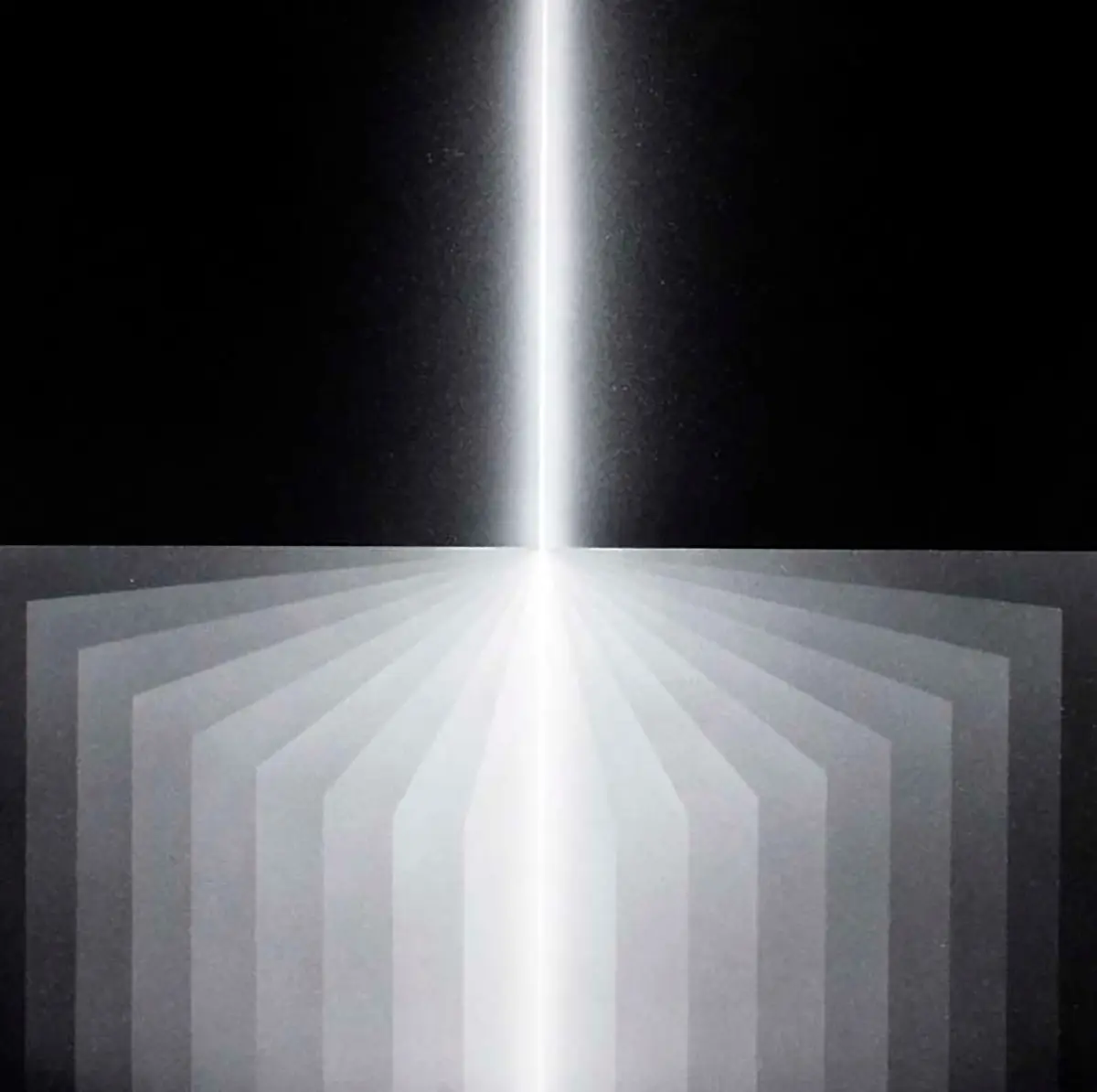
Modulation 1160, from 2004, is one of the finest examples of the Modulation group. The piece is symmetrically divided in quarters, right in the middle from the top to the bottom with what seems like a ray of light, and side to side with a structure that looks like an open 'fan'. This painting gives the illusion of movement of the light and the 'fan' at the same time, giving the impression that the light activates the 'fan' and puts it in motion.
The Alchemy Group is his tribute to this science. Two of the pieces within this group Alchemy 175, from 1991, and Alchemy 216, from 1992, explores the significance of water. Alchemists see it as one of the main four elements of nature, and as a symbol of flux, renovation and purification. In these pieces, Le Parc is exploring the movement in the water, as part of fountains sprinkling in umbrellas forms. As with the rest of his work, in these two paintings, he is interested in exploring movement, in a physical and metaphoric way. In these paintings, he achieves both, since visually we see the water in flux while the meaning is suggested.
Most of the paintings are monochrome, in black and white, but there are a couple of them where the artist used bright colors. In those instances, the color is very bright, consciously applied in contrast with the usual black and white. Le Parc is using color to highlight elements that he wants to make relevant. One such painting is Modulation 965, from 1987, where he used orange to paint the ball in the forefront and the cylinder on the back, highlighting the contact points for the light trajectory passing from one to the other.
By looking at Le Parc's work we can recognize his incredible thirst for experimentation, which has lasted throughout many years. Despite the advances in technology that could be useful in constructing this form of art, Le Parc has always resisted it, preferring to continue working with the same simple materials he used when he began to make art in the early years. For Le Parc, his viewer is an essential part of the work, how he or she perceives it makes all the difference to him and he takes it seriously into account when preparing an exhibition. There is an interactive game that goes on between the artist and the viewer, a continuously amusing sensation in discovering the various elements the artist intentionally left undefined. This is a highly sensorial type of art, and it defies the senses in more ways than one, thereby maintaining the element of surprise and discovery.
IRINA LEVYA