
Artist Luis Luna created the work Lux Feminae to challenge spectators to reflect on the notion of hybridity, in order to attain a subjective and open vision of reality that encompasses several aspects of the construction of contemporary identities. A continuous process of re-creation, re-definition, and re-articulation of a world vision allows for the possibility of completely articulating the experience in terms of a visual and textual language.
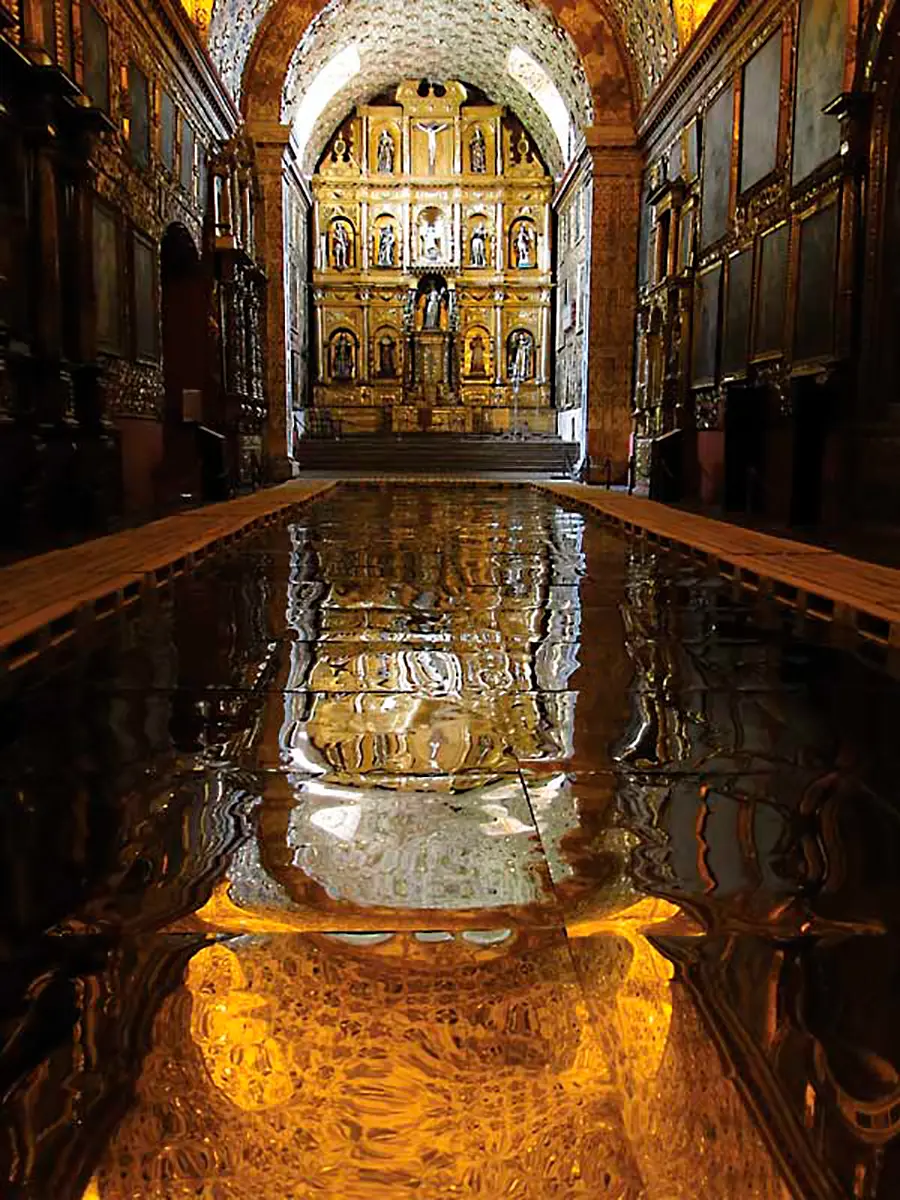
The work was presented in two separate spaces. One consists of an intervention at the Santa Clara church in the city of Bogota. It is an installation created with metal sheets placed across the floor of the space that achieves the effect of a lake or mirror by reflecting the elements from above, with the ceiling vault and the wooden altarpieces laminated with gold leaf. "It is the hybrid between heaven and earth." On the other hand, the other part of the exhibition is presented at the Galería La Cometa. It is an exhibition of paintings, derived from Luna's intervention at the church, and combined with several works from earlier periods that are full of discoveries, relationships, travels, and experiences.
This work by Luna was initially based on cultural and historical references, graphic elements, text fragments, and sheet music belonging to the Santa Clara church, along with book images from the time of the Spanish conquest and the 19th Century in Colombia, imagery from Baroque and Renaissance engravings, alchemic and hermetic signs, and images from the cosmos. Luna approaches hybridity as the product of sensorial experiences across several landscapes and memories acquired in travels, as the artists also allow narratives from other time periods. This results in paintings that are presented as layers of memory in situations or images that the viewer can culturally identify with. It is a process by which Luna transforms this practice of addition or superimposition of cultural fragments and layers of the external world, into a way of thinking, reflecting, and producing critical thought directly associated with the construction of a multicultural identity outside of the parameters outlined by history.
In the work, Lux Feminae, Luis Luna pays more attention to sheet music images, as he adds to these several meaningful layers of colonial life that lead viewers closer to the female monastic life in Santa Fé de Bogotá, including some meanings and associations from the colonial life of women. Nonetheless, the work exteriorizes a great number of sources and, therefore, it is a reflection of personal and contemporary identities. There is no room for a simple articulation of Latin America or for linear or constrained narratives about time and place. An example of this is found in the description by the curator of the exhibition, Natalia Vega, regarding the work entitled Partitura I (Sheet Music I, 2010), a small digital painting printed on acrylic in which several image layers are superimposed: the satellite photograph of a nebula captured by the Hubble telescope, a musical score with a manuscript by Clarisa's sisters, and on top, various floating signs that evoke the marks of another type of annotation or writing. It is right there where we can observe that the concept of hybridity is latent throughout Luna's work, not solely in the combination of materials and techniques, but also through the superimposition of images, iconographic elements, and texts from several cultures. Luna invites spectators to participate in a global process of integration and inclusion, without erasing the individual identity of the components; on the contrary, these are superimposed one on top of the other in several cultural layers.
Throughout Luna's work there is the strong presence—and contemporary mise-en-scène—of the legacy left by romanticism, a dialogue with the traditions of abstract expressionism, as well as appropriation and conceptualization strategies from more recent times. Luna resorts to mediums like collage, drawing, engraving, and digital techniques. His paintings are characterized by a great colorfulness that stems from the use of various pigments and materials. Yellow, ochre, and sienna earth tones are predominant, as well as very saturated color areas painted with crimson or turquoise.
Luna's Lux Feminae exhibition is a work that resorts to hybridity through the superimposition of multiple layers of cultural referents—historical, geographic, visual, and iconographic—that, combined with the appropriation of the Santa Clara church in Bogota, invites viewers to reflect on their worldviews from a multidisciplinary and globalized perspective, through a process of constant change and expansion, for the construction of a contemporary and personal identity.
DIANA MARCELA CÁRDENAS