
At the end of 2010, a young Venezuelan filmmaker, Mariana Rondón, presented a video-mechanical installation that was the result of eight years of research. It is a robotic invention that consists of the large machine with arms that move vertically and horizontally—the two degrees of freedom that allows them to move in that manner—trays with a soapy solution, and video projectors. Through the use of a motor and a scaffolding structure constructed with several metallic elements, the machine produces soap bubbles that function as a screen that in its interior shows digital images of human figures moving or in process of transformation. To view it, it was necessary to have the exhibition space totally dark.
During the eight years that elapsed, this experimental project unfolded progressively as the machine became more complex. The first version Llegaste con la Brisa (You Arrived with the Breeze), was followed by versions 1.5, 2.0, and 3.0. Each version was recorded by the artist and exhibited in several parts of the world. The machine installation itself is entitled Llegaste con la Brisa, but the complete installation shown at Periférico is entitled Dos Grados de Libertad (Two Degrees of Freedom) and, in addition to the machine described earlier, it includes two additional robots behind plastic curtains that give the installation a phantasmagorical effect.
The soapy liquid used in transparent containers was thickened for the occasion in order to get larger and longer-lasting bubbles. Since these inflated when the vapor was injected, the temperature and humidity had to be closely controlled. The vapor that was created enabled the images to be displayed, as it made the bubbles opaque and made the figures look as if they were moving in "amniotic fluid."
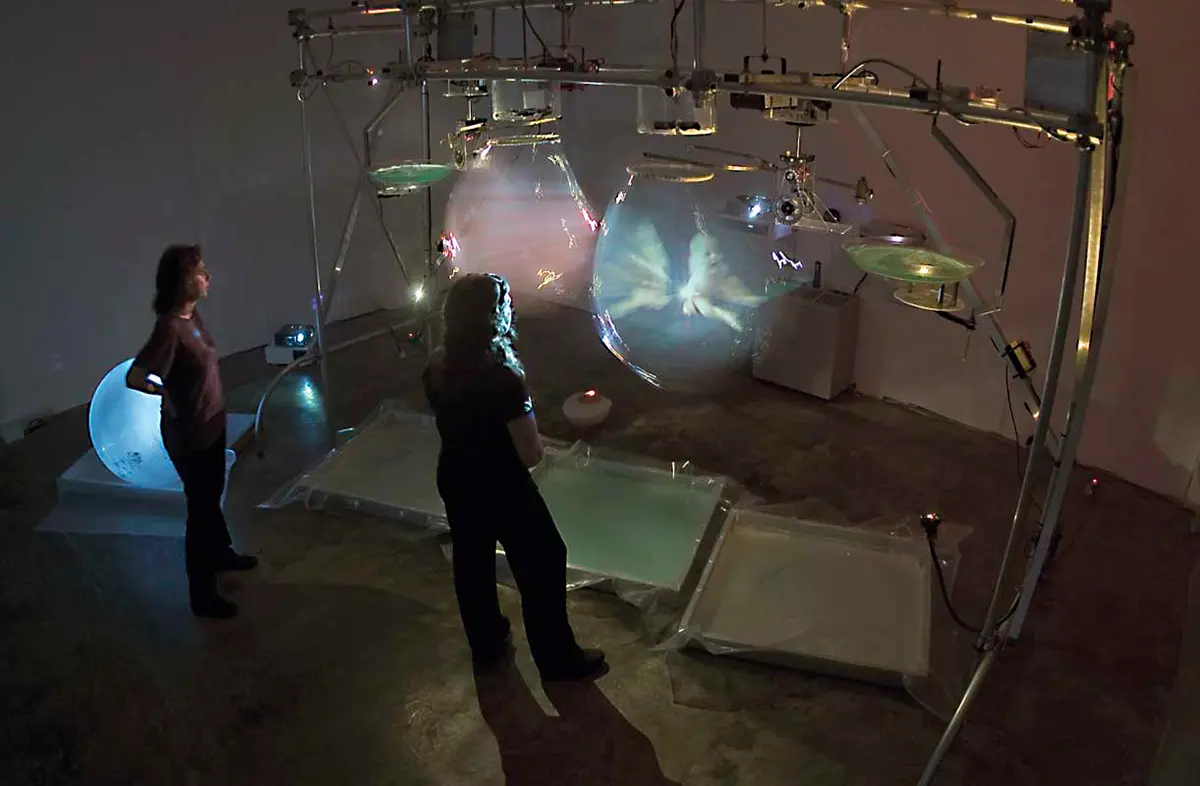
To Rondón, the central objective of this work was to create her own genetic laboratory. At a time when transgenic engineering is increasingly invading our lives, Rondón decided to create her own "laboratory" of hybrid beings; an idea that was conceived in 2001, when she read that several clandestine research facilities had been closed for creating monstrous beings by altering DNA. Unlike those facilities, her lab was a center for creating human beings through the projection of images—some depicting the human figure floating underwater—inside a powerfully poetic environment. The integration of the machine (technology), the moving images, and the continuous echo of sound in the background, definitely created a timeless, cyclical, and eternal environment.
The videos—all of which look like fictional floating uterus—were projected on the bubbles and on the translucent sphere located on the floor. They showed faces and moving body parts and offered a singular take on the origin of life, as well as a reflection on its unavoidable end. Seeing through the continuous movement of the machine, this process serves as a metaphor for the life and death cycles.
The environment in the exhibition gave the impression of being a sidereal space. Each "uterus bubble" floated amid infinite darkness. Like in a children's game, they appear by blowing—the vapor injection—cyclically performed through large rings. The appearance of gradual expansion of the bubbles simulates the birth of babies covered in amniotic fluid as they exit through the "ring-vagina." We see something similar to the process of birth that occurs before and during labor in the bubbles that appear and gradually grow in size. This birth becomes cyclical as the robotic arms are constantly repeating the movement. Space (sidereal) and time (childbirth and death) represent a perpetual event with no beginning or end.
Rondón has pointed out to the press that transgenesis has not been her only reference. She also draws from art history images of incongruent or hybrid appearance, like the ones that appear in The Garden of Earthly Delights by Bosch, as well as some paintings by Remedios Varo and Rene Magritte. In Dos Grados de Libertad, she portrayed realistic versions of those images from art history, as she placed in certain areas of the exhibition space jars with projections of defective fetuses, a resource that permitted her to work with the idea of genetically prompted accidents.
In 2006, this project was awarded the Premio a la Producción-Vida Artificial 8.0 under the section "Production Incentives," which is given by the Fundación Telefónica in Spain. To execute the mechanical aspects of the piece, Rondón was advised by a mechanical engineering team from the Universidad Simón Bolívar, who in turn received the Premio Nacional de Tesis de Grado (National Thesis Award) for working in the initial part of the project. The sound was conceived by Marité Ugas, also a filmmaker and collaborator. Likewise, it was necessary that Rondón learned about robotics, mechanics, and chemistry, and about integrating these disciplines to her knowledge about video and digital media. The result was a truly interdisciplinary challenge.
SUSANA BENKO