
Squeeze is the title of the most recent exhibition by Argentine artist Mika Rottenberg at the Mary Boone Gallery in New York, presented from October 13 through December 18, 2010, in collaboration with Nicole Klagsbrun Gallery. With this work, Rottenberg continues her research on the mechanisms that generate valor, as it pertains to globalization and the transmutation of artistic production.
Squeeze consists of a video installation in which reality and the absurd collide in a 20 minute-long story projected in a loop—without opening or closing credits—it becomes a closed-circuit multidirectional labyrinth that invites spectators to observe until they get tired. The work documents a reality that unfolds through fictitious narrations that transform the artistic proposal into a combination of contradictory elements. But it is precisely through such unexpected and dual combinations that the artist is able to convey commentary about the state of the world. The work was generated during a long period of time in which real characters, stages, and concepts were selected to build expansive groups in uncommon places that resulted in the fiction.
This time around, Rottenberg based her video on a research about the work environment of a rubber factory in India as well as in a lettuce farm in Arizona; integrating both of these worlds with scenes of female workers in an absurd makeup factory—created by the artist at her New York City studio.—Rottenberg underscores these sites to outline the mass production of an "object;" specifically, a cube created with rouge, decomposing lettuce, and rubber. It is a product that represents the value system of a contemporary art market that places artists and art objects at the opposite hierarchal spectrum of factory workers and their products; in other words, it places the factory in opposition to the realities of mass production.
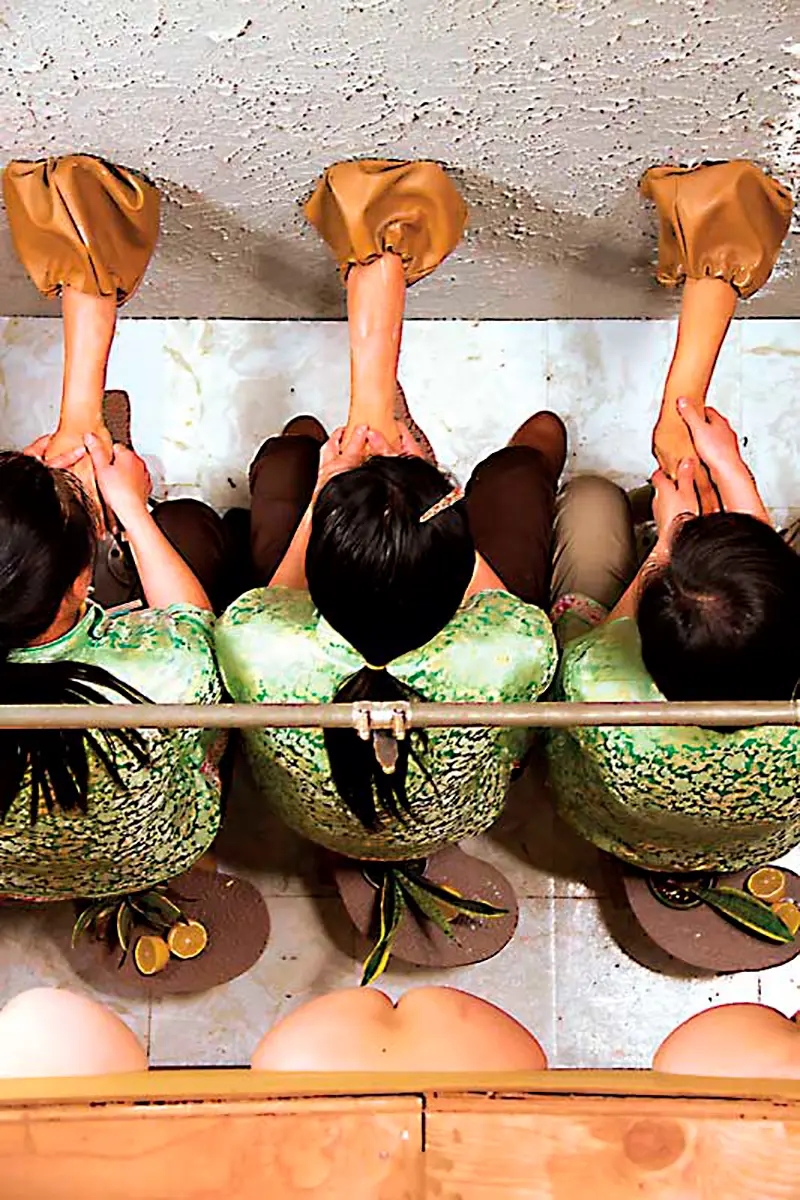
The central subject of the video is only revealed through the raw materials; namely, through the characters, atypical women, persons that stand out because of their unusual height, musculature, or being overweight. These are characters help convey the fact that, in today's capitalist society, the goods are produced by a working class that is socially, racially, and geographically removed from the life of consumers.
The story centered on the workings of a fictitious factory. It dealt with how to capture the energy and the way things are made. It is a choreographed sequence of continuous work—narrated in a non-linear manner—through several mechanisms and rooms, figures and landscapes, hands, feet, working tongues, and buttocks; all elements that require care and maintenance. Squeeze shows scenes like one depicting an obese woman who rotates onto a circular plant, or another that suggest that the origin of rouge can be traced to an attractively dressed blond woman being squeezed between two pressing walls; there is also the scene of a wall with buttocks wet by a spray bottle, or a line of women that through openings on the wall massage the hands of women workers. The interior spaces are penetrated by the eruption of "foreign elements" that come from the outside. If one pays close attention to the various components of the factory, these components appear to be moving for the sake of movement or as part of a sequence. They converge to illustrate Rottenberg's objective: the use and production of the body through work and continuous movement.
The characters in the video communicate through shared tasks. In other words, the characters from the lettuce farm and the rubber factory are intertwined in order to convey the meaning of Rottenberg's work. According to the artist, her work is an attempt to eliminate the geographical distances that exist among these two spaces and to turn them into one, as she shows not solely that the body can be simply used as a factory that produces things, but also that it (the body) can become a raw material.
With Squeeze, Rottenberg once again draws a crude but real and subtle parallel between reality and fiction, as it relates to the production of work and art. She creates in an amusing—and yet unsettling—manner, political art about situations that arise in a society, while she also documents that reality and creates a—surrealist—narrative fiction around it.
DIANA MARCELA CÁRDENAS