
To insert a photograph into another narrative is one of the proposals of this exhibition that most interests me. That is, to place it in the narrative of a mockup, of installation, and also amid the issue of the riddle that vision is. In my search for some definitions of the word narrative, I have come across the following possibilities: the recounting of interconnected stories, to tell something, to make history; and then, I found a verb seldom used to describe it: to represent.
The idea of placing a photograph in other narrations, in other representations, interests me because, despite years of discussions about the postmodern condition, it seems that we still internalize the—modern—idea of seeing an object as something outside of ourselves. We represent as we ignore those who helped us realize that the word is actually formed by two words: "re" and "present." Thus, the word can also mean "to present again;" or "to bring forward to the present." Those who proposed this word also opened the possibility of creating fissures in the narrations about ourselves and our history, and of bringing objects, spaces, and entire periods even, back to the present.
Conversely, this exhibition demonstrates dissatisfaction with the idea of mere representation. It proposes to viewers a confrontation between narrations, between photography and mockup, between mockups and the gallery space; between the apparently anthropomorphous, but subtle and radically modified, scale. It is a provocation between photographic diptychs that propose a "find the error" game.
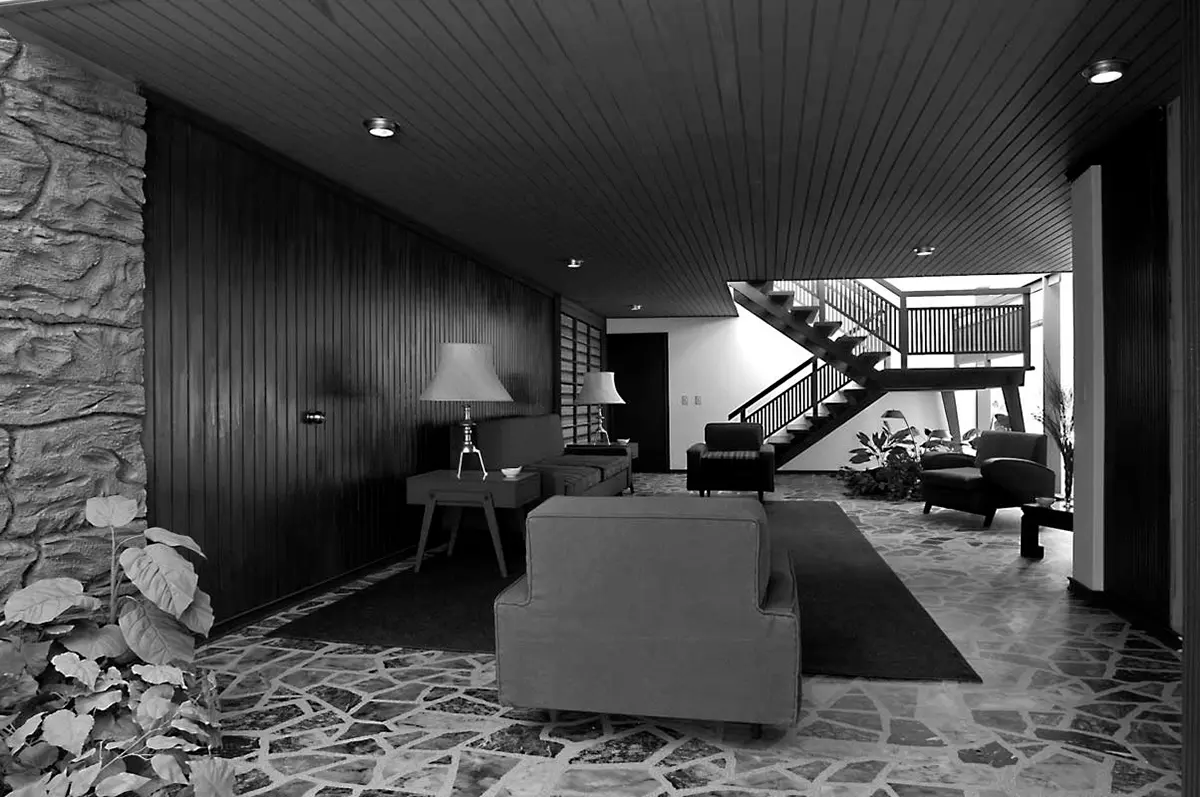
The idea behind the exhibition began with a black and white photograph by Paul Beer (1904-1979), a German photographer who arrived in Colombia at the end of the 1920s and documented the image of the modern city. The photograph chosen by Consuegra depicts the living room of a house with all the characteristics of a home from the Sixties: an ample, rectangular, space that includes certain textures fashionable at that time, such as marble floors, stone walls, a canopy that lets the sunlight through an interior patio with plants, a rug, and armchairs supported by short legs that do not completely interrupt the space and, of course—being in Colombia—a sacred silver-embossed heart framed like a painting.
Beer's photograph is not in the exhibition, it is only used as a reference. Consuegra incorporated it into another representation: a mockup that respects the greyscales of the original and faithfully reproduces all of the details; it reminds one of a T.V. or film set. This living room mockup appears to have traveled from the past and settled in the gallery.
But actually, one could not walk through the mockup. The spectator was left outside because the scale was real only in appearance. It was modified to give the illusion of depth, to give the illusion of reality. Architect Peter Eisenmann breaks with the scale in order to liberate architecture from its original value. He frees architecture from the human scale, as he transfers it into another narrative. He lets go of the idea of mankind's environment as a safe place that needs not to be questioned. According to French philosopher Jean-François Lyotard, inhuman thinking is the same thing as linear thinking. An anarchic event is required—such as the modification of the scale—in order to instill in the viewer an inquisitive attitude; in this case, it took a subtle but aggressive modification. I believe that if the exhibition space had been used to install a dollhouse, it could have never achieved the same effect on the spectator. In this exhibition the living room was almost real, as one could think it was almost possible to enter it, only to realize it is impossible. It is a sort of psychoanalytical living room-mockup: the Sixties are present and are not at the same time, as it is only possible to walk through them through the recreation of their narrative, which will inevitably lead us somewhere else.
The confrontation between narratives in this exhibition continues with the photograph of the mockup—impressive for the amount of detail it contains—and with the presentation of photographs from another archive by Manuel H. Rodríguez (1920-2009), a Colombian visual reporter who also addressed the modernly in Colombia. Once again, Consuegra chose photographs of interior spaces. There is a living room with a chimney, a man in his office, a lobby, a studio, a bar, secretaries, children playing on top of rugs, living and dining rooms, and a kitchen. History is told through the spaces experienced. Consuegra used this photograph in diptychs: the archival photograph next to his version, modified through small details, in order to once again rediscover how complicated seeing actually is. There is a final gesture awaiting visitors on the last floor of the gallery. It is the mockup of a modern building in Bogota known as the Lersundy building. Some of its windows are illuminated with red or blue lights as if its inhabitants were watching television or illuminated their lives with lamps with different shades of color.
Movements of confrontation: photographs of interior spaces from the Sixties and Seventies turned into mockups, perhaps in an attempt to claim past experiences; archives that are once again represented—with alterations in scale—and that bring forward the past as if it were the present, and reclaim the space as a story once lived.
NATALIA GUTIÉRREZ