
The artistic practice by Nicolás Lobo stems from the perspective of an observer of the forms of cultural resistance that filter through the hegemonic spaces of art. He explores ways of representing what is unrepresentable due to invisibility or dimension—like the intangible information networks that saturate the aerial space and everyday life—in a desire to map cultural moments in which sound, associated with relational environments that emerge from the thresholds of the system, opens crevices in a contemporary Weltanschauung or world vision, where ethics, politics, and ontology answer to an absolute global economic configuration.
Lobo inserts a sort of hybrid cultural observation, both in its origin—sound codices intertwined with often unruly social interaction networks—and in its development—the transplant of sound into visual forms of representation that gather alternative discourses or that suggest divergent paths—that crack the borders between subcultures and the structures of powerful capitalism.
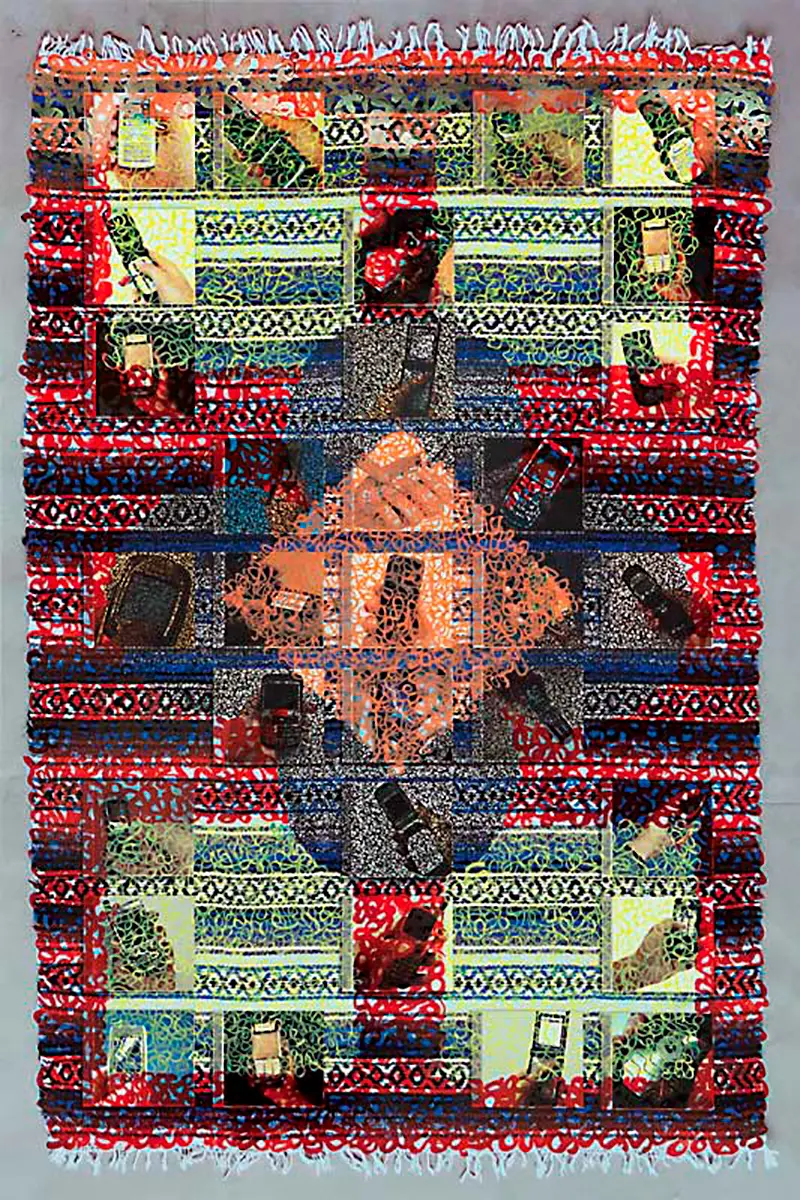
Lobo has always rejected being represented by a gallery. Still, the Charest-Weinberg Gallery in Miami presented an exhibition of his most recent works entitled Limestoned. It included works of a porous quality that appeared to be absorbent and impregnated with a network of superimposed cultural experiences in the process of disintegration. The series Ethnographic Sound Blanket had a specific origin that enriches the possible readings of the manner in which the collages of contemporary commercial and computer-driven exchanges are represented.
In Brazil, Lobo observed the way street vendors on Sunday use the fences that surround the banks as shelves to store and display goods like bootlegged CDs and cellphones. Lobo transformed the practice of informal trade by placing images of cellphones on blankets. He photographed them and then intervened in the digitized image of that installation with ink, in order to caricature the design of the original blanket by adding undulating interconnected lines that made the exchange of sound information visible. This endeavor of constructing images over the traces of other images is a palimpsest that, according to Lobo, is visually reminiscent of an image of a "geological stratum," and one that also conveys the ancient reference to the loom; an instrument that allowed illiterate cultures to create referential iconographies of their worlds—from these stemmed the first informational processes. The resulting images converge, not solely diachronic social practices, but also that unification in the circulation of sound data that involves all sectors—even if it occurs through unregulated appropriations.
Consisting of drawings inspired by the faces of celebrities like Kurt Cobain and Madonna, the Defaced Musician Caricature series addresses the connection between dominant music and the social system. The faces are not only unrecognizable but are also repeated with the purpose of achieving a type of animation, centered on a single scene in which fragments of the brushstrokes are missing. More than simply disfigured versions of the originals, the final images are subjected to multiplication and dispersion that results in a visual equivalent of the echo of the masses in relation to the musical communicative phenomena and its reduplication in time. Very evident in the drawings filled with flesh color, the biomorphic perseveres in an attempt to represent sound as codices of social organization.
In agreement with a way of visualizing forms of organization that defy dominant structures, Lobo decided to install some smaller works from this series in the interior and exterior of his piece entitled Heavy Metal Donut; a circle created with felt, lard, and small black stones that alludes to a free collective telephone service: The American Donut Free; namely, an anonymous group that gathers people in a virtual place where they all can "eat the same donut," in an action that supposes the opening or crack of the commodified total system. To a certain extent, it represents the opposite of the 1800 numbers that codify a type of relationship ruled by codices of pre-established options circumscribed in the false ¿nonprofit¿ nature of a commercial structure. In the piece entitled Straightened Record, Lobo cut the shape of numeric symbols from the surface of metal sheets used in mobile publicity. Here, he referenced the prerecorded system integrated to the market of clients who passively select alternatives from among various audio tracks.
In the sculpture entitled Screwed up Alvin and The Chipmunks, Lobo alludes to the cartoonish musical trio that Ross Bagdasarian created¿under the pseudonym of David Seville. He manipulated the recording speed of his own voice to obtain the three tones of the anthropomorphized characters—squirrels—named after the production executives of the original record: Alvin (Bennet), the leader; Simon (Waronker), the intellectual; and Theodore (Keep), the sensible one. In addition to the fact that the altered voices were complemented by the visual animated representations of the characters, there is also the appropriation of Bagdasarian's invention by Robert Earl Davis (DJ Screw), who in his bedroom began playing with the speed of the recordings, making these slower so that "the amalgam of themes by the chipmunks, standard pop and soul, intervened again through a change in speed, could fit the drug-induced mental drowsiness of his listeners." In his sculpture, Lobo offers clues to the synesthetic game associated with that cultural phenomena by showing three limestones that resemble the chipmunks and by soaking these in the grape-flavored cough syrup used by Screw's fans to get "stoned." The calcareous "faces" are placed on an arch created with Formica, a material normally used in interior decoration. The documentation triangle—namely, superimposed practices, the disfiguration of original referents, and the exploration of the sound market as a social force that permeates everyday life¿is as present in Lobo's sculpture as it is in his Ethnographic Sound Blanket series. Although in these works the images are so well understood that the information is destroyed. They nevertheless share the same attribute of the rest of Lobo's pieces: they too deal with the representational forms of the impossible and map the ruptures of the global structure from the peripheral spaces of culture.
ADRIANA HERRERA