
Octavio Arosemena's work has followed a progressive, meditative, and rising path. About ten years ago, he began to explore the possibilities of self-expression through painting, specifically with watercolors on paper. He did this on his own and as a self-taught artist, discovering the magic and the potential of water-based colors, which he combined in compositions that revealed a most personal sensibility and an innate sense of order.
His most recent solo exhibition titled Spirals reveals how this artist has successfully transferred the effects he achieved within his watercolors on paper, and later on "clayboard" panels (whiteboard with a clay, gesso-like primer), into the medium of acrylics on canvas. In these new paintings, his compositions are still made up of repetitive forms but are bolder and brighter in color than those of the past. Horizontal and vertical patterns have given way to the dominant forms of spirals or curves in larger formats. Usually, the coils are born from a dark center and expand outwards towards ever-increasing clarity. Sometimes, the circles open up, becoming large curved forms, like waves that spread and multiply, one over the other. The large spirals meet and overlap, are invaded, or yield their space to other forms—at times triangular or rectangular, curved or straight—thereby creating interesting visual dynamics. At first glance, the series could easily be interpreted as an exhibition of abstract works of flowing soft colors in structures based on essential geometric shapes.
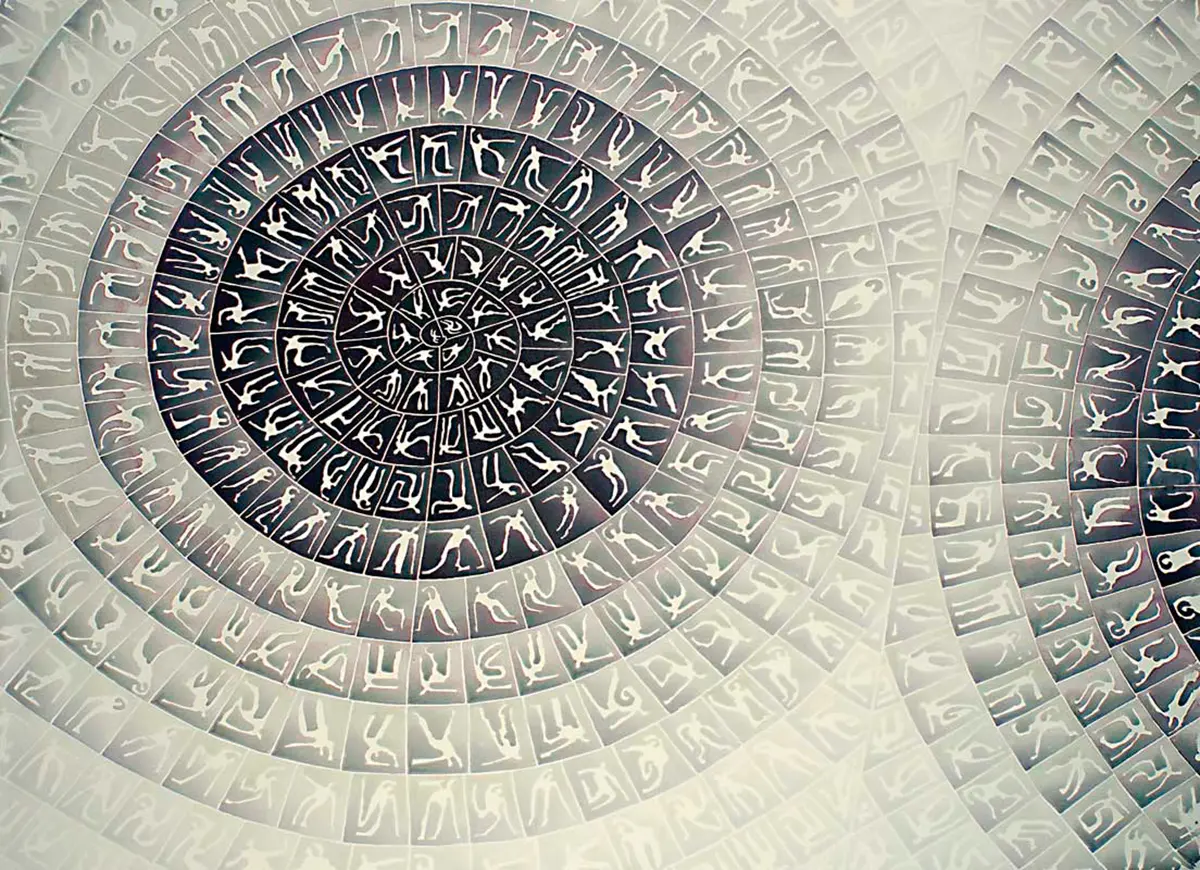
Upon closer inspection, we notice how, within these curvilinear mazes, there are endless numbers of rectangular cells, each of which contains a small and lonely human figure. Although they have heads and limbs, the shapes of these mini-men are almost abstract graphics, to such an extent that they become human "signs". They are dynamic, with forms and extensions that move in different directions, like the wings of birds or the tentacles of medusas in the ocean. They appear to be standing, on their heads, flipping over, with open arms, and with legs that are extended or even contorted. They give the impression of being controlled by a movement greater than their own strength as if carried by currents of air or water, over which these men have no control.
The titles reveal an interesting relationship with the concept of time, the passing of months, or life's relentless continuity. Arosemena describes the works with names such as spirals "of March" or "of June". In other cases, the titles seem inspired by colors and feelings, as in the spirals "of summer" or the "loving spirals." Nevertheless, these beings that exist in close proximity are always alone within their own small spaces. The flow of the structures that contain them is made up of separate elements, which together create a sense of harmony.
It is tempting, perhaps inevitable, to associate the shape of these works with music. Before becoming a painter, and even now, Octavio Arosemena has been a great lover of classical music, a topic about which he even directed a radio program for years. His works arouse associations with rhythm, sensuousness, and melody. His colors are usually gentle and pleasing, starting from a more intense hue and becoming gradually lighter, although, in his new works, we perceive a search for more dramatic contrasts. These are necessary experiments and questions in the creative process, for which the artist has not yet found all the answers.
Although most of Arosemena's works render an initially peaceful impression, closer inspection brings to mind possible meanings for these tiny beings locked in their own worlds, like small jails. The flaccid limbs imply a total submission to the forces driving the spirals in which they are trapped, perhaps willingly, but without recourse. One recalls that in the past Arosemena has painted flowers, but also war missiles; letters in lyrical sequences, but also illegible documents; as well as the shapes of persons but also of ghosts. The artist seduces the viewer with his delicate strokes, colors, transparencies, and almost liquid environments, but there is something to be considered beyond the outward appearance when smooth curves are used to describe missiles, flowers are lonely, and disconnected human beings inhabit endless spirals.
Arosemena produces structures that are crisp, clean, and almost obsessive, which are the products of long hours of detailed work. One can imagine the very process of their creation: the hypnotic reproduction of forms and the kind of peace a person finds in performing simple, repetitive operations. Using a deceptively simple language, the artist delivers real acts of catharsis.
MONICA E. KUPFER