
The paintings, boxes, and reliefs by Pablo De Monte combine various historical sources to form a personal language that undoubtedly contributed to diversifying the vast artistic field of Argentina of the 1990s. Awarded in 1995 by the Fundación Telefónica, De Monte received grants from the Fondo Nacional de las Artes (Nacional Fund for the Arts, 1991) and the Fundación Joan Miró (1993).
While De Monte does draw from the art of the past, he does not resort to the pictorial euphoria that characterized the 1980s. Through the use of the drawing line and flat colors, he is able to distance himself from the objects rendered and rid it of emotional subtleties, unrepeatable traces, and exacerbated gestures.
New in his most recent works are, not solely the references to historical artists—from Piero Della Francesca to Fernand Leger, Oskar Schlemmer, and Allan D'Arcangello—but also the appropriation of works by street painters that he uses as the material foundation for his proposals. The "non-original" origin—in that it was created by others—is of little importance when it comes to establishing the authorship. In the end, it is the combinatorial act—knowing how to merge his original mark with the marks of others, and the concept that articulates such diversity—the determinant factor behind the creative idea and the author's proposal.
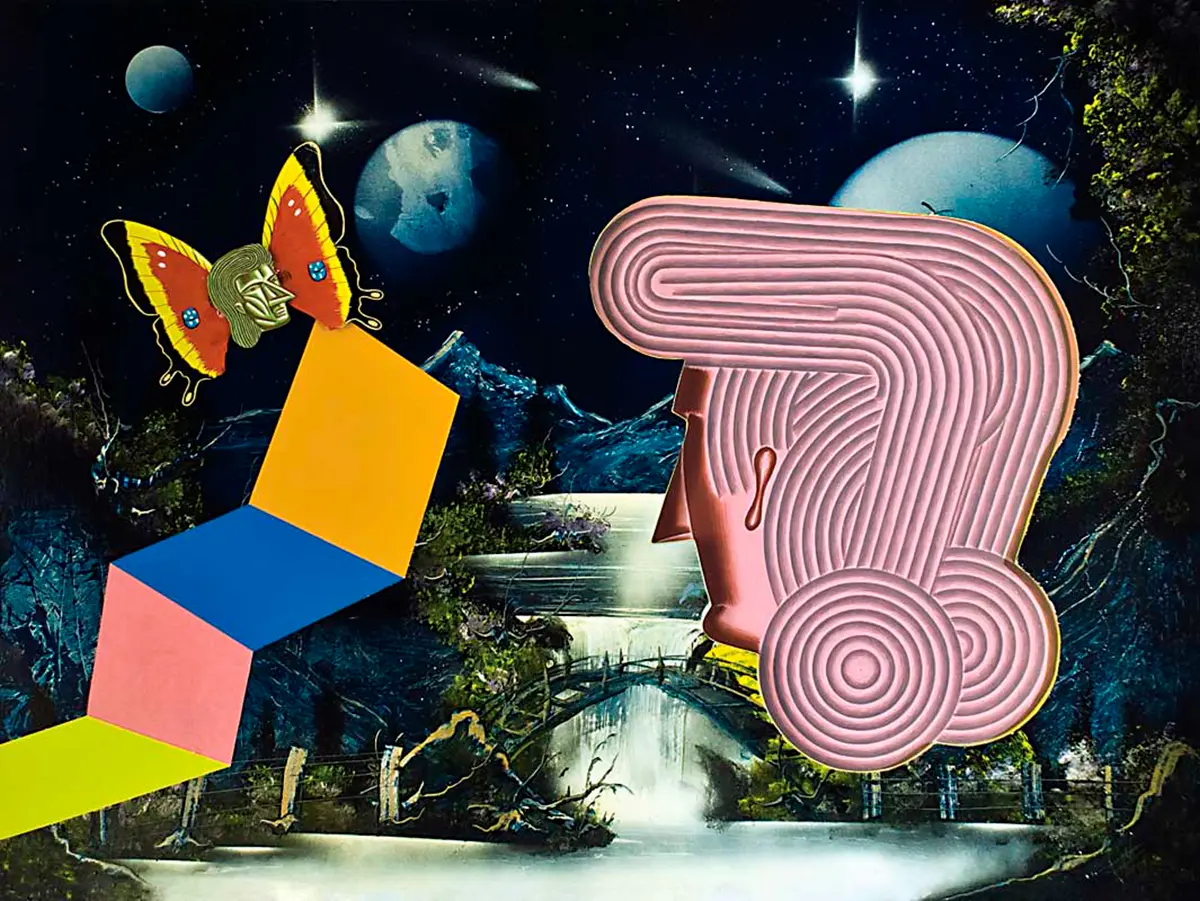
Another strategy used in his most recent works is the inclusion of actual movement. It is a resort that De Monte already applied in 1995, during the groundbreaking exhibition titled A, E, I, O, U at the Centro Cultural Recoleta.
¿Te Acuerdas de Aquella Tarde en los Everglades de Miami? (Do you Remember that Evening in the Everglades in Miami? (2010) and ¿Qué Cosa Está Detrás de la Imagen? (What is that Behind the Image?, 2010), are works activated by mechanical movements that contrast with hieratic physiognomies reminiscent of the famous portraits of Bautista Sforza and Federico de Montelfeltro by Piero Della Francesca. Leger's and Schlemmer's mechanistic schematism resonates in the human figures outlined over hyperrealist backgrounds designed by unknown painters. Contrasting the sobriety of the flat colors—with which a great part of De Monte's scenery is constructed—these backgrounds boast a cosmic-romantic tone that borders on the kitsch; a situation that is repeated in La Cosa es Vista en Júpiter (The Thing is Seen in Jupiter, 2010).
The mirror effect—the questionable reality of what is being perceived—is one element that all De Monte's works have in common. From the first gaze, one begins to question the laws—real or virtual—that govern a visual universe full of uncertainties. Everything oscillates between the purely visionary and the real that is a reflection of the known. We have barely identified a figurative space when an abstract variant barges in. It is an ambiguous space inhabited by fragmented figures—contorted in impossible positions—that oscillate between the representation of something living and the allusion of a static sculpture planted in the space. Thus, the imagined movement suddenly turns into frozen stillness and the vision of the supposedly real becomes, almost imperceptibly, pure illusion.
There is no shortage of optical kinetic resources in De Monte's most recent artistic production; like the reversible perspectives of figures simulating screens or the vibrant "curls" on the characters' heads. These are elements that are obsessively repeated, as are the cones, ribbons, and color discs. They are predominantly metaphysical environments—suspended in time—that are reminiscent of the silent landscapes by José De Monte—the artist's father—the ratified atmospheres by Magritte, and the secrecy of the scenes by De Chirico.
The Sartrean "nothingness" or "that which appears"—according to the etymology of the term— is the "phenomenon." It is intangible to the gaze as it becomes present. It is not coincidental that De Monte is an avid reader of authors such as Sartre, Merleau-Ponty, and Lacan. His works contain a suspended narration, a story that is never unveiled, unlike the nude figures that are indeed unveiled in the sense of "having their veils removed." According to curator Marcelo Pacheco, "His men and women are provocative, but not because of their nudity, not because of their bodies, but because of the possible story they are experiencing, as they are always longing, always in the middle of an obvious but suspended action."
In summary, the work by De Monte captures the gaze of the observer who sees the image as an observed and vulnerable figure—as if it were the reflection of the viewer's own body. Something that is very curious is the imposing sharp strokes that cut through the faces of the characters; faces that are not peacefully beautiful, but rather ones that can be described as having a sharp beauty more closely associated with wounds, crevices, and splitting. Theirs is an ambiguous but seducing beauty that defies our understanding and reveals an attraction to the abyss, to the power images have to shape the world.
ELENA OLIVERAS