
The study of the phenomenon of the domestication of mankind—in terms of the manner in which it is connected, globalized, and consumed—constitutes one of the timely motivations behind the exhibition titled Domesticated Homosapiens in Traditional Costume Circa Twenty-First Century by Ricardo Estanislao Zulueta. The show addresses the causes and effects, social arrangements, breakdowns, organizations, and proportions of such phenomena. In Zulueta's work, domestication implies a process of taming the individual, a suction, a calamitous transformation of a person's living circumstances that subtly make him/her function according to a specific way of thinking and/or behaving—predetermined by consumerism—and that incites individuals to accumulate material and immaterial goods of an assigned commercial or formative value. It represents capitulating to advertising, arbitrary categorizations, and to the misapplied use of technology, elements that appeal to the vulnerable nature of our emotions that excuse us from our need to confront, reject, or avoid the uncertain—and perhaps commercial—nature of cultural strategies.
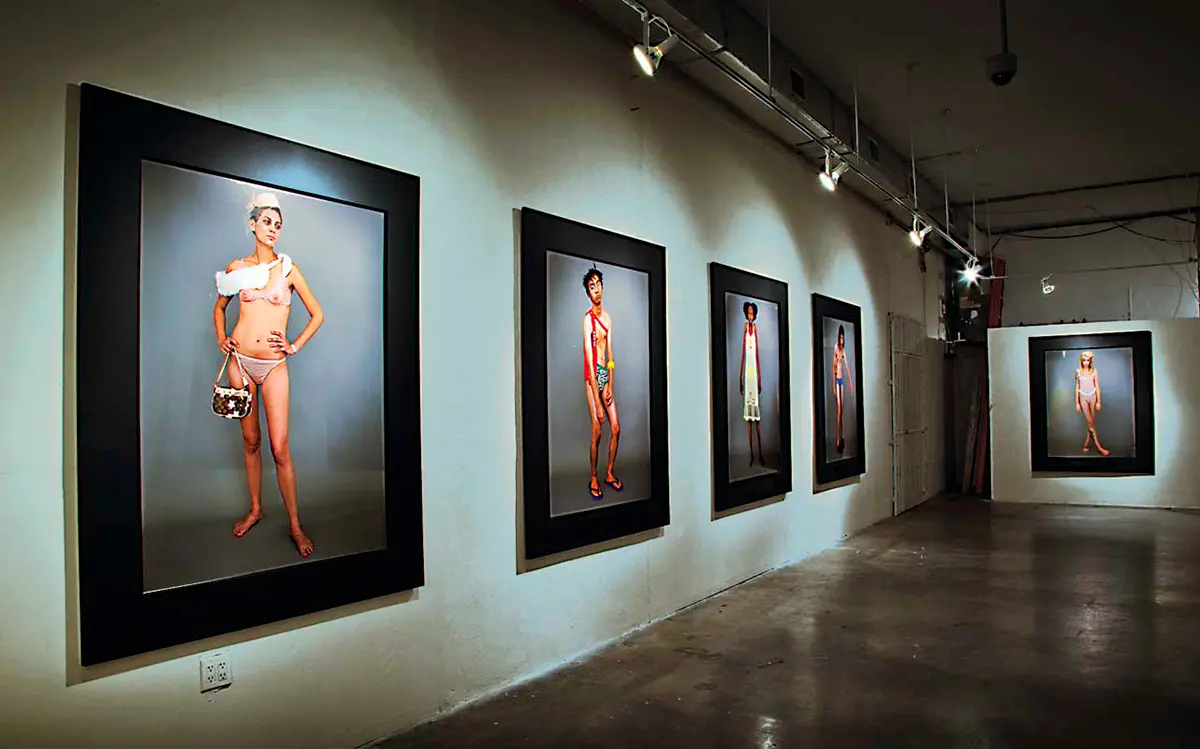
Zuleta photographs characters found in a variety of urban settings. These are men and women whose social status is not immediately revealed to us at first glance, as this blends into a set of tangential expressions and gestures that appear to be making fun of the systemic pattern that absorbs them. The artist selects costumes and the basic gesticulations that function as elements of domestication, as well as of incentive, to awaken the "artistic" capacity of the subjects photographed. The latter adopted a large number of poses that involve the use of suggestive facial and corporal masks that serve to liberate them, in a creative way, from the clutches of subordination and classification. Zulueta dissolves the usual ethnographic paradigms in search of a less rigid model of organization and categorization that enables individuals from different socio-cultural backgrounds—individuals exposed to constant segregation and gentrification procedures, art students, doctors in philosophy, among other social agents—to be grouped together, individuals who consciously or unconsciously could form part of this group of people molded, softened, by the technological avalanche and the stamp of consumerism.
From the cushioned body that has been subjected to rigorous corrective training—imperceptibly limiting its purpose to that of a public vessel for promotion, distribution, and marketing—emerges valuable subjective matter that enables the organism to be reborn, to adapt, or to react in unpredictable ways. The oppressed subject opts to employ punitive techniques because these encourage the creation of anemic spaces to distract and entertain him, as well as to offer temporary joy. Contrary to what was expected, the photographic study transforms into two, a form of recreation, not solely for the artists, who play his role of the orchestra director, but also for the trained individuals and additionally, of course, for the public eye that is also unable to resist domestication. If we observe the photographs carefully, we realize that neither the skimpy outfits nor the confectioned accessories created by trendy designers, are able to dominate the represented environments on their own. Instead, these appear to be at the service of the subjects portrayed: asymmetric bodies that appear to shrug, this making them become smaller, as they expand into other dimensions.
Zulueta presents one life-size photograph of each character that hangs on the wall and a video projection that includes the entire sequence of images captured during the training session, while lively electronic music accompanies the presentation. The performative, theatrical, and the harmonized environment is accentuated behind the scenes, in a small area of the gallery. While it is true that the anthropologic model proposed by the artist invites us to reflect upon the variable, intermittent, and intrinsic qualities of the acts of categorization, it is also true that such a model also operates as a mechanism that seduces, amasses, and domesticates perceptions and sensibilities, one that establishes formulations and other analytical details, as if these were vertebrae from our dorsal spine. Nevertheless, it is important to clarify that Zulueta's work has no direct connection to chiropractic art. The artist prefers to rely on other cognitive techniques to infiltrate into various human groups—if these can be termed thus—and into multiple fields of knowledge, as he dodges obstacles, oppositions, and masquerades.
Who domesticates? what is domesticated? Is it Zulueta, the public, or the obediently adapted, assembled, fractured society? Such categorizations disappear or are, at least, dissimulated in his work, so that Homo sapiens can (re)emerge in their purest form, as the legitimate carriers of knowledge and producers of social interactions. Thus, domestication becomes a rehabilitation or restoration strategy of the psychic, internal, substance, of the executioner who refuses to be tamed, despite the fragility or vulnerability of the corporeal, the fissures generated by the pressure to consume. The artist aligns the object of study and redistributes the central basis of the individual through a precise and well-reflected-upon list of persuasive (oratories), theoretical, and digital maneuvers. Zulueta's objective is to construct a very effective sensorial structure in which art exerts a disciplinary function in order to influence the subject in a positive manner, given it allows him/her to have fun in front of the photographic camera, to intervene, to modify, and to domesticate his/her faculties.
DINORAH PÉREZ-REMENTERIA