
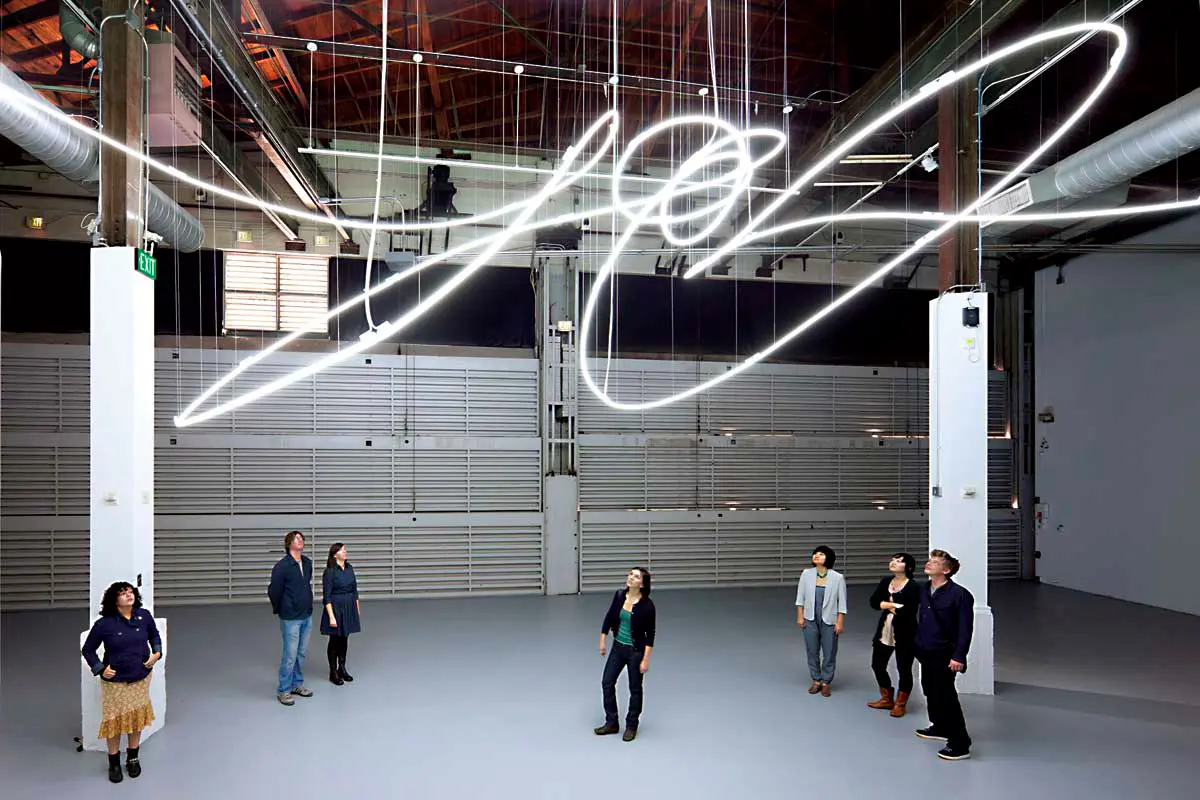
Curated by Alma Ruiz, the exhibition presents five large-scale installations by emblematic artists Carlos Cruz-Diez (Venezuela, b. 1923), Lucio Fontana (Argentina/Italy, 1899-1968), Julio Le Parc (Argentina, b. 1928), Hélio Oiticica (Brazil, 1937-1980), and Jesús Rafael Soto (Venezuela, 1923-2005). Upon entering the exhibition, space is vibrantly "activated" (as Willoughby Sharp would describe Fontana's work) by Struttura al neon per la IX Triennale di Milano, 1951, which is one of Fontana's first experiments with neon installations after the notorious Spatial Environment in Black Light from 1949. A precursor of the use of light (after Laszlo Moholy-Nagy's first lumino-kinetic sculptures from the 1920s and 1930s, and contemporary to Gyula Košice's Madí luminous sculptures), Lucio Fontana saw this practice as "the beginning of a new expression." He was the first to use artificial light in closed spaces or "environments," and to implement the use of an element that he sought as close to "the man on the street" due to its commercial utilization for decoration and urban advertising.
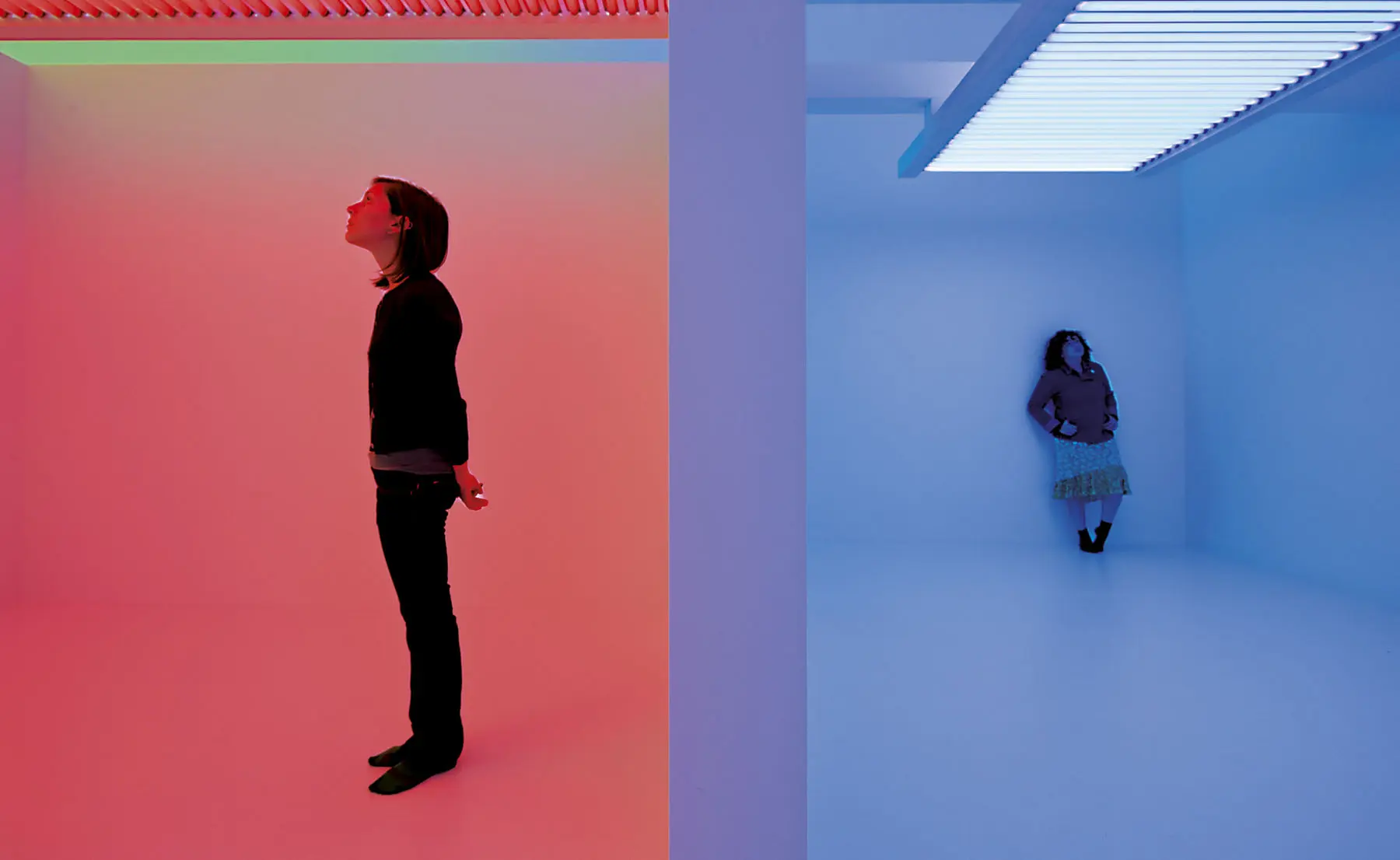
Struttura al neon consists of neon tubes in abstract undulating forms attached to the ceiling, which resembles a sketch or a doodle of the trajectory of light in space—light taking a physical form, evidence of a movement of light or a drawing made of this movement to capture it in present time. The sensory experience of this piece is both kinetic and luminous, as movement embodies the aims of modernity and light of the industrial era. Color as light (or vice versa) merges as a spatial experience in the next installation corresponding to Carlos Cruz-Diez's Cromosaturación (Chromosaturation), from 1965. Chromosaturation is a chamber where the viewer participates in a color-coded environment, divided into different sections with different colored walls and corresponding colored lights, so the spectator is induced in an optical and cognitive blending of light and color. This piece is an antecedent to his well-known Labyrinth for a Boulevard in Saint Germain, Paris, 1969, an interactive tunnel in a public space—outside the Odéon metro station—that would invite the passer-by to perceive and participate with color as visible inside and outside of the translucent colored-plastic structure of the piece, made "to affect the individual" who participates in this event. Carlos Cruz-Diez's interest and dedication towards color stem from graphic techniques from his origins as a graphic designer in the 1950s.
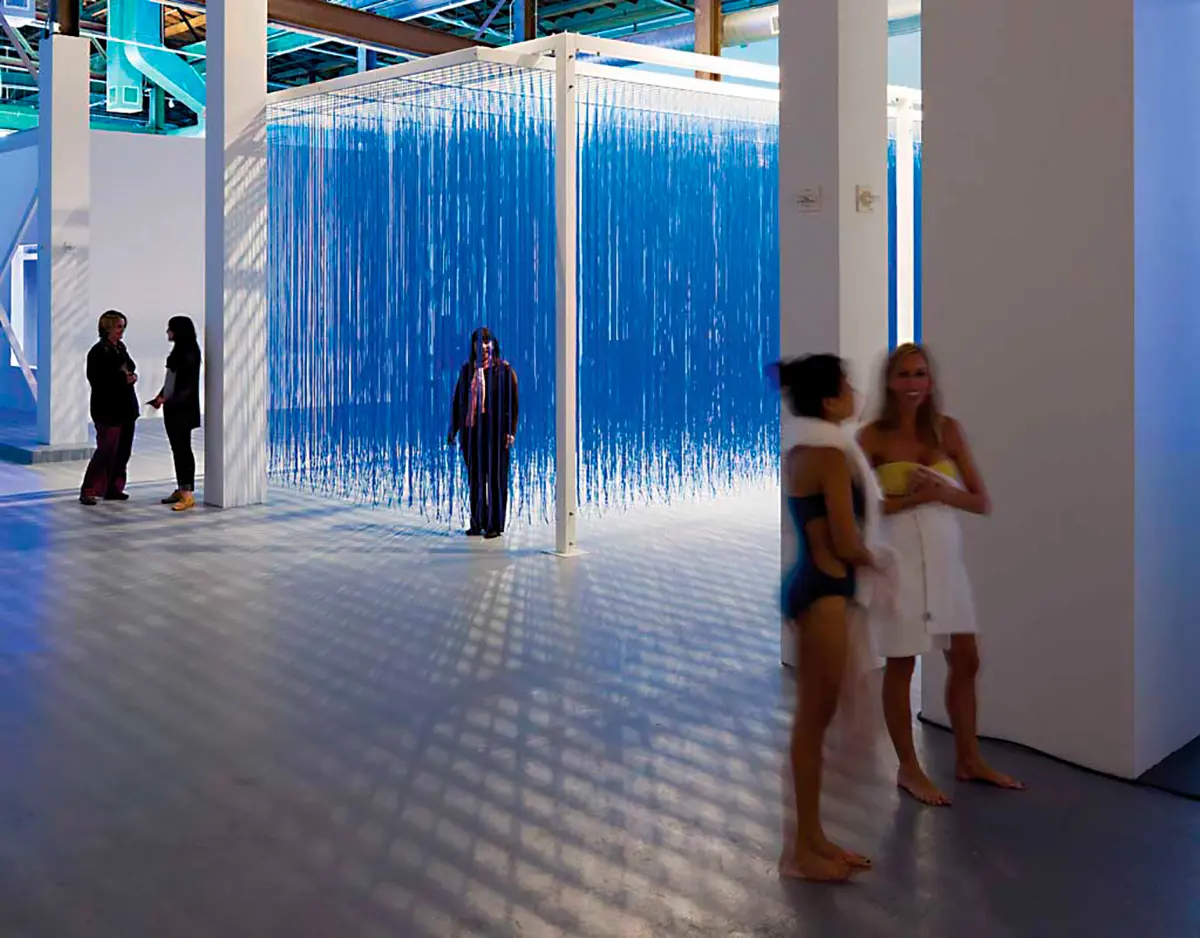
This particular installation, along with Cruz-Diez's friend and interlocutor Jesús Rafael Soto's interactive Penétrable BBL bleu, 1999, and Hélio Oiticica and Neville D'Almeida's chromatic pool, Cosmococa-Programa in Progress, CC4 Nocagions, 1973, seemed to be the favorite of the public, particularly children. My personal interaction with Soto's Penétrable, was heightened by encountering a little two-year-old girl that entered the piece from the opposite end as I did, and who was perhaps in the same state of jubilee that I was but expressed it more freely and effusively in an explosion of laughter that made me think of how limited and repressed adults can be while experiencing art that was or is meant to awaken our senses and minds. Soto's piece continues with the idea of interacting with color in a physical state, as the installation is a cube with cerulean blue nylon tubes that the spectator has to go through, touching and being touched by pure color—a primal (or) primitive experience of color.
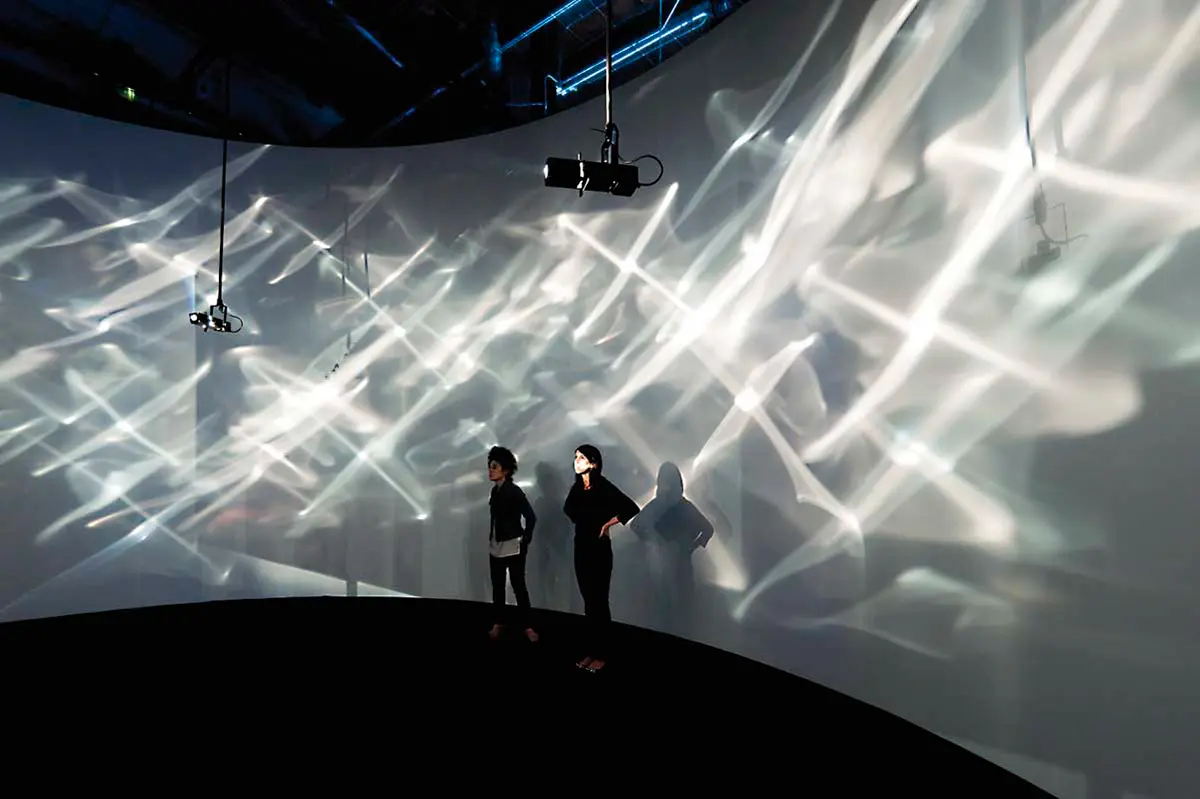
Behind Carlos Cruz-Diez's Cromosaturación, Julio Le Parc's Lumière en mouvement-installation, 1962, is found inside a dark semi-circular hallway where light is experienced as a beautiful spectacle of reflection and refraction. Le Parc, one of the main exponents of Op and kinetic art, bases his work in scientific principles to invite the spectator to participate in experimental and perception and movement-based experiences. This mobile, re-fabricated in 2010 for its installation at the Geffen, focuses on the "visual [experience] and omits the anecdotal"—Le Parc stated in an interview with Alma Ruiz on MOCA's website—as all of the works are representative of light and kinetic art, which did not aim to be narrative but experienced-based, and presented light, color, and movement as autonomous phenomena.
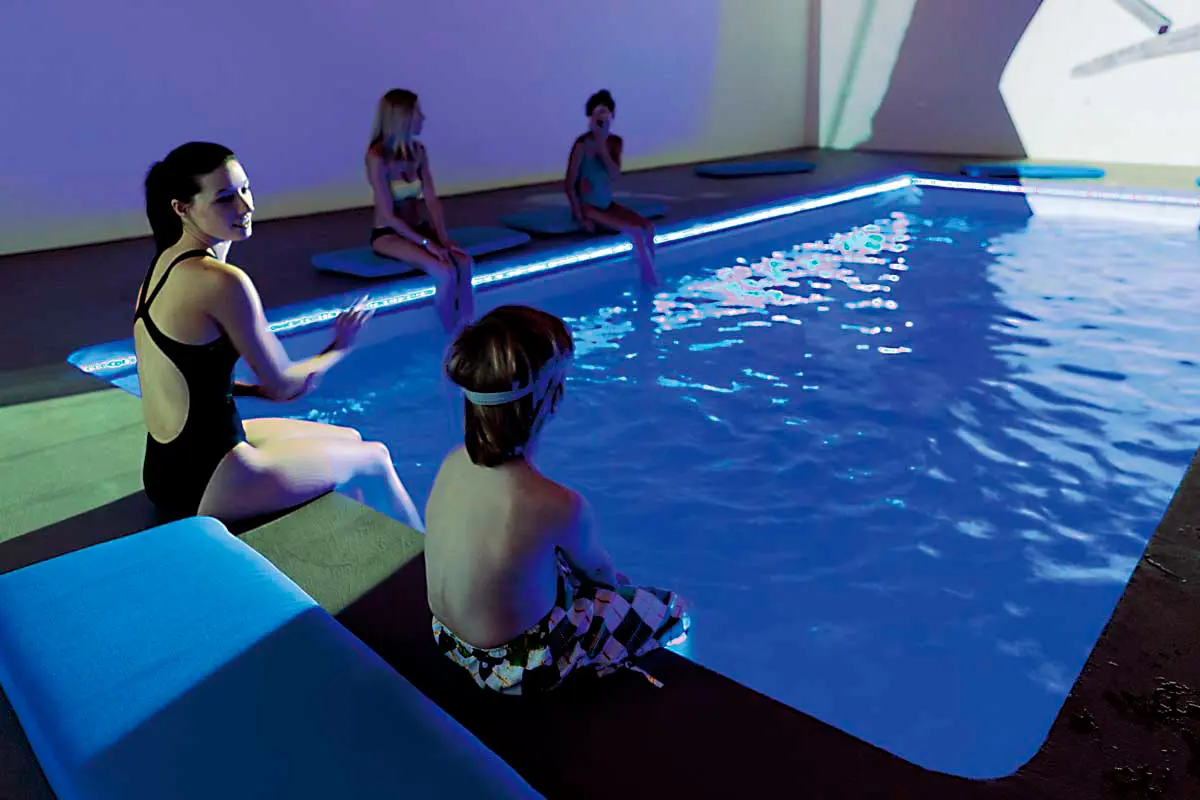
Lastly, the most successful installation in terms of public interactivity is Hélio Oiticica and Neville D'Almeida's re-fabricated pool with electric lights and projections, Cosmococa-Programa in Progress, CC4 Nocagions, 1973. The spectator is invited to bring their own bathing suits or purchase disposable ones at the entrance of the installation—adding an element of entertainment and accessibility that is not customary in museums where people are usually invited to not touch the artwork, and here the purpose of the works in the exhibition is exactly the opposite. Oiticica is mostly known for his own penetrables, which were unlike Soto's in the sense that his were "wearable" tents or objects that could be danced with. Oiticica's relationship with the sensorial was not "limited" to experiments with color and light, but also with space as a bodily experience, with the inclusion of music and dance. Brazilian filmmaker Neville D'Almeida collaborated with Oiticica in the 1960s and 1970s with works that precede conceptual video and installation art of the era, such as this pool accompanied by projected slides and sound on the walls, as well as color lights in the water.
The five installations seem and feel independent from each other or even disconnected, as they do not represent a specific period in time. They are like study cases for the thesis of the exhibition, and the viewer travels through them as different sensorial "stations" that are placed next to each other—not in any apparent order of theme or chronology, but so we can connect and understand their purpose based on our interactions with or in them. Artists such as Alejandro Otero and Gego (who were part of the avant-garde project in Venezuela along with Jesús Rafael Soto and Carlos Cruz-Diez), felt lacking from this selection of artists and works representing early experiments in light, color, space, and abstraction in Latin America, but the exhibition succeeds in presenting the viewer with the opportunity to live art as "the sensory knowledge of the immaterial," as Jesús Soto once stated.
Photos: Iwan Baan.
SELENE PRECIADO