
What questions do we pose for ourselves as we travel through an exhibition that, in a succinct way, is founded on the idea of covering the art scene of the first decade of the new millennium in Argentina, in the context of Germany's financial center, so far from Latin America?
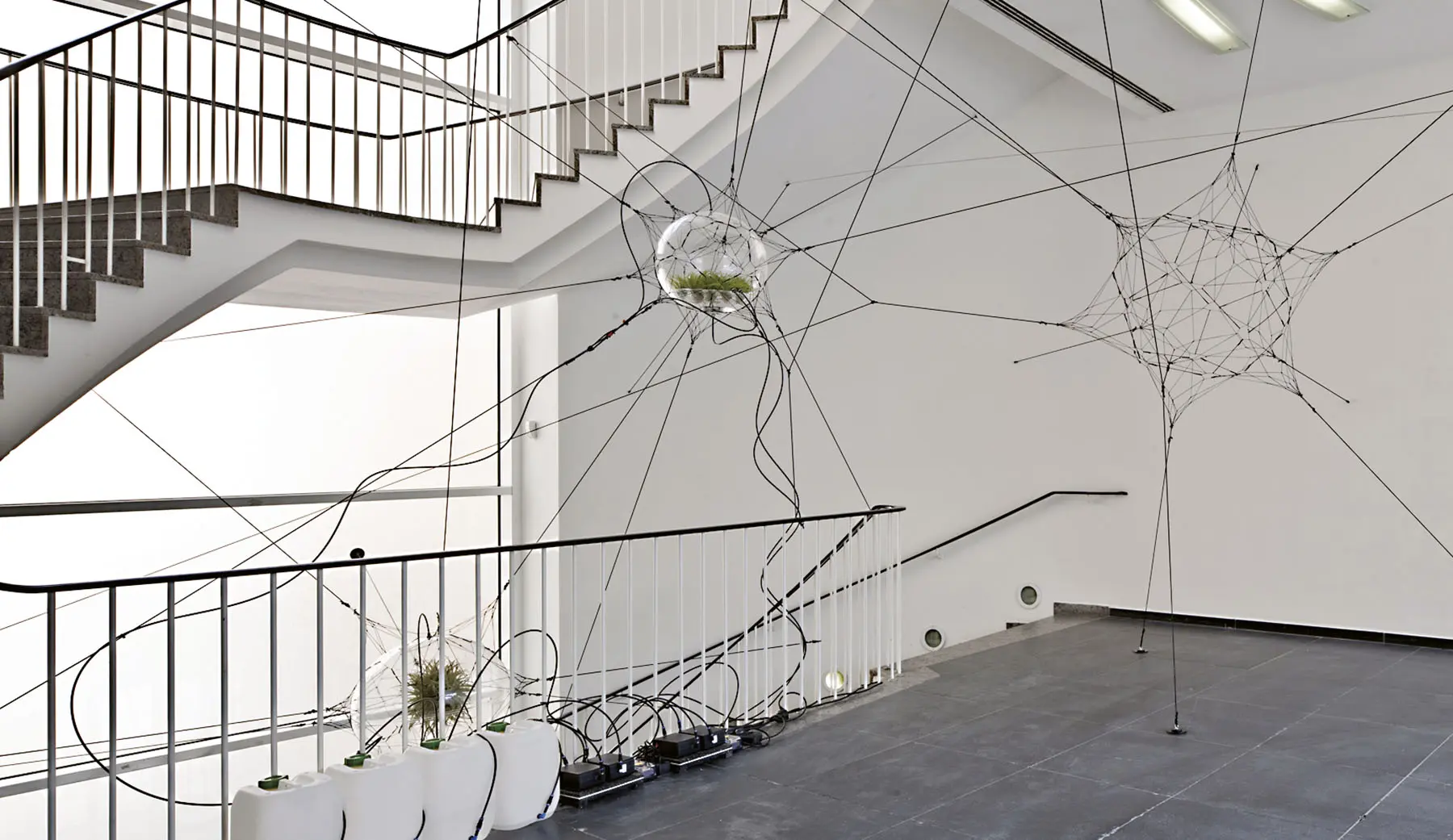
The answer is suggested by Biósferas, by Tomás Saraceno: acrylic spheres resembling soccer balls, suspended in space thanks to a network of threads interwoven in the vacuum of the staircase of the Kunstverein building. Inside them were planted, artificially supported by a "homemade" hydraulic system. Just like Argentina's art scene, sustained by a precarious institutional system and inserted in the artificial space of modernity, those plants, encased in the "architecture" of European tradition, held on to life almost like viruses.
Tales of Resistance and Change, organized by the coordinating committee of the Frankfurt Book Fair—where Argentina was the special guest—and the COFRA committee, was presented at the Kunstverein as part of the celebrations for the Latin American country's 200 years of political independence. In parallel, another large-scale exhibition at the Akademie der Kunste in Berlin attempted to cover the artistic production of those same 200 years with more than 100 artworks in three galleries. Reality and Utopia. Argentiniens künstlerischer Weg in die Gegenwart (Argentina's artistic course into the contemporary) 1 was represented by Daniel Ontiveros' emblematic SUR, an advertising image that could be seen all over the German capital. Expectations were heightened given the inclusion of many big-name Argentinean artists; yet, the selection of works did not match the anticipation, and the arrangement was dispersed and forced. Tales of Resistance and Change was better conceived and installed, focusing on the first decade of the current century from a decidedly political vantage point. Like a large portion of the international scene cooked in the traditional New York-London-Berlin axis, the exhibition abounded in media such as video, photography, drawing, installations, and collective works. There was, however, much to be said in terms of the subjects of these works and their potency as a proposal. Conceived from single authors or groups that emerged and continued to grow in the context or the social and political actions in which they found themselves immersed, they fostered the development of products that broke the confines of the art circuits. They offered solutions and activated responses within marginal sectors in Argentina in crisis.
Rodrigo Alonso, the show's experienced curator, starts with a concrete event that radically changed the positive-thinking, free-market Argentina of the 1990s: the economic disaster and financial meltdown of December 2001. From that starting point, the narratives proposed prioritized for their theses those artistic experiences resulting from the social, economic, and political processes and conditions thus experienced. "In the midst of this brutal and unstable scenario, some artists have devised tactics, projects, and metaphors of resistance and transformation. (...) As a result, there have emerged collaborative, communitarian, and socially interactive projects where artists and civic groups share experiences and productive capacities with the purpose of transforming certain aspects of their immediate reality." 2
Without losing sight of the fact that the history of Twentieth-Century Argentinean art has moved between the coordinates of European art—with the historical avant-garde—and the creation of a locally-defined movement that formed important scenes such as Rosario's and Buenos Aires in the 1950s and 60s, artists like Antonio Berni, Marta Minujín, Alberto Greco, Luis Felipe Noé, Rubén Santantonín, to mention just a few, attempted to break pre-established Twentieth-Century molds in order to access more vital experiences of art as it relates to life 3, a process that peaked with Tucumán Arde. 4 Conceptual practices—as manifested in several Latin American cities—changed the tautological meaning of the Anglo-American movement, assuming a role of ethical and political critique of existing institutions. 5
The Argentinean scene of the 1960s was key to understand this relationship between art and life, overtaken by artists' commitment with direct involvement in political activity. The idea was to act from the standpoint of operative strategies with an artistic object that transmitted ideological contents, even encompassing the mass media in order to reach receivers-active participants: "Unlike Pop Art, we intend to build a work of art 'inside' those media." 6 It is precisely those antecedents that we need to bear in mind to contextualize artists' responses to the political situation of systemic ungovernability after 2001, and to understand the resurgence of the Tucumán Arde tactics of "violent collective action," employed by the TPS.
The TPS (Taller Popular de Serigrafía) was a collective that emerged from the popular assemblies organized in Buenos Aires, based on an open silk-screening workshop in remembrance of the 1976 coup d'etat. The artists revisited the experience of printing directly on the street "no longer as a workshop, but as an artistic and political action." 7 How to visualize on a white wall inside a gallery the energy that motivated these artists to involve themselves so fully in the worker's struggle and the efforts of left-wing groups and movements, immersed in protest and under such pugnacious vibration. We can only see it as the aestheticized historical documents of Tucumán Arde and to admire their tremendous capacity for invention and for responding through images, posters, and printed typographies under the influence of current events, with a reemergence of the influence of constructivism but also of that kind of drawing that is so indebted to the Italian post-avant-garde and the German "Neuen Wilden" of the 1980s.
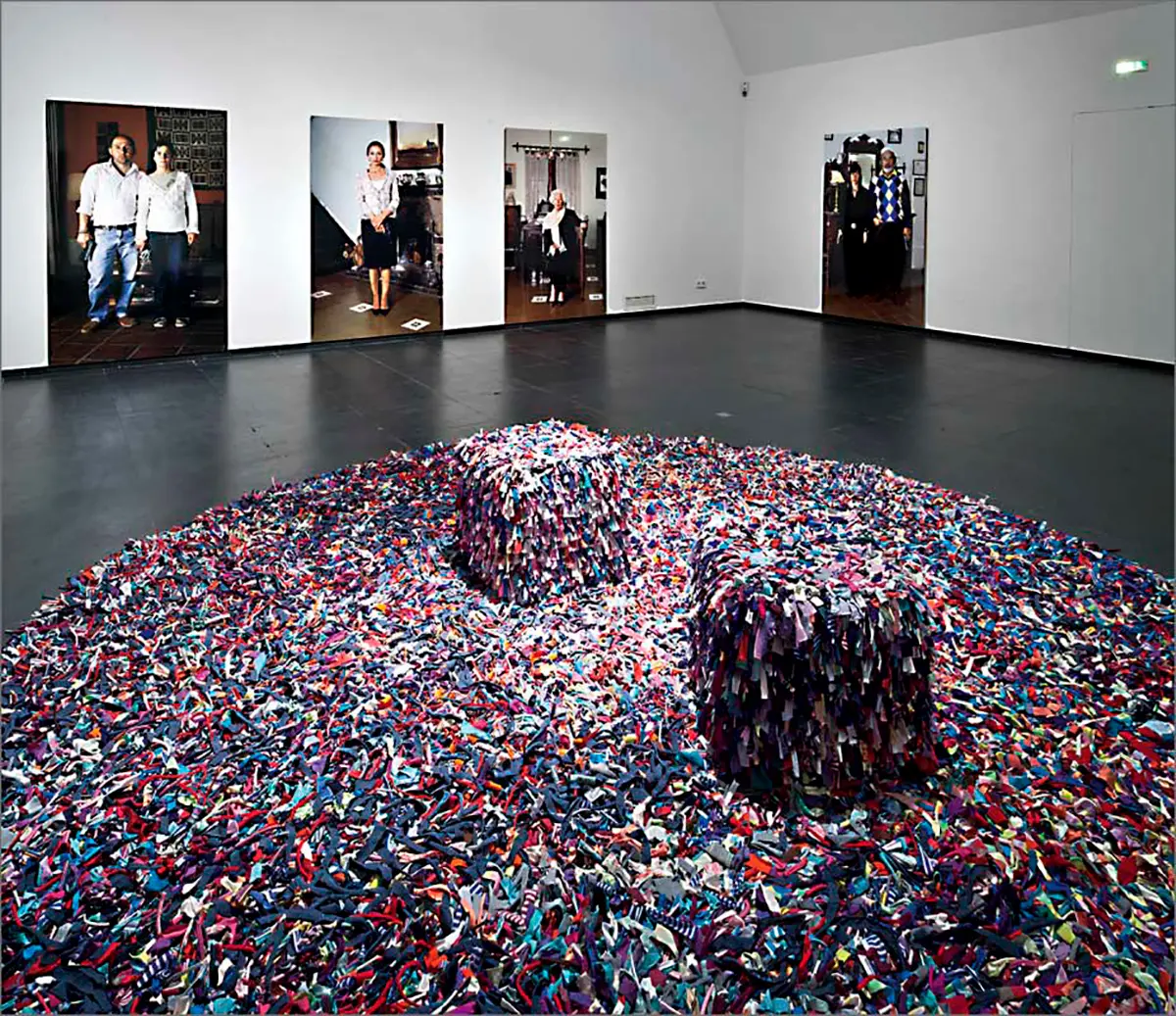
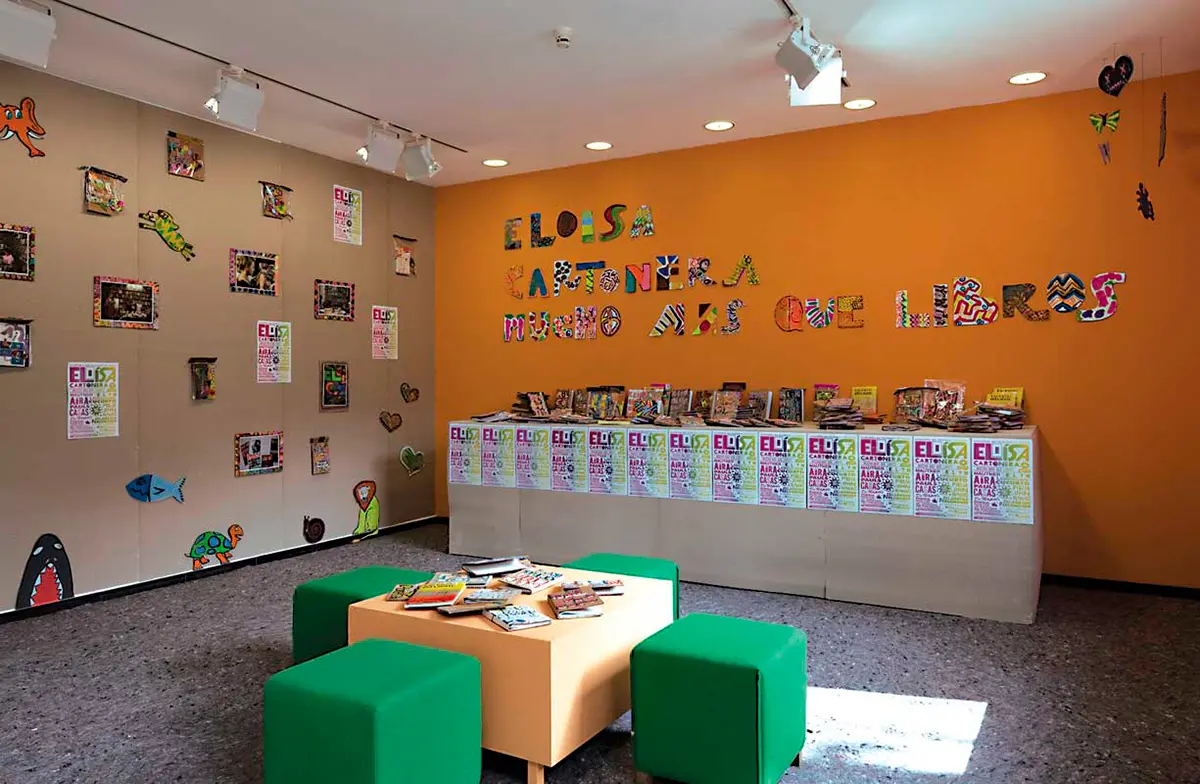
Eloísa Cartonera, a publishing collective that has gained recognition in biennials and bookstores across the world, was another response to the same context. Less directly involved in the politics of the moment yet as a consequence of the same circumstance, they started as an initiative to recycle cardboard boxes discarded by stores to be used in the production of hand-made books. For its part, Proyecto Nido was an initiative of designer Mariana Cortés to revitalize the Brazilian tradition of collecting discarded cloth patches that, once joined, formed other designs. The presence of artisanal objects in a contemporary art exhibition must be understood as part of the curatorial intention of tensing up those practices of construction of collective works and social devices in response to the historical juncture. In that sense, it is interesting to note the counterpoint provided by Mónica Millán's delicate, aestheticizing work. Since 2002, Millán visited an indigenous community in Paraguay that subsisted on the basis of the production of weavings and embroideries. Fully immersed in that world, Millán makes drawings, weavings, and installations that reproduce in other formats the community's ways. The narrative built with her threads and the shape of her tracings relaunch the cosmos of an appropriated culture to give it a voice of its own and to become part of that same consciousness. The same happens with Gabriel Baggio's installation: a collective kitchen that seems to hark back to the soup kitchens of Argentina in crisis. However, beyond being the performative action of cooking inside a museum, Learning Process (2010) is also part of Baggio's investigation of his family's own Jewish and Italian culinary traditions, a representation of the crucible of cultures that continue to mix today in a complex process of identity formation.
The traditional, isolated artist workshop has been definitively left behind, in the Twentieth Century, and is increasingly replaced by a kind of collective experience facilitated by mechanical means of reproduction. While previous experiences point directly towards the erasure of borders between individual and group spaces by practices and mechanisms of meaning, photography and video also demand, in some measure, the fulfillment of those relationships. Both media have changed, who can doubt it, the relationship between support, the object of interest, and the ulterior interaction of the public with the work of art. To this, we must add interest in other subjects and conditions of production of the work of art, and, in consequence, in the function of artistic creation.
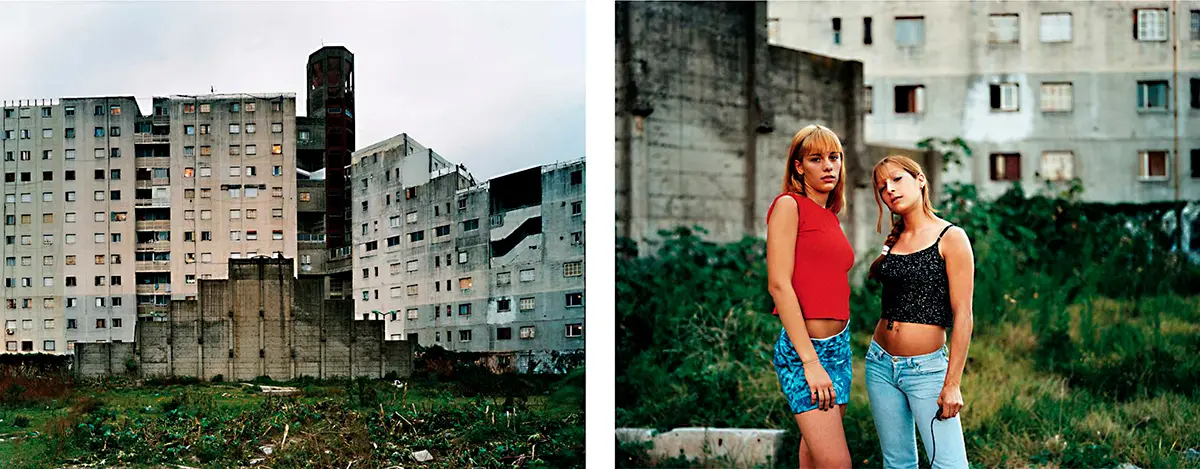
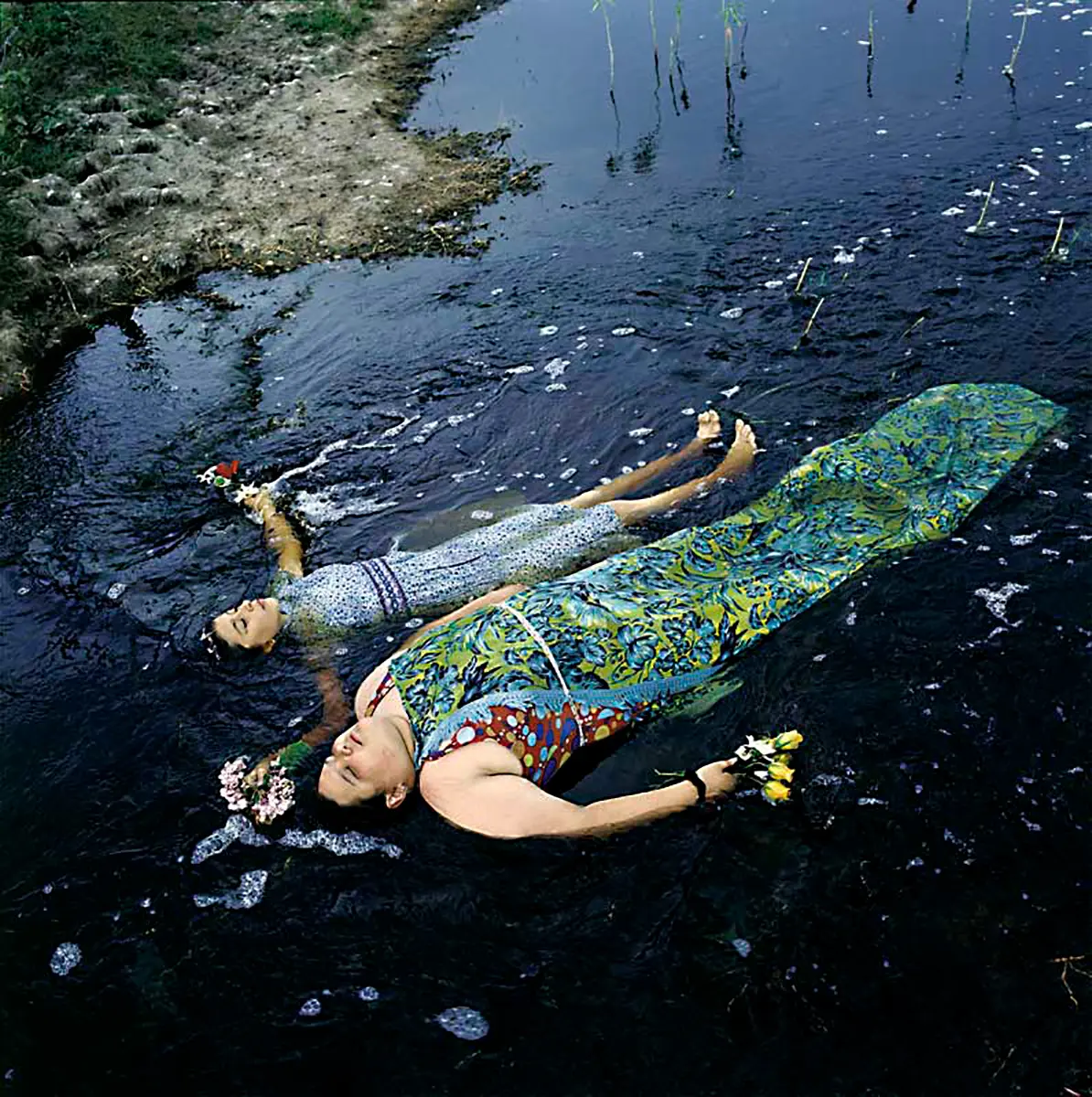
Thus, in series like Zona Sur, Barrio Piedrabuena (2001-2007), by Gian Paolo Minelli, in the industrial shanties of Buenos Aires, it is the young that interpellate us with their gaze and with their power to represent themselves holding the camera in their hands, much like German photographer Nina Schmitz. In counterpoint, the gaze is that of middle-class men and women who pose in a state of permanent wakefulness and fear, behind the false security provided by firearms. Or Gabriela Golder's videos, which record repetitive body actions by domestics and homemakers as well as narratives by the unemployed, connecting the human body with the social body, marked by the gestures of the re-production of Capitalist economy. A unique case of a record of private life is the series Las aventuras de Guille y Belinda y el enigmático significado de sus sueños (1999-2007), by Alessandra Sanguinetti, which has followed over several years the shifts in the lives of two sisters from a rural area in Argentina. Although we find here echoes of Nicholas Nixon's The Brown Sisters, where the main characters were photographed every year since 1975, the sensitivity with which a world so seldom visited by contemporary art is illustrated here, reveals an approach from the standpoint of poetic narrative, and the almost staged, the almost film-sequence-like photograph is an approximation to a brutally harsh context for two girls who become adults.
Films and videos as resources for field research in the social arena, in the emergence of collective situations and in interaction with subjects that are contextualized in their "real" historical space, is what we find in the city presented by Florencia Levy in Sistema de Caminos: Buenos Aires (2009), or in the Patagonia of The Way Between Two Points (Terra Incognita) (2009), by Sebastián Díaz Morales. In the former, the protagonists of the multi-channel video installation are people who use the capital's public transportation system, and who through their micro-narratives generate anthropological cartography of the city and its inhabitants. In the latter, the characters are lost in the brutal landscape of Patagonia, with its bases for oil extraction and its oil-economy towns. Both respond to recognizable visual structures and languages from documentary and fiction genres, which is part of the operation of the artistic subject on the resources and methods at his or her disposal.
In this context of production, the autonomy of art is unthinkable. To refer to the field of aesthetic theory is to recur to a rather trite word in the description of projects conceived in Latin America and to once again fall into utopian thinking. In the collective imaginary of the Euro-centered subject, utopia has been left behind. Tales of Resistance and Change offers, without a doubt, a panoramic of the strategies and ways in which contemporary art has transformed its approach to new issues as a consequence of social problems and in consonance with its own context. Although world-oriented images are what is best known from Argentina, this exhibition makes an effort to contribute a more reflexive and self-critical vision of a country capable of interweaving its achievements and abysmal failures in the contemporary global context, proposing a convincing representation of its world.
NOTES
1. Realidad y utopía. 200 años de arte argentino. Una visión desde el presente was curated by Diana B. Wechsler.
2. "El arte de la protesta" TPS, Rodrigo Alonso, in Relatos de resistencia y cambio/Tales of Resistance and Change (Artists from Argentina). Buenos Aires, Ministerio de Relaciones Exteriores, Comercio Internacional and Culto and Frankfurter Kunstverein, 2010, p. 22.
3. "Manifiesto Dito del Arte Vivo", 1962, Alberto Greco, In Heterotopías (Medio Siglo sin lugar: 1918 - 1968), Museo Nacional Centro de Arte Reina Sofía, tf editores, p. 528.
4. "Tucumán Arde (Manifiesto)", 1968, Ma Teresa Gamulio, Nicolás Rosa. In Heterotopías, ibid., pp. 538-539.
5. "Tácticas para vivir de sentido: orígenes percursores del conceptualismo en América Latina." Mari Carmen Ramírez, Ibid., pp 373-382.
6. "Un arte de los medios de comunicación", 1966, Ediuardo Costa, Raúl Escari, Roberto Jacoby. In Heterotopías, Ibid., p. 531.
7. "El arte de la protesta" TPS, in Relatos de resistencia y cambio/Tales of Resistance and Change (Artists from Argentina). Buenos Aires, Ministerio de Relaciones Exteriores, Comercio Internacional and Culto and Frankfurter Kunstverein, 2010, p. 173.
DERMIS PÉREZ LEÓN