
One of the 2010s most representative art exhibitions was The Potosí Principle: How Can we Sing the Song of Our Lord in a Foreign Land? This show, first presented at the Haus der Kulturen der Welt in Berlin, then at the Museo Nacional de Arte Reina Sofía in Madrid, will also be seen at the Museo Nacional de Arte and the Museo Nacional de Etnografía y Folklore in La Paz, Bolivia. The show has the virtue of articulating a rather controversial thesis that has certainly started to generate a different view, not only of art but also of history and critical theory: modernity wasn't born in London, Paris, or Berlin, but in Potosí in the Sixteenth Century. Manuel Borja-Villel, director of the MNA Reina Sofía, puts it this way: "What would happen if we substituted Descartes' ego cogito with Hernan Cortes' ego conquiro, or Kant's principle of pure reason with what Marx called the principle of primitive accumulation? What would happen if, rather than starting the tale of modernity in Industrial Revolution England or in Louis Napoleon's France, we started it in Vice-Regal America?" Indeed, this question poses a different, more objective approach to grand historical narratives that have always been built from an exclusionary point of view, and open the door for "a bastardized perspective on history."
Potosí appeared on maps put out by Plantin's press in Antwerp as one of the pre-capitalist world's most important centers. In the Seventeenth Century, a century after its European discovery and conquest, this mining city was one of the world's most important sites, with a population greater than that of any European capital, among which only Paris and London could boast of significant demographic figures and urban extension.
Crowned by its "Cerro Rico" (rich mountain), Potosí was the equivalent of today's Abu Dhabi or some Chinese cities, sources of exploitation and wealth for the global capitalist world. Potosí's silver mines served during colonial times to sustain the Spanish crown, to pay its debt, and to finance wars across Europe. Mineral extraction in subhuman conditions, which continued well into the Twentieth Century, came accompanied by indoctrination through art on the hands of the counter-reformation Catholic Church. In that sense, Baroque art played a key role, and in fact, is one of the essential axes of this exhibition.
Principio Potosí has the virtue of collecting a historical perspective on the colonial Baroque and contemporary art. Artists Inés Doujak, María Galindo and the Mujeres Creando collective, Elvira Espejo, Luis Niño, Eduardo Molinari, Harun Faroki, Lucas Valdés, Rogelio López Cuenva, Anna Artaker, among ohers, create critical works offering a close look at the current context, marked by a globalized world where Capital generates new ways of rendering the world visible.
The exhibition presents the way in which the Baroque expressed a hybridization of forms and meanings where society is rendered "motley", to use the words of René Zavaleta (1935-1984); the curatorial project by Alice Creischmer, Max Jorge Hindered, and Andreas Siekmann was able to demonstrate that history can be revisited in a critical manner through contemporary art. The curators' gamble was to see whether it is "possible to establish a connection between the function of colonial painting and the function of today's art industry as the legitimation of the new elites of globalization." In that sense, the very idea of curatorship is reformulated, as it is not a question of bringing together a series of artists around a particular topic, but to allow for teamwork with them: "...curatorship is not a profession, but a way of exploring how artists can continue with their work under the current political conditions. Our curatorial process is participatory; we don't simply choose finished artworks for exhibition, but develop them alongside the artists." On the other hand, this exhibition could have fallen prey to the de-colonializing vision that characterizes the field of cultural studies. However, the curators were careful to maintain a distance with regards to such an identity-based position that end up negating any principle of hybridization and foster a kind of communitarian fundamentalism. "This made us assume, in the course of the project, a decidedly internationalist and anti-identity position, and this is why we gave greater weight to the contemporary, which is to say, to the presence of responsibility towards current historical and political processes."
The Potosí Principle: The World Upside Down, or, This Side Up
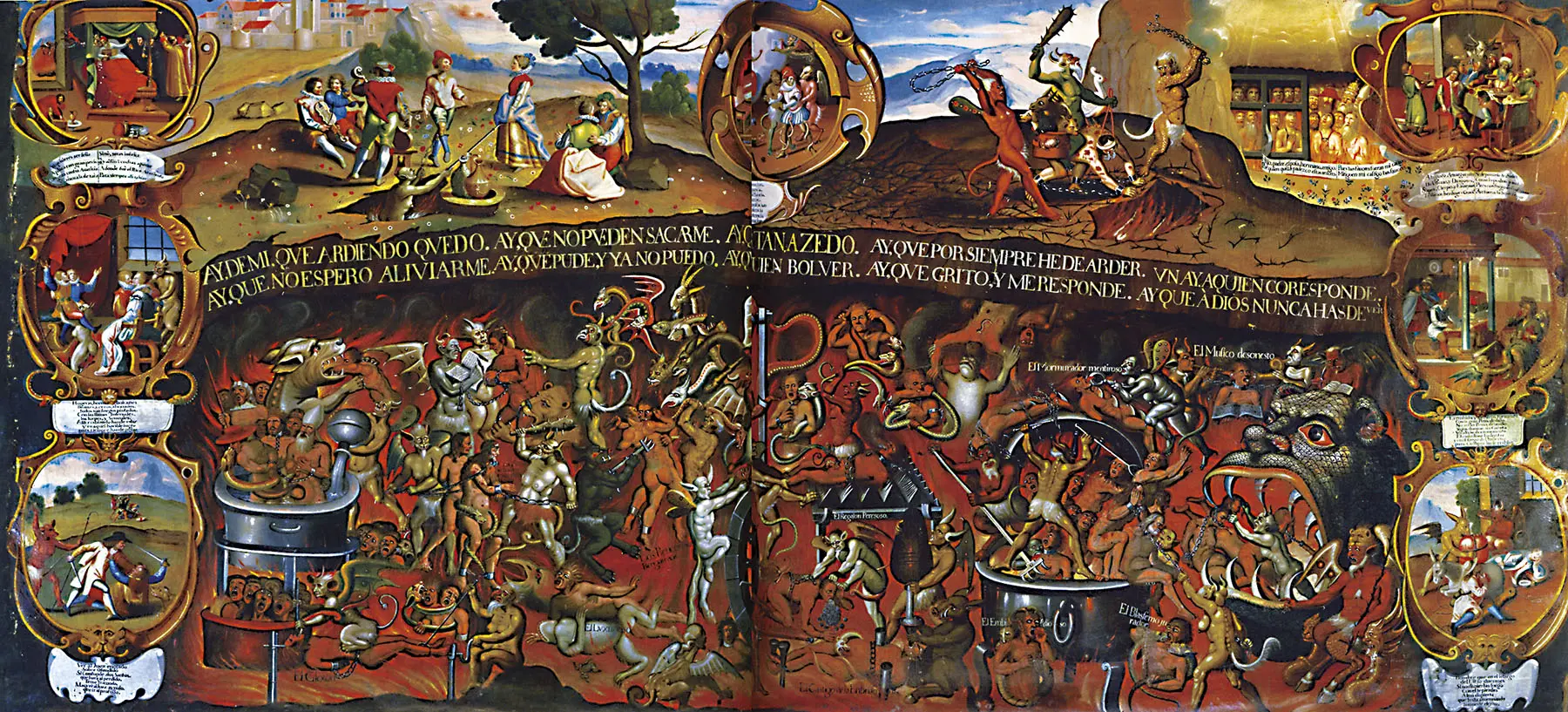
There is a constant in the Baroque images found in the exhibition: the representation of hell. Hell in opposition to the divine is found in the deepest recesses of the Earth. In this radical inversion, where the indigenous people's "mother earth" becomes the hell of the Christian imagination, a series of images inundate the imagination of the period. Does hell, filled with flames and demons and pots where souls are boiled, have any relationship with work in the copper mines? Indeed, forced Indian work in the mita (the colonial system of economic extraction) was comparable to hell as represented in those images. Confronted with this, the redemption of a heavenly paradise populated by angels and cherubs is presented as a palliative against the painful reality of mineworkers sentenced to death by their working conditions. A kind of economy, or economic system for the circulation of images, was founded on the space of the Counter-Reformation, the ideal sociopolitical and cultural stage for the consolidation of the colonial Baroque.
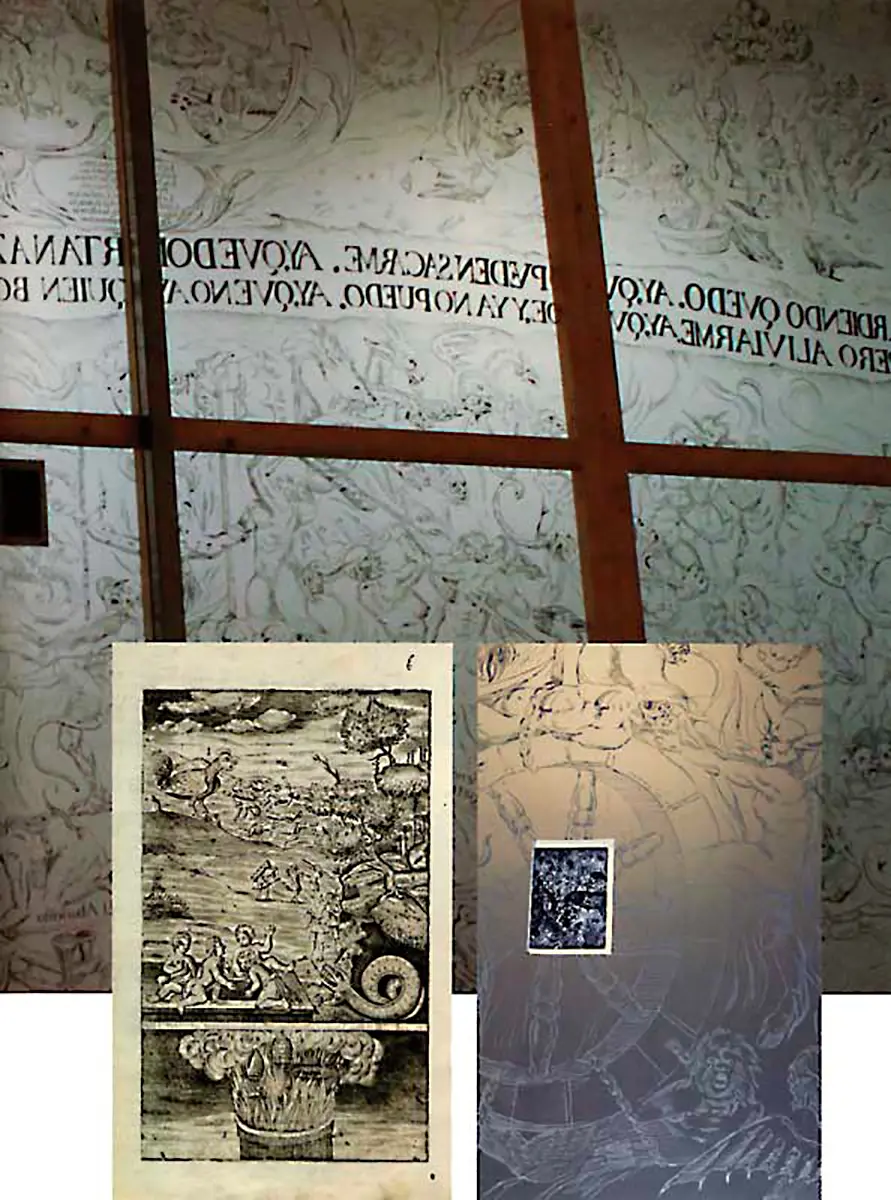
The show is in itself a Baroque gambit, profoundly variegated. We the viewers enter the gallery to find first of all a large painting on board that includes reproductions of Juan Eusebio Nieremberg's 1705 Punishment of the Senses, intended to emphasize the terror and fear of hell and death in Paraguay's Jesuit reductions. This compendium of images also circulated in colonial Peru, translated into Guarani: one individual, for example, is chained by his neck and hands to a large rock, his torso wounded by a spear and devoured by flames, his head nailed by an iron spike that penetrated him through the ear. According to the curators, these images are characteristic of the "shock" methods employed by the region's dictatorships during the Cold War. What is made evident here is that "terror and structural adjustment, the paralysis of resistance against social policies achieved through fear, are to this day part of the neo-liberal program," as the curators say.
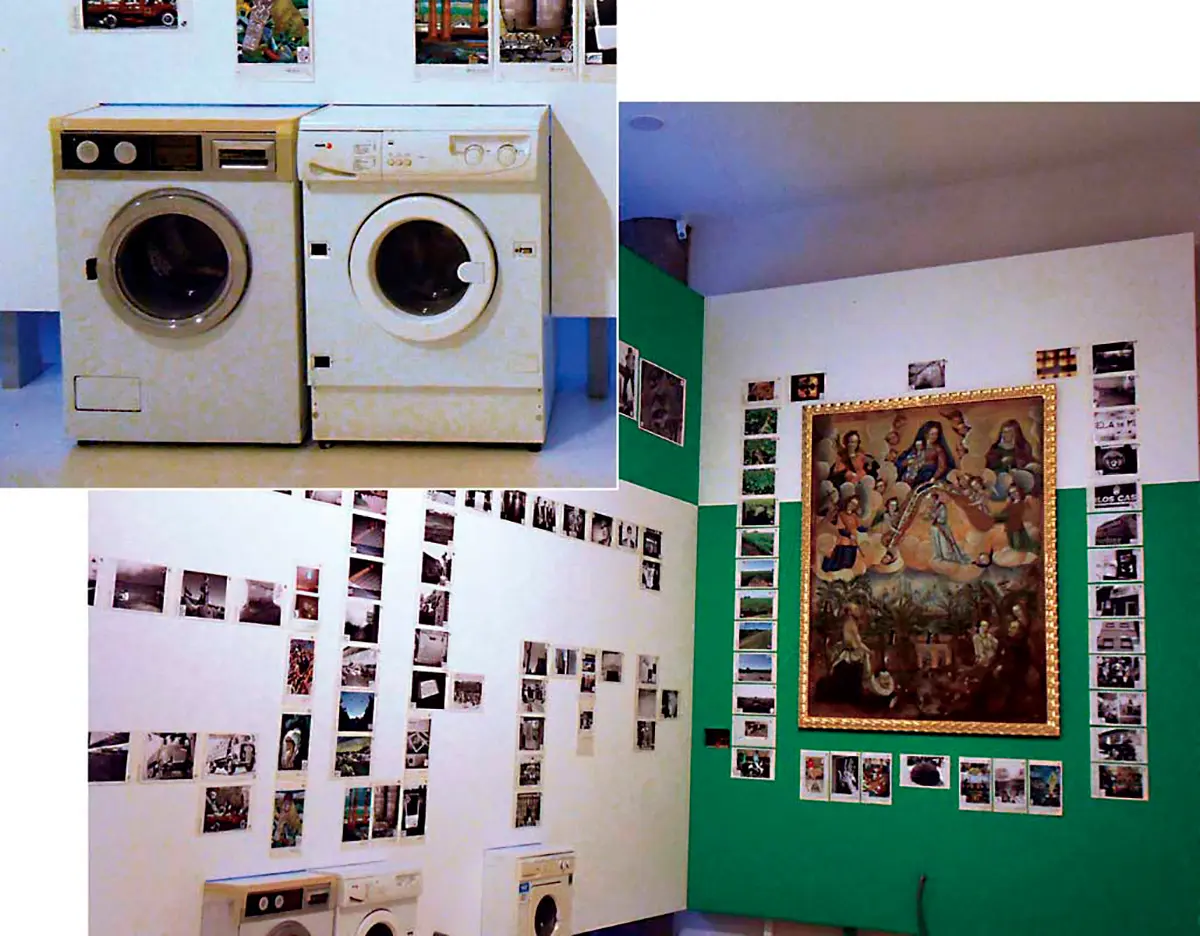
Eduardo Molinari develops a work titled The Chidren of Soja (2010). In this work, which dialogs Nieremberg's images, we see a number of washing machines. On a wall is a sizable amount of images and drawings resulting from the artist's travels through the provinces of Buenos Aires and Santa Fe. This work makes a forceful critique of transgenic farming across Argentinean fields and all over the world's markets. The washing machines are the perfect metaphor for the liberal world that purports an idea of cleanliness yet constantly pollutes all waterways. Transgenic fields have generated unprecedented levels of contamination in water sources, causing an alarming number of deaths and malformations among children. In the middle of all this, The Imposing of the Casulla to Saint Ildefonso, an anonymous painting from the Seventeenth Century.
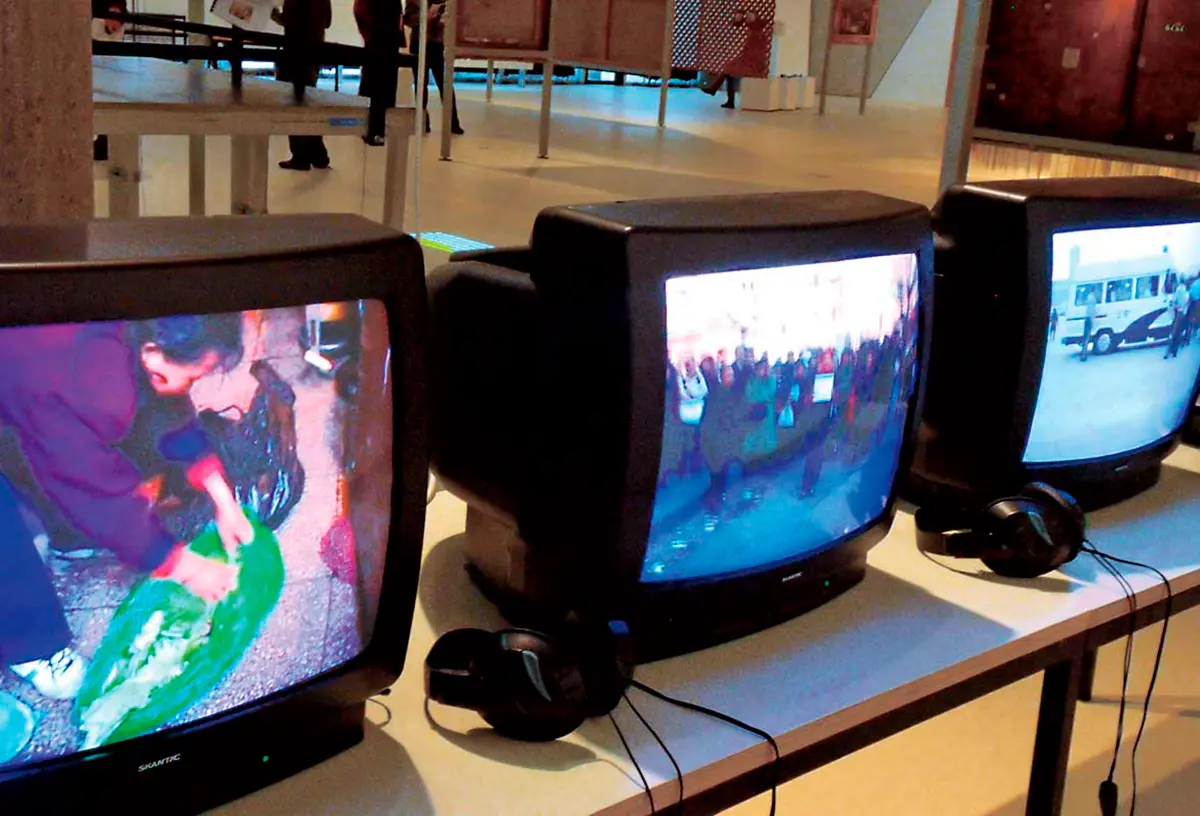
Artists David Riff and Dmitry Gutov present an interesting work: The Rosy Dawn of Capital. The Karl Marx School of The English Language (2010). Entering a semi-dark room, we see some images of writings and hear the discussion, in English, of some paragraphs on primitive accumulation from the first volume of Capital. These conversations began in 2005 in Moscow, in Gutov's workshop, and included philosophers, artists, and political activists. They compared translations of Marx from German into English and Russian and debated the currency of his thought. The installation reveals the complexity of the contemporary world, assuming political positions that remain valid. At the entrance of the room, a painting by Lucas Valdés, Miraculous Portrait of San Francisco de Paula, depicts the painter laying on the floor while an angle takes his place before the easel where the portrait of a saint is in progress. Behind the angel, next to the window, a print of the same image of the saint, produced in the presses of Antwerp. The artists can do nothing against the divine command to produce images.
Another work that captured my attention was The Tower: Songspiel Chto delat, (2010). This film staged by Thomas Campbell and Dmitry Vorobyev shows a conversation between industrialists, owners of Gazprom in Russia, which is financing the construction of a giant tower that will carry the firm's name. The industrialists are compared by the artist to Antonio López de Quiroga, the Silver Baron, regent of Colonial Potosí who developed a veritable criminal enterprise for his own enrichment and that of the Spanish crown. Near this work, we find three Seventeenth-Century paintings: Phillip the 5th Converted into Santiago Matamoros (anonymous); Santiago battling with the moros, by Lucas Valdés (1660); and Antonio López de Quiroga (anonymous, 1660), where the illustrious politicians acquire the character of deities while their horses gallop on thousands of corpses of infidels. López de Quiroga does not trample the bodies of Moors but those of Indians, who are the ones working his mines.
Marcelo Expósito presented 143.353 The Eyes Do Not Want To Remain Closed (2010). This work consists of a series of mirror-like projections under the paintings of the "Santiagos," depicting images of exhumations and the contemporary exploitation of workers. According to the artist, the intent is to turn the mirror of the "Santiagos" towards Spain. The artist says regarding his work: "I think that the relationship between modernity and colonialism, in the case of Spain, was rather problematic, since the colonial metropolis was also, in historical succession, a European bastion of Counter-Reformation, anti-Enlightenment, and fascism: every project of modernization or reform has been problematic here, and they all have been essentially defeated."
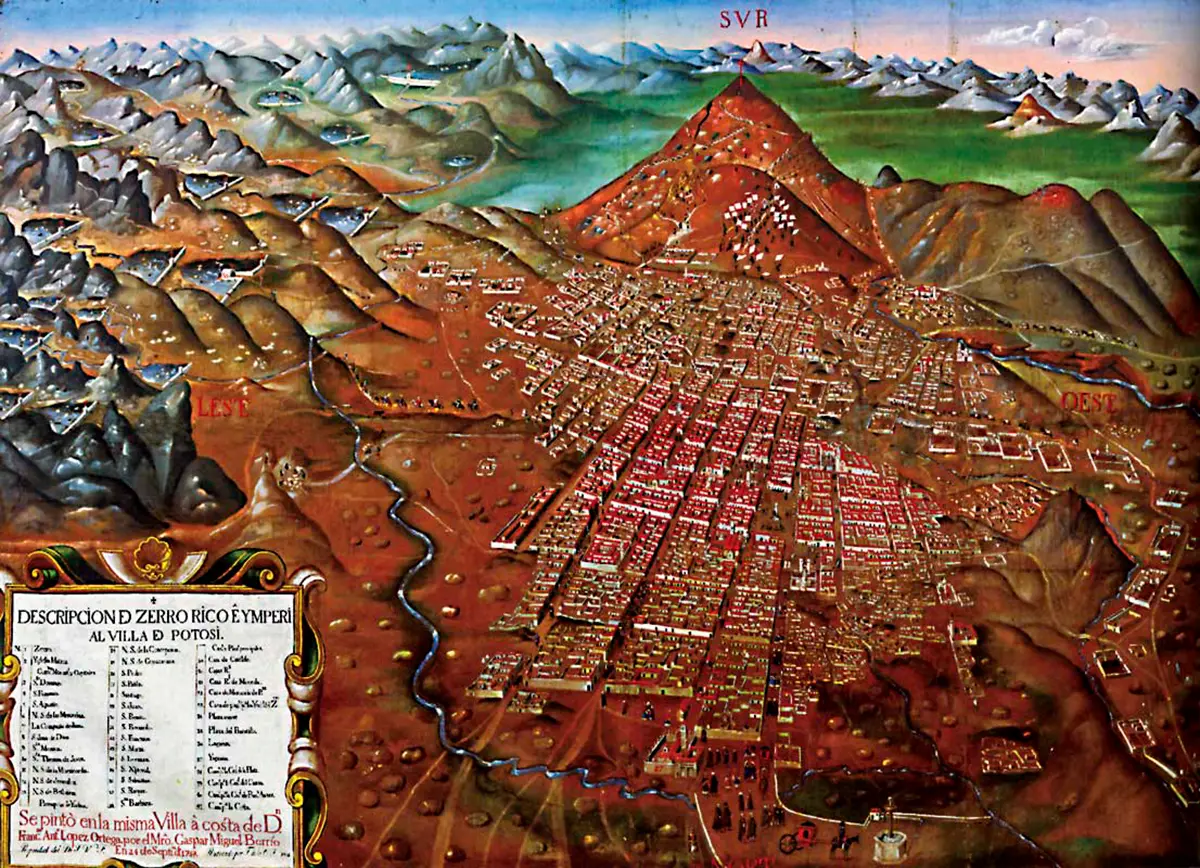
Harun Faroki's Silver and The Cross (2010) is an interpretation of Gaspar Miguel de Berrio's 1758 Description of the Rich and Imperial Villa de Potosí. This large-format painting is a true testimony of the city at the time, showing its splendor, its large aqueduct system, its public squares, streets, parks, and buildings. Faroki traveled to Potosí to confront the painting with reality and found that not much has changed beyond the normal wear (for instance, there are only vestiges of the aqueduct). Faroki proposes to work on what the painting makes invisible: forced laborers.
The Potosí Principle: Bodies That Don't Speak Are Condemned to Hell
One aspect I want to highlight in this exhibition is the reference to the body: the attempt to evangelize the soul through the domination of the body, reduced to a living waste interred into the very bowels of hell in the silver mines of the "Cerro Rico". One of the show's most interesting works was Eviva el cotillo (2010), by Inés Doujak. It is a performance where a naked individual is barely covered by a silk suit in the purple color of religious vestments. This character dances, showing his genitals. After the action, what is left is the purple suit, hanging in the gallery.
The artist takes into account a text by Jesuit Pablo de Arriaga, who published Extirpation of Idolatry in Lima in 1621, applying to the letter the guidance of the Council of Trent. The book was a manual for the Inquisition-led witch hunt. Doujak insists on resistance against the struggle of good and evil, the soul and the body, where the latter is fated to sin and to hell (synonymous with work). A series of medallions, Witches (2010), made using digital color photography, depict women shouting while a serpent emerges from their mouths, and a woman barely clad on a white-embroidery shawl next to a donkey.
These works dialog with Death, by the Master of Caquivari (1739), where, in a center-bottom detail, we see an Indian in the confessionary being prevented to confess by the devil, who grabs him by the throat. The artist asserts a way to begin resisting in the complex world of symbolic production at a time when the confession of one's sins could be a death sentence or result in unprecedented torture. Capital sins, in this case, pleasure, are kept secret.
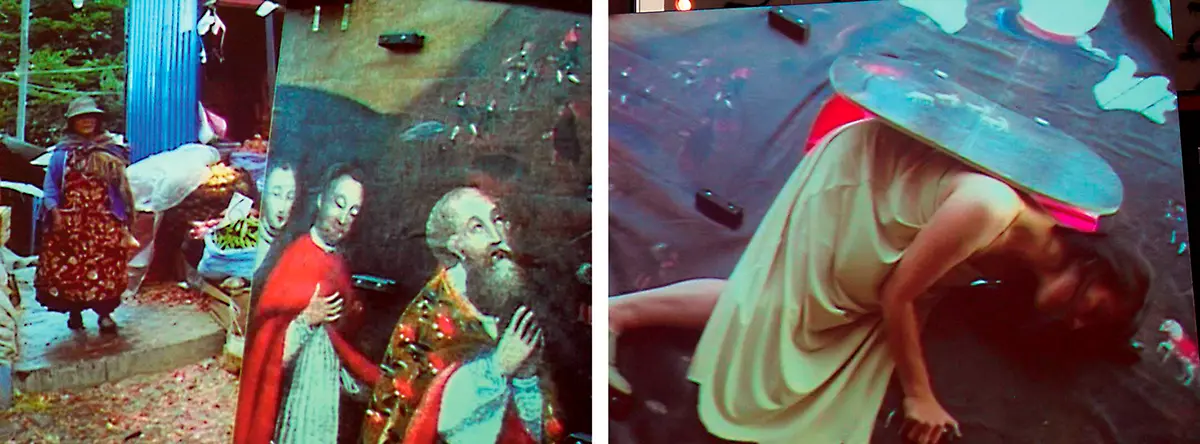
Women and the female body have been silenced for centuries. During that time, the image of the Immaculate Conception, of the Virgin, is linked to the image of the Earth. The outline of the Cerro Rico is transformed into the Virgin Mary's shawl in the anonymous painting La Virgen del Cerro. In this image, which alludes to the Virgin Mary's miraculous apparition, the Sun and the Moon are represented to the left and the right, and on the upper portion, the Holy Trinity flanked by the Archangels, Gabriel, and Miguel. Philip V is represented to the right, and church authorities to the left. At the center, the Cerro Rio. This painting is reproduced and transformed into the stage for a street action by María Galindo and Mujeres Creando, under the title of Ave María Full of Rebeliousness (2010). The action evolves in a market in La Paz, where the sellers see a woman emerge from the painting to cut out two of the bodies of the Holy Trinity and undress them. The Virgin from the painting now has a body, she is no longer buried, and maybe she is not even a virgin anymore, Galindo seems to insist on a clearly feminist bent similar to Doujak's.
In summary, this important exhibition, with its exceptional curatorship that has plenty to teach us, is proof that The Potosí Principle is the very beginning of wild capitalism, something that is still with us and perhaps has gained renewed energy in this globalized neo-liberal world. In this case, the colonial Baroque shows us how art is at the service of an unprecedented in history, reinforcing its ideology of domination.
RICARDO ARCOS PALMA
Art critic and theorist. Director of the Master's Program in the History and Theory of Art, Universidad Nacional de Colombia.