
The conceptualization-color-kinetism relationship is presented in Tony Bechara's work with clarity and tight elegance. Perhaps it would be important to explain this last aspect: Elegance by itself does not destroy a work of art, and much less when this is consistently, reflexively, and inflexibly constructed. Tight elegance alludes to the synthesis in an artwork that—as is the case in the paintings by Bechara—is not descriptive, disperse, or strident. The exhibition Minima Visibilia: Pinturas Grises (Minima Visibilia: Grey Paintings) places the spectator in this situation just described. Square, square, square, greys, white, black... Although the works are reasonably large—60 × 60 inches—they appear to be of a smaller size. Such is the restraint in the interplay of tensions created by works painted in white, grey, and black. It is undeniable the way in which the geometry, the division between the surface and the module, shapes the work without turning it rigid; on the contrary, these elements achieve proportional amounts of order, fluctuation, and dialogue. Bechara is "interested in the process of observing, even when it comes to Renaissance artworks..."1. The artist is interested in creating work that entices the viewer to join him in such a process of observation.
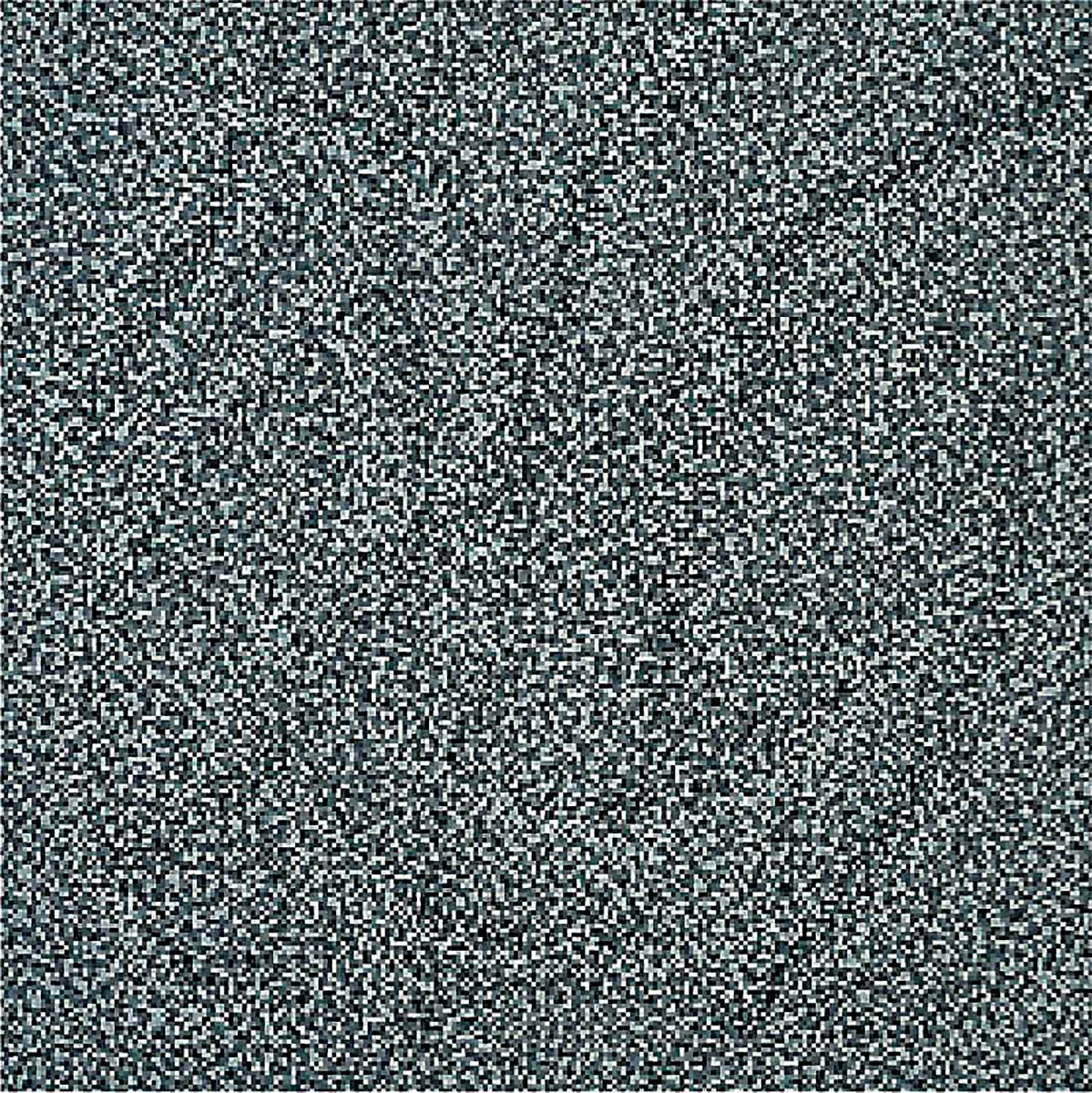
The exhibition consists of several paintings that, for almost four months—from September 2008 to January 2009—were exhibited at the Museo de Arte de Puerto Rico. Accompanying that exhibition, and still available for this new exhibition, is a white catalog with an essay by expert Juan Carlos López-Quinteros. Some of the paintings shown before are missing from this exhibition, as are the spiral-bound workbooks that reveal—or corroborate—the process, that conceptual facet of the artist. They were drawn and painted just like the canvases now shown in New York City. Bechara's work consistently shows an understated architecture that is essential to the image and to the entire experimental and innovative aspect of his work—a facet not well-known outside of his studio—developed with his own materials. Despite being under the paint, drawing is the grid, guessed, or perceived, which completes the pictorial process. It is found on the edges of the shutter—adhesive tape—and in the outlines of every "tessera," covered and uncovered throughout the pictorial process. In Mínima Visibilia: Pinturas Grises, the author allows himself to be surprised. As he places the tape across the vertical and horizontal sections of each painting, paints the visible squares, lets them dry, and then seals some and uncovers others; he does not yet have a vision of the entire image. It is until the very end of this process when he will be able to see the results. The juxtapositions of tones and/or colors represent a discovery after the fact after the image has been completed. The supremacy of one color over the rest is not existent, since the ones that are covered are a mystery to us and to the artist, as he does not keep track of what he used and he cannot remember what pigment he used.
Tony Bechara approaches Twentieth Century abstraction in a very personal way. He does not navigate those aesthetic seas straight through. Before getting there, he transits in search of the non-figurative or non-descriptive. Several decades ago, when Bechara was going through a crisis—as he attempted to leave figurativism behind—he had a good fortune or was destined, to see with his own eyes the Byzantine mosaics in Ravenna and some paintings by Giotto. Observing these two artistic forms of expression enabled him to further develop his gaze. It was an eye-opening experience very much like the one he now offers to the viewers, in works like Agosto 21 (August 21), Julio 16 (July 16), and Abril 8 (April 8); three of the works included in the exhibition at the Frederico Sève Gallery. About his approach, the artist has said: "I am interested in broadening the context experienced by the viewer. To this effect, I decided to leave one of the walls of the gallery empty... I am interested in using the dimmer to lower or raise the light level... in my work, I look for new and different options to offer to the viewer."2 In the back area of the "modular" gallery, there are small color paintings by Bechara. It does not matter if his images are yellow, grey, blue, small, or large; they are all subjected to the same process and to the same tight elegance. How does Bechara approach the works he creates with other colors? In the same way; although he has used colors in other periods of his career, he could very well reintroduce their use in that pop-conceptualist approach he has developed. Whether he uses colors or only a monochromatic palette, most of the aspects involved in the treatment of his works are the same. Nonetheless, some works like the Pinturas Grises, do require a higher degree of involvement by the artist and the viewer alike. In these works, the synthesis is more intense, and—although it is hard to believe—they can actually appear to be less monochromatic, in that each module seems to be independent of the rest and reveals its outline in a clearer manner than its equivalent would in a color painting. Atmospheric and poetical, Mínima Visibila: Pinturas Grises is also an urban experience in the most urban city in the world.
GRACIELA KARTOFEL