
The degree of Yoan Capote's social-political consciousness emerges through, although is not fully contained by, a solo exhibition. Experiencing his individual works one at a time tends to place an emphasis on humor, individual creativity, or even vernacular culture. But here, the individual psyche cannot be shunted into merely individualized elements, shorn from its public embeddedness. Here the connecting threads of critical consciousness, ones we commonly find in the double-consciousness of Cuban island culture, can be seen, felt, and considered. Even the title of his exhibition, Mental States, speaks to a disequilibrium that is so socially normal and necessary it is impossible to separate the social from the personal.
The most visually spectacular works mark a return to his painterly roots now recombined with his decision years ago to move into sculpture as a medium more oriented to a material and public world. These constructions can be appreciated individually for their physicality, craft, and even their illusionism, all of which now seem secondary.
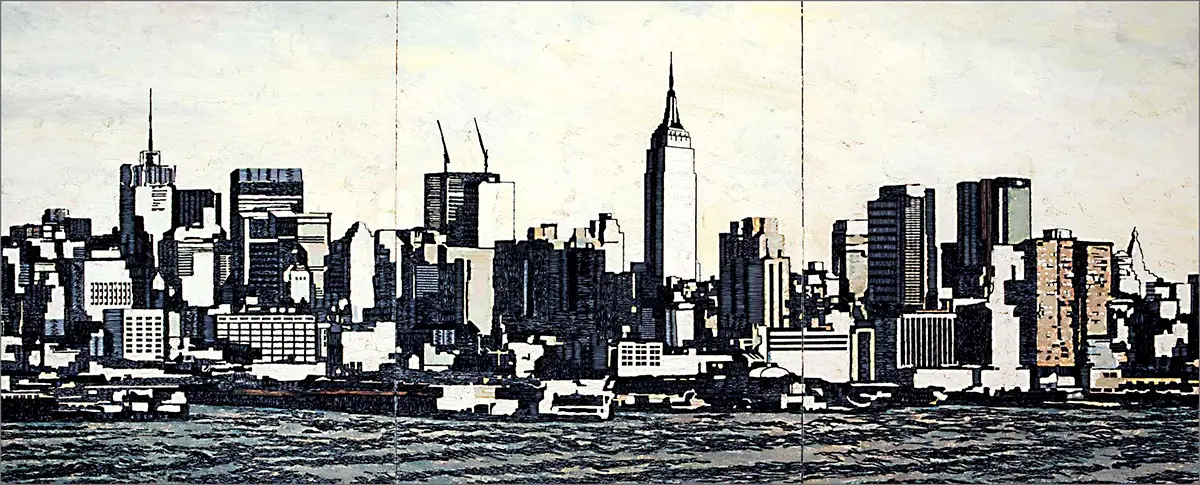
Two of these works use very largely, multi-panels of plywood to support the weight of his thickly textured oil painted ground laid over a jute covering—whose use can be read in relation to the US withholding of food aid to Bangladesh during the 1970s famine to end shipping jute to Cuba—and the thousands of fish hooks used to create the images. Isla (4 panels, 106x315 inches) is part of the island series he began around 2007 and its subtitle See-scape is a word pun that refers to several issues. The fine interweave of fish hooks so successfully recreates the dynamism of ocean swells you initially miss seeing them. But the other parts of the exhibition allow us to also "see" in it one of his major themes: gazing outward from Cuba to what is beyond. And one answer to that question comes in the other two hook constructions.
The title of the series they belonged to, American Appeal, redirects the general tension gained from using barbed metal hooks to create an image to the specifics of biography, and perhaps personality as well. With Postcard, the subtitle of the largest (3 panels, 96x236 inches) we are given a panoramic view of the Manhattan skyline seen from the harbor ferry entrance of the immigrant to this other island, a distant dream now present and presented in terms of local island fishing gear. And yet what can be "seen" as a simple postcard dream of a Cuban "escape" to New York takes on quite more complex meanings in light of the exhibition, and Capote's biography. Poignancy and politics combine in the biographical reading because US government policy blocked Capote from entering New York in 2006 despite his winning a Guggenheim award. Other works complicate overly simplistic and nationalistic readings.
The Window is a crudely made brick and cement version of the US flag set inside a wooden casing that is a shipping container (75x37 inches). Nationalism is not attached to one geographic or imagistic location. The work appears again as one of two images in a lightbox diptych (In and Out) next to an ocean view that refers us back to Isla. In turn, its source is made apparent as a process in the twin videos titled Historical Fatalism. Both videos are shot from within a small, container-like room with a window that frames a view of the sea. The left monitor shows someone slowly closing the ocean view by laying courses of brick and cement. The right-side video shows the finished section, the crude flag, but now slowly removed, layer by layer.
While such an arrangement might be read as merely a simple dream of escape from a lesser to a greater, Capote puts the relationship into playful question with his over-human-sized metal balance in a separate room. While one balance pan is significantly larger and shinier than the other and clearly tips the scale in "its" favor, the title tells us of the general situation Status Quo (Reality and Idealism) but refuses to name which one is which. His other large bronze sculpture, Migrant, is a visual embodiment of uncertainty. What seems to be two long tree trunks with roots at one end are trouser legs that have worn shoes at the other end. The small drawing of the same title on the wall next to it shows the shoes standing upside down on the ceiling of a box with the roots downward, while another show the shoes also "up" but through the roof of the box, such that one is conflicted by the visual as to what is up and what is down, much like what is real and what is ideal: the roots or the mobile migration. Such is the unsettled Mental States in the peripatetic status of today's diasporic individual.
RICHARD LESLIE