
To reflect on what surrounds us, on the way we see the world, we must start from zero, change our inherited codes, and extricate knowledge from its habitual field, displacing it towards different terrains. The work of Carla Zaccagnini (Buenos Aires, 1973) starts with that drive to investigate the world and transform the structures around us, demonstrating that a different perception of them is possible when one uses imagination and willpower. Artist, curator, art critic... her work is characterized by the reflections it proposes about knowledge, practices, mental constructions, institutions, perceptions, and representations; analyses that act as the launching platforms for the execution of diverse, multifaceted works and actions that are not defined by one concrete medium, language, or constructive formulation but by the expressive freedom that such ideas generate.
A resident of Brazil since the age of eight graduated in Fine Arts and Masters in Visual Poetics, Carla Zaccagnini has been a curatorial assistant at the 24th São Paulo Biennial (1998), curator at the São Paulo Museu de Arte Moderna (2001), and a member of the editorial committee of the Brazilian journal Número. Such diversity of experiences has significantly impacted the development of her artistic practice, reinforcing its critical character, its reflective spirit, her collaborations (teamwork involving contributions buy specialist from a different field), and her avocation for site-specific interventions (based on works created in the context of private residences), as well as her heightened interest in language as a possibility of articulating meanings.
According to Zaccagnini, her work as curator and critic feeds into and updates her work as an artist, and vice versa. At the same time, her experience in the institutional realm helped her understand her preference for freer positions, closer to more immediate, more effective, real results. In this way, her artistic practice has allowed Zaccagnini to develop works and projects such as excavations in search of similar artifacts in abandoned houses in Flanders (Bifurcaciones y encrucijadas: sobre la igualdad y las diferencias II: a casa ao lado, 2006); the construction in a museum patio of a park with swing sets interconnected though a complex hydraulic/mechanical system activated through the simultaneous use of the pieces that comprise it, producing a result (Reacción en cadena con efecto variable, 2008); a deck of poker cards silkscreened into clear plastic (Juego transparente, 2006-07); or donating a series of Brazilian art publications to the Centro de Arte Wilfredo Lam in Havana (Bibliografía, 2002).
"From the standpoint of private and intimate use of language, artistic form is not predetermined, and neither are the displacements of the meanings it explores."1 Her discourse is driven by this almost obsessive impulse—which animates large swaths of contemporary art—that seeks to rediscover every day in order to raise awareness, activate our vision, and open up the field of perception.
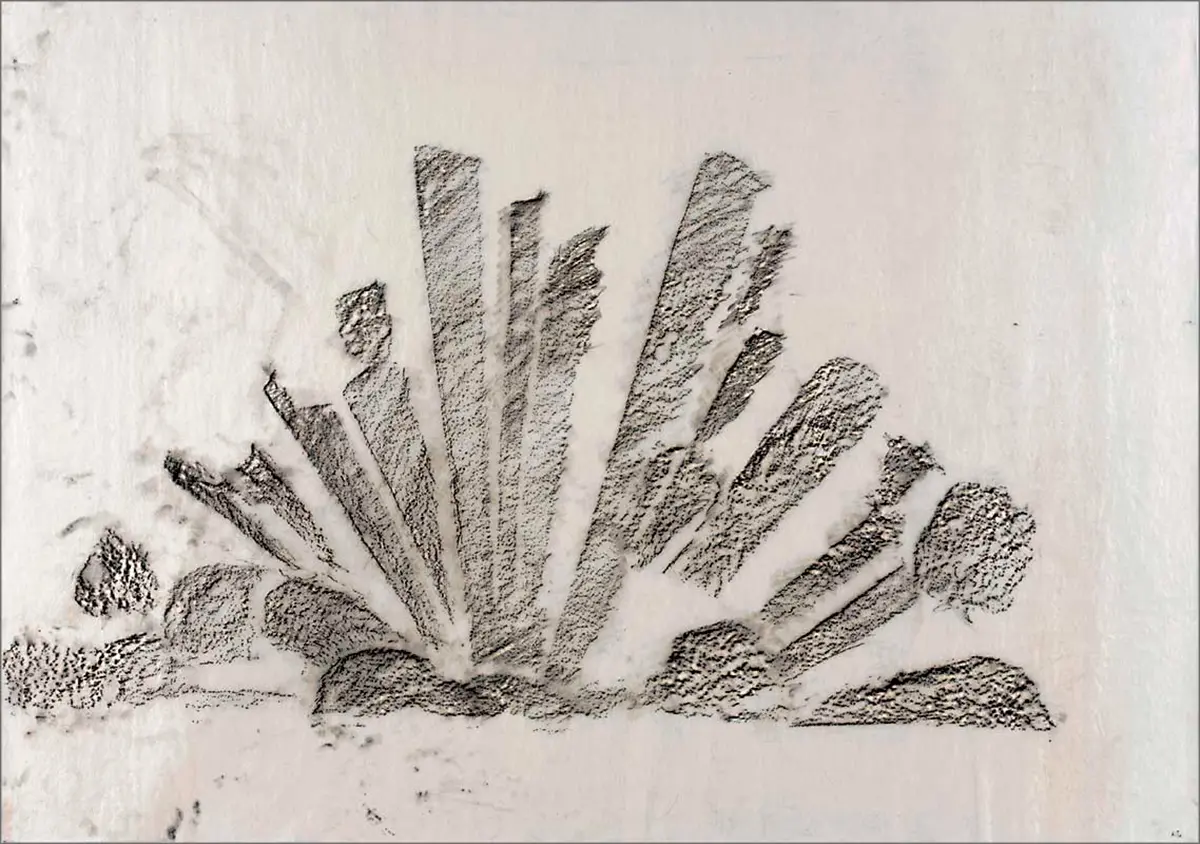
The two series on paper (frottage and lithograph) that comprise Zaccagnini's individual exhibition at Joan Prats Gallery insist on the artist's interest in language as the articulation of meanings and, at the same time, as the exercise of power. The works reproduce fragments of the representations of explosions found in the reliefs at the Soviet Memorial in Berlin's Treptower Park. Cut out and isolated from their original context, reinforcing the geometrization that condenses these shapeless events, almost iconic, in sum, these strangely beautiful images resembling representations of landscapes, intriguing dawns, or archeological remnants from ancient civilizations open up surprisingly, propose new readings, and confound the viewer's understanding.
The gesture of moving papers, those fragments of commemorative reliefs, placing them outside their context and impregnating them with new, plausible conceptual and symbolic connotations, adds new steps to Zaccagnini's investigation of the limits of representation (the unstable balance between desire and impossibility that accompany any attempt to represent an experience) and the possibilities of construction of a discourse: How can it be structured, what meanings does it reveal, and how can it be deconstructed and recomposed in order to be ultimately resignified, according to the same sources.2 An exercise that connects with previous works, such as when she drew in pencil the outlines of a museum's classical art collection (Exhibition Contour, 2001), or when she produced a series of drawings copied from the pages of a wildlife encyclopedia (Todas las descripciones son comparativas: grandes felinos, 2001-08), transforming these isolated fragments into something obviously subjective, irregular, and non-authoritarian.
Inaugurated in May 1949, the Memorial was built to honor Red Army soldiers fallen in the struggle against Nazi Germany. The denatured, camouflaged, weirdly peaceful representation of these explosions also implies a reflection about the way in which iconography of terror has become globalized, and how real violence has been transformed into a kind of semiotic merchandise; involving ideas related to the growing damage caused by the virtual era, the conflictive power relationships, and the devastating impact that war and economic systems have on individuals.
Displacing knowledge from their areas, displacing objects from their regular context, displacing practices towards other goals, in order to wonder about their limits and possibilities, is all part of actions, strategies, undertakings—perhaps impossible but necessary—intended to confront the borders of the visual, the fallibility of perception, institutional barriers, the limitations of scientific knowledge or of cultural and ideological conformity.
NOTES
1. C.f. latinart.com an online journal of art and culture.
2. C.f Reacción en Cadena con Efecto Variable en as Zonas Vedes del MUSAC, in arteenlared.com
WENDY NAVARRO