
Cravo is the last name of a family of Brazilian artists renowned and respected in Brazil and around the world. A poetic sculptor, Mario Cravo Junior is the eldest member of a dynasty of artists that also includes son Mario Cravo-Neto (1949-2009), a sculptor and photographer, and grandson Christian Cravo, a photographer who has found his own way of continuing the passionate syncretism, density, silences, and ritual visions of his father and grandfather. In opposition to the natural course of things, with the passing of time, a great part of the art in Latin America has self-corrected its mythologies and suppressed its profound levels of syncretism. While there is no short supply of shows staged for tourism, it is hard for foreigners to find authentic and meaningful ceremonies in Brazil. A fact that is not solely true in the northeastern part of the country, like in San Salvador de Bahía—where the Cravos are from—but one that has become relevant in a comprehensive study on Latin American art. Authors from various fields have worked on identity studies approached from two fronts: a Pre-Colombian perspective and an African one; the latter being the one that predominates in Brazil. Although the Cravos are not that directly linked to the afro approach, there is in their work a profound rituality that allows their proposals to breathe, to gaze, and to perceive life.
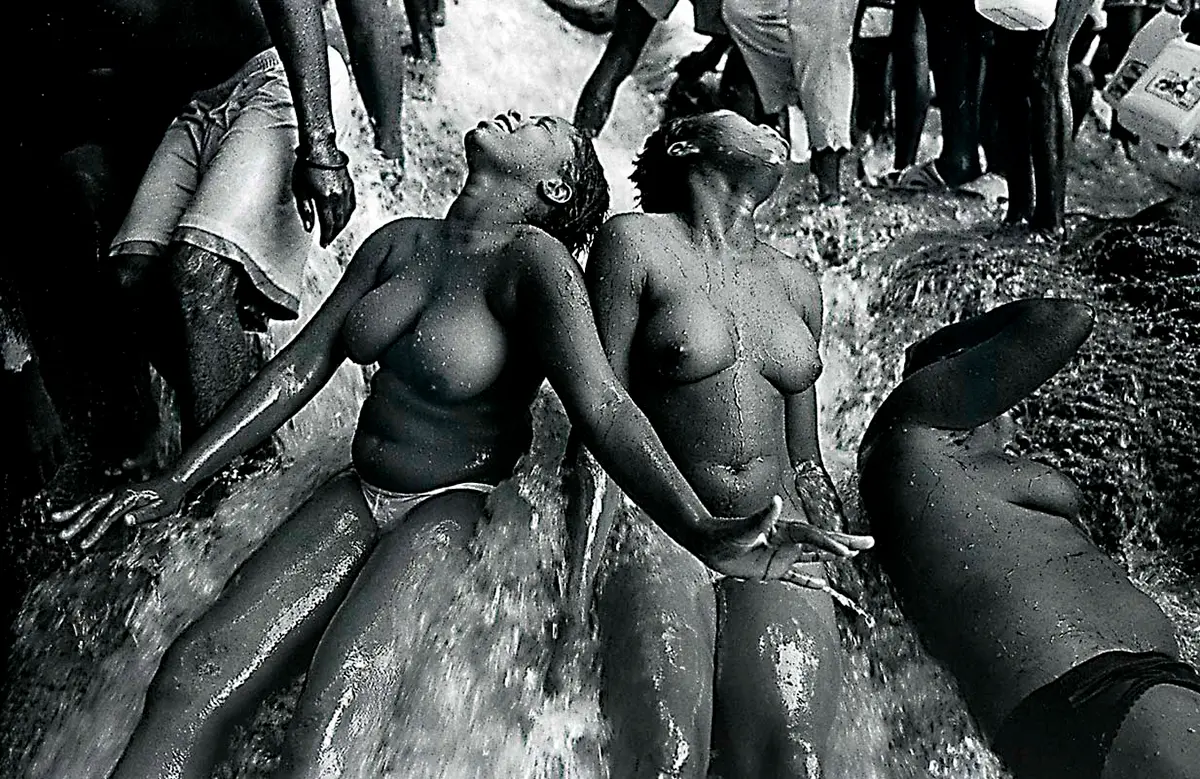
The exhibition In the Gardens of Eden by Christian Cravo at Throckmorton Fine Art resides in that transcendent gaze charged with an intense sensibility of the natural and the human but projected on to a different stage. It is not his natal Brazil, nor is it Denmark, his mother's homeland, and where he lived part of the first twenty years of his life. He began the project with a work about the water in Haiti that gradually and passionately focused on the authentic Vodou of the place. "I have grown in an artistic environment, so it is impossible for me to refrain from that way of seeing and living," affirms Cravo. The natural formations of several places in Haiti—particularly in Saint-Michel-de-l'Atalaye, in Sodo, and in Soukri—corroborate the bare nature of Cravo's photographs. He does not regard his work as anthropological, nor do we perceive it as such in this exhibition. The thirty-five images included in the show present a number of subjects devoted to a natural environment in which falls and the ocean set the tone for ritual devotion. None of the subjects depicted appears to rest or to notice that they are being photographed. This interaction with the environment was very compelling to Cravo, who gradually began to immerse himself in the cathartic spirituality of such devotional behavior, for it offered him an insight into the "Gardens of Eden."
This work began in 2001 and was completed before the 2010 earthquake and hurricane that devastated Haiti. This Caribbean nation celebrates several festivals during summertime—although calling them festivals sounds a little superficial—that consists of several public celebrations. One such event, for instance, centers on the belief of an apparition of the Virgin in the 19th Century. The exhibition is accompanied by a superbly executed hardcover catalog with a dust jacket and presented in landscape format. It includes bilingual texts by Edward Leffingwell and José Renato Baptista. When the format of the works permits—which is usually the case—the images cover the entire page. All these pictures by Cravo are black and white. About this, the artist said, "I can only work emotions like these in black and white." Each of the images shown at the gallery is part of an edition of ten 16 × 20 inch prints and is signed on the back with a pencil.
The integration with nature, with water especially, is a predominant element of the exhibition. Some photographs underscore the use of masks and costumes. Persons in a trance state, direct physical contact with animals, the contrast of fire and water, and the naked body represent constant elements of a natura a natura narrative. The acceptance of nature, of water, is expressed through the ritualistic immersion of the human figures and faces. These are highly contrasting photographs in which light plays a symbolic role as most of the images were taken outdoors. The water with its white froth set against the dark skins surrounded by bodies of water becomes a framework that adorns the poetic devotion to Vodou. And not just Vodou, but it could also frame the entire magic realism that exists in Latin America, where the real and everyday are naturally intertwined with the "magical" and the "trance states." The works showcase the purification and healing of a Haitian culture rooted in Africa. Everything occurs in caves, by the shore, under falls, like when the mud receives and bathes a subject in sensual anonymity. Animal sacrifice is only guessed as there are no brutal acts depicted in the images. The images feel as if they could actually splash the viewer and make one want to hold that man that bends his body like a liana while in a state of ecstasy. The darkness in the caves is intimidating, the rainbows and waterfalls are joyful, and the conglomeration of people on cliffs and other dangerous places is something to be amazed at.
GRACIELA KARTOFEL