
Agencia intermediaria is a process work by Claudio Correa that integrated—between November and January, at Gabriela Mistral Gallery—a "pictorial-graphic" work and a "sculptural-sonic" one, aesthetically materializing a series of previous actions relative to Chile's prison culture. Correa's ever-shifting proposal acquired meaning upon meaning in its permanent transit, under transference operations that had as one of their keys the distortions that occur within a communication process.
Between 2009 and 2010, the artist taught Writing and Portraiture Drawing to the workshop for young convicts, who learned to use several expressive tools, among them a software called Identikit, employed by police for their sketches. The convicts then created posters to be placed on walls around the city, seeking to re-establish contact with loved ones. Alongside their own faces or a variety of graphic motifs, they gave a phone number where voice messages could be left.
In the gallery, the "pictorial-graphic" side of the project was comprised of three posters, assembled in context: occupying an entire wall, it was a kind of ready-made piece of the city with the posters attached on top of ripped layers of previous advertisements. The kind of portrait on view here referred immediately to the realm of police activity; the nature of the context, the visuality of the street; the design in large format, to the world of advertising and urban graphic arts. Despite its advertising overtones, the search for specific people carried a dose of emotional content: under the portraits, one could read, for instance, sentences like "...let's not allow distance to be an obstacle to friendship" or "with sincerity and from my imprisonment/ I can only say.../ Mother, I still love you." Meanwhile, the visual richness of this decollage, the detailed graphic patterns, and the ambiguity of the texts referred us to the realm of art and to chapters in the history of painting such as the moment when neo-expressionism fed on Pop Art.
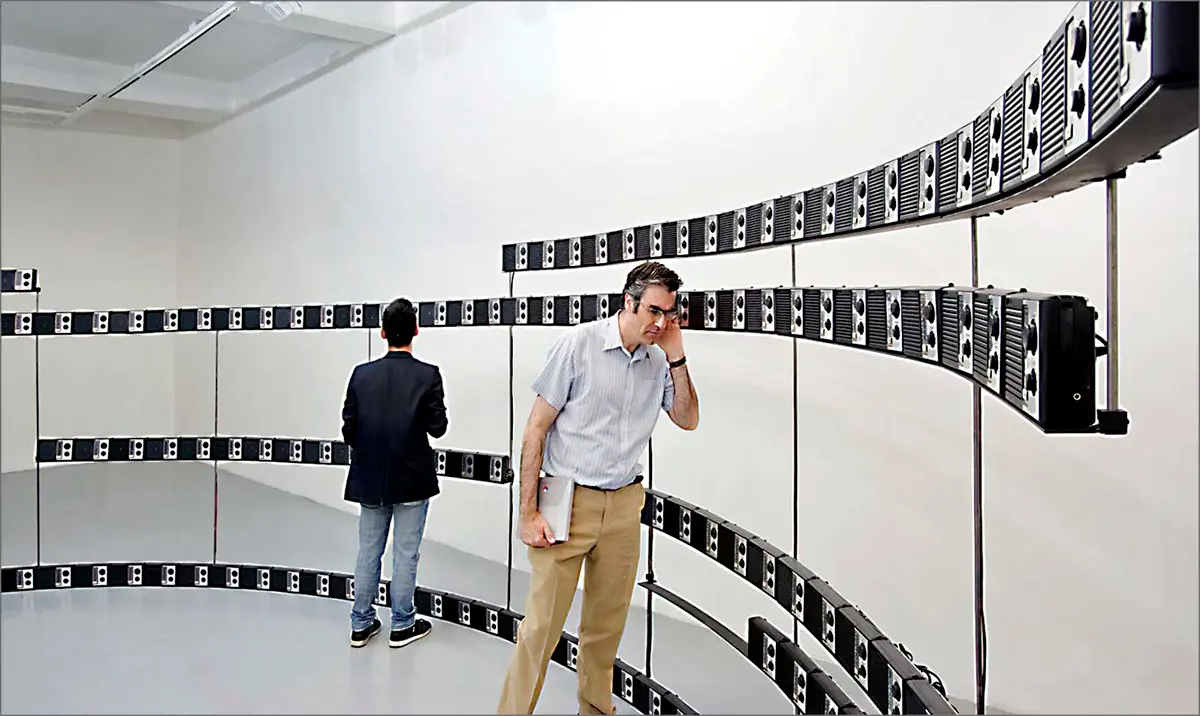
In the next gallery, the "sculptural-sonic" side of the project presented elements of minimalism. There, 200 identical portable radios, all black and arranged in parallel lines on a semi-circular structure, drew discontinued lines across space; an arch that rose as a sound screen with surround effects. Turned on, the radios crackled and randomly transmitted certain messages. First from one speaker, then from another and another one, we had to move around to hear a selection of three calls that appeared suddenly at some point in the dial. Like in a "connections" program or on those radio shows where members of the audience call to leave their testimony, the sentences came to us in the first person, revealing some incongruences. A man counseled, for instance, that "you can and must change," or that "you can do some of those things, but don't let them catch you"; further, a woman told us that maternal love is unconditional and that a child will be loved "even if he is the worst criminal."
As it happened, the voices were not those of the loved ones the prisoners were looking for, but those of anonymous passersby. They were messages from the streets that didn't reach the convicts, but visitors in the gallery. Speaking directly to us, they carried clichéd blandishments about the world of crime and illegal activity. It was a kind of speech act from Chilean society, expressing opinions on a topic carried to levels of paroxysm by the local media. It was also a low-tech messenger service surreptitiously ironic about the information society: the radios were of a kind very common in the past, especially among the working class. Despite its displacement by digital media now in widespread use, the radio was the technology that connected one half of the country afflicted by the earthquake of February 27th, 2010. When the communication system collapsed, hundreds of ears were attuned to these battery-powered receivers; radio stations generated a closer-to-the-ground, more effective, and constructive network than TV or even the internet.
The two works on the display are connected to one another through a cause-and-effect dynamic. But if the intention was to reconnect broken emotional ties, it was deliberately not fulfilled. First, we had a seemingly social-action work in an institution outside the art world. From there, Correa built a bridge between the convicts and the street, attempting one-way feedback that escaped towards an art institution and the public space. However, at this last point in the communication process, the viewer was subjected to an operation that distorted the message and rendered it virulent. Texts and voices spoke to us from a position of otherness, and the ambiguity of the noise became significant. The worn-out posters in the gallery, the faces of prisoners with their emotional messages underneath, the blurred voices coming through those low-tech devices, the advice given about how to live as a criminal...even if we were not convicts: It seemed that no communication was possible, which ultimately dramatized our distance from that marginal world, enclosing us within our own isolation even while at large in society.
CAROLINA LARA B.