
In the course of less than a century, abstract painting has gone from being the most divisively controversial art practice of its time to being the dominant mode of art to, by century's end, being regarded as almost an exhausted art practice whose very continued existence was far from assured. The domination of body politics and semiotics in contemporary art has left little room for the critical validity of abstract painting in the eyes of many. For the majority of contemporary artists who choose to work within this idiom, the challenge has increasingly grown to become one of finding new visual modes that will not be judged as derivative nor dismissed as either devoid of meaning or as kitsch.
Emilio Pérez is a comparatively young artist who, through a persistent commitment to his own abstract idiom, has developed a body of work that proudly stands in a bold affirmation of its artistic heritage. Pérez's paintings are large, energetic affairs that feature compositions full of fragmented forms that swirl, slash, and shift throughout their spaces with cutting diagonals and colors that tend to be dark, somber, and serious. In their fragmented forms and diagonal energies, they are reminiscent of Vorticist paintings while their large scale and evocations of landscapes and the primal forces of nature lend them an Abstract Expressionist sensibility.
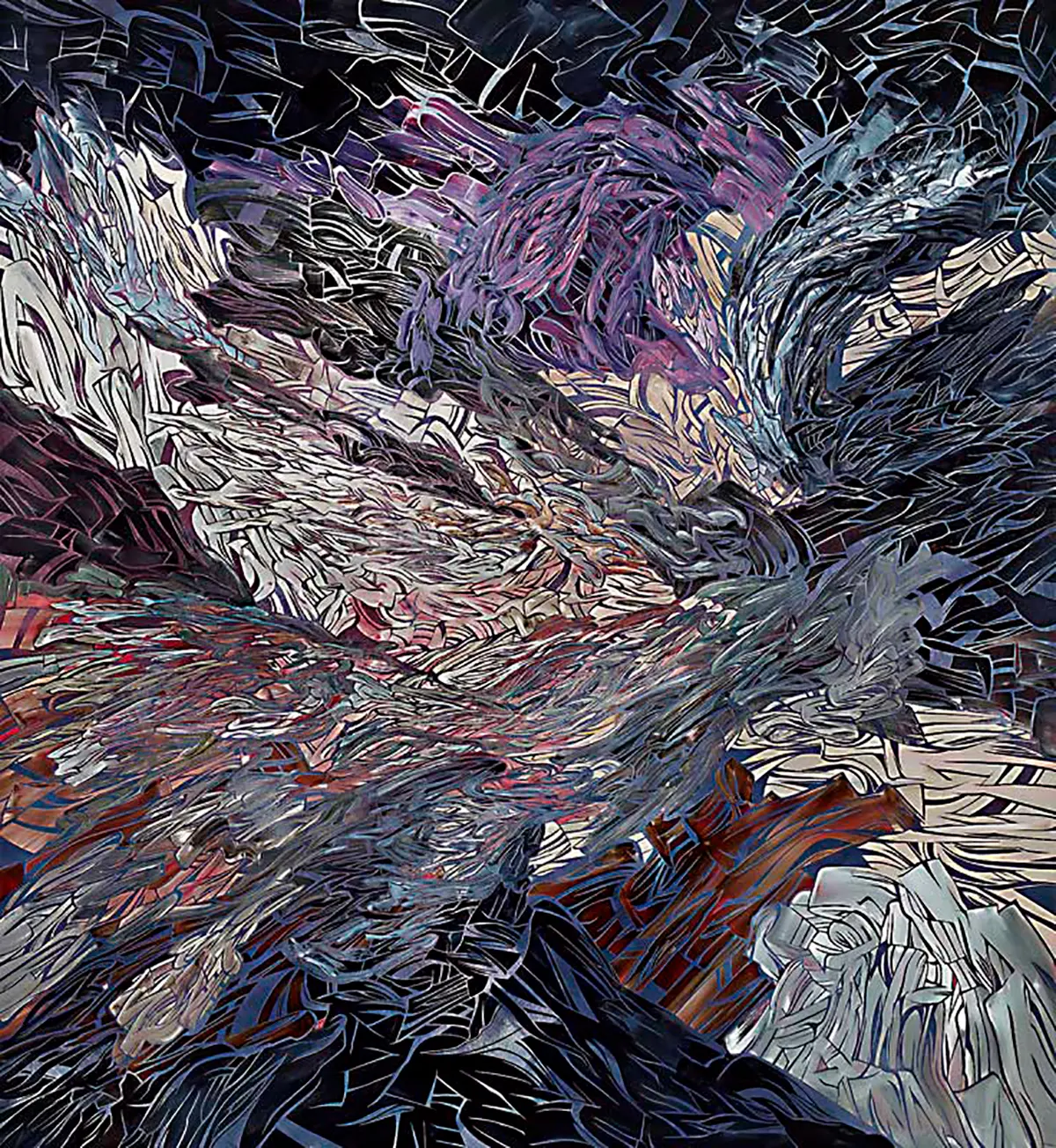
In addition to finding a personal voice through the fusion of these precedents, Pérez creates a further layer of visual complexity through the tactility and surface of his works. Each painting is comprised of built-up layers of acrylic and latex on wood panels. In a sort of updated decalcomania, Pérez then cuts into these layers in an additional act of composition. The paintings thus evoke space both tangibly and visually, as well as offering different visual effects. Their surfaces range from matte to glossy and they can be read for their overall designs taken as a whole or more intimately by engaging their intimate details.
Pérez shows his mastery of these techniques in his recent exhibition titled Breakfast by the Light of the Moon. Most of the paintings in this show bear similarly poetic titles and there is a somewhat nocturnal, as well as oceanic, quality to these works. This is further expressed by Pérez's choice of the palette that is dominated by rich blues and deep greens yet allows for flashes of white, red, and pink throughout, as one can see in works like Growing Up Fine or Forget All I Said.
Pérez shows another side of his creative process in this exhibition by including a number of large-scale works on paper. These offer a similar palimpsest quality as the paintings, with independent strata of ink and color patches layered on top of one another. With their curling cherubic lines and soft pastel hues, there is an almost Rococo richness to these pieces. They also bring Pérez very close to the edge of representation in certain instances.
These drawings present a divergent sensibility and show a fuller view of Pérez's artistic range. This helps to counterbalance the fact that, for the skill and power that these works evince, they are still a further elaboration of a style and a technique that Pérez has already presented in prior exhibitions. While it is understandable that an artist might want to follow a concept as far as it may take him or her, it is potentially disappointing to think that a relatively young artist has already entrenched himself into a mature, recognizably "trademark" style, something which the market seems to increasingly demand and which also fuels the argument that abstract art has essentially exhausted itself. One celebrates the complexity, sheer energy, and commitment to a refined technique that Pérez evinces in these works but one also longs to see what else he might have to show.
JOHN ANGELINE