
Enrique Martinez Celaya is an extremely prolific and multifaceted artist. He is a painter, a sculptor, a photographer, and a writer. He is a restless creator that conceives pieces beyond the limitations of a particular media. That's what pushes him to master different mediums in order to recreate exactly what he had in mind. Despite the fact that he used various techniques, and consequently each piece is restricted to the potential within it, all his work shows a lyricism that transcends the visual aspect. He brings the poetry of his writings to his canvases, achieving a continuous flux of ideas and metaphors. His work has a fable quality; each one narrates a particular story, all connected to him to some degree.
His last solo exhibition in Miami, at Gary Nader Gallery, was prepared consciously taking into consideration his approach to art. Although it is not a retrospective in the classical sense, it serves as a survey of his work for the past eighteen years by successfully bringing together pieces from different periods and diverse techniques. It is a good example of his work at large, allowing the viewer to walk out with a clear idea and an understanding of his oeuvre.
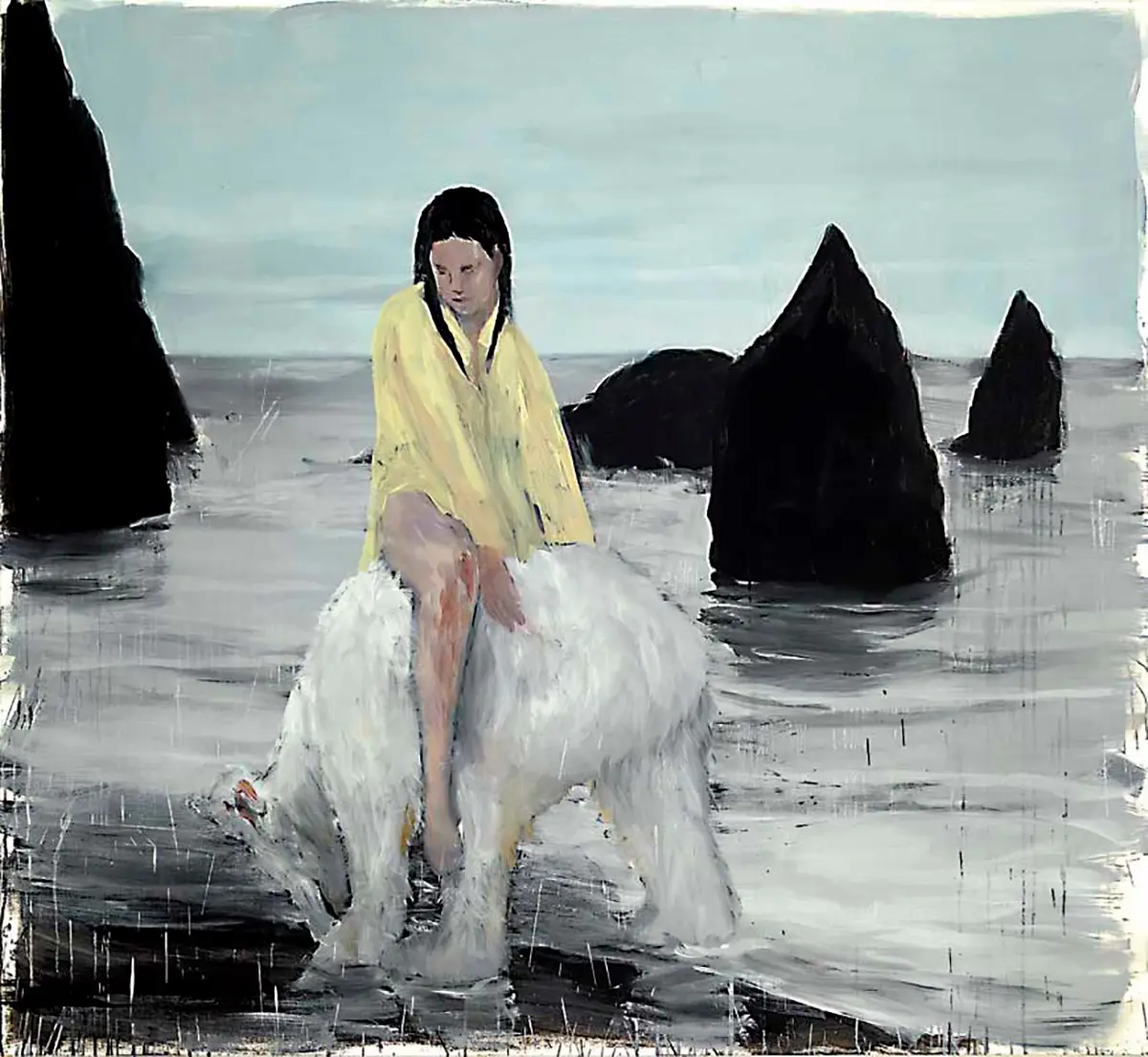
In most of his paintings, he recreates an oneiric world, where there is no border between reality and fantasy. One of those is The Sea and the Bear (2009-2010), which seems like a dream scene from a Bergman movie: a girl riding a polar bear seated facing the back. The gray tones, the long brushstrokes, and the obvious impossibility of the image reinforce this association. Although the girl's face is merely sketched, there are enough details to entail a melancholic mood.
There is an underlying spirituality in all these pieces. Some would show a more explicit truth-seeking propensity, like The Heard and the Seen (2009-2010), aiming to represent these two actions described in the title: to see and to hear, and the implications of each of them. There is a question dangling in the air: how accurate can it be, something that we see and hear? Can we completely trust those two senses? He chose two blackbirds to represent the dichotomy at hand, exposing the fine line between perception and illusion.
A nostalgic atmosphere and a longing sensation dominate his paintings. There is an embedded sadness in these images, something intangible, and a darkness that is not restrained to his use of color but also extended to the conceptual part of it. Undoubtedly his condition of being exiled has influenced his artistic path, especially that feeling of being uprooted and incomplete in a certain way has affected the themes he chooses and the images he creates in the end.
Martinez Celaya uses recurrent symbols in his work and one of them is the deer. He has portrayed it in almost all the media that he has worked on. In this exhibition, we can see two examples: The Savior, 2008, a life-size bronze sculpture, and Untitled (Deer) from the same year. The first one suggests his view of the deer as a totem animal, showing it as a strong and dominating presence. In the second one, he highlights the graceful and gentle nature of the animal, by cutting and isolating the detailed image from a previous painting.
Another recurrent element throughout his work is the presence of children, which are very often the center of many of his pieces. In some instances, it represents an alter ego and in others, it serves as remembrances of his childhood.
Despite the universality of his work, we can see the influence of certain artists who paved the path before him. One of them is Joseph Beuys, whose influence is seen in Vitrine with Flowers (2005). A delicate transparent white outfit with embroidered blue flowers displayed on a hanger, remind us of the similar iconic Felt Suit (1970) by Joseph Beuys. Martinez Celaya used it for his very well-known photograph, Boy at the Shore (2005), in which he portrayed his son wearing it. After making the photograph the artist kept the clothes as an independent art piece, playing with a concept similar to what Beuys intended with his suit.
This is Martinez Celaya's cosmogony; all the elements of his life coming alive in his art. His oeuvre escapes the propensity of being defined in terms of an artistic tendency, geographically, or by ethnic constrictions. His concerns are of a spiritual and philosophical nature. His themes are as universal as a man can be; his humanity transcends any other aspect. His work reflects an identity search, not only in cultural terms but a more intimate and universal one; his quest aims to define himself as an artist and as a human being.
IRINA LEVYA