
María Cristina Cortés has been showing her work in a systematic way for a long time. Each of her exhibitions reveals a new exploration of the landscape, a theme she has been approaching for some time now, driven by a preoccupation with the deterioration of the environment. Throughout her process, she has relied on traditional mediums like painting, drawing, engraving, and more recently collage. She is continually exploring different ways of seeing and constructing images.
In her last exhibition titled Quebrantos, at the Galería el Museo, the experimentation with collage Cortés began several years back has resulted in unsettling images that sometimes are just unrecognizable as landscapes. In the images that still resemble landscapes, the tree branches are strangely burnt, all rendered with a lifeless black color—an ash black—and were taken from printed images; their structure reminds us of a vertebral column as if they were trunks created by charred, fossilized, vertebrae. Death is somehow present in Cortés's recent work. The dried branches intertwine to create images in which life barely emerges through discrete tonal changes that hint at sunrises or sunsets of the plains in Bogota; a savanna landscape that she has been observing her entire life. A passionate colorist in her earlier work, Cortés takes risks this time by transferring black and white images on the canvases and merging them with areas of color and luminous atmospheres. It is a justified risk given her interest in showing the calcination of nature and the prevalence of paint, and also because she achieves powerful images that propose interesting challenges to the gaze.
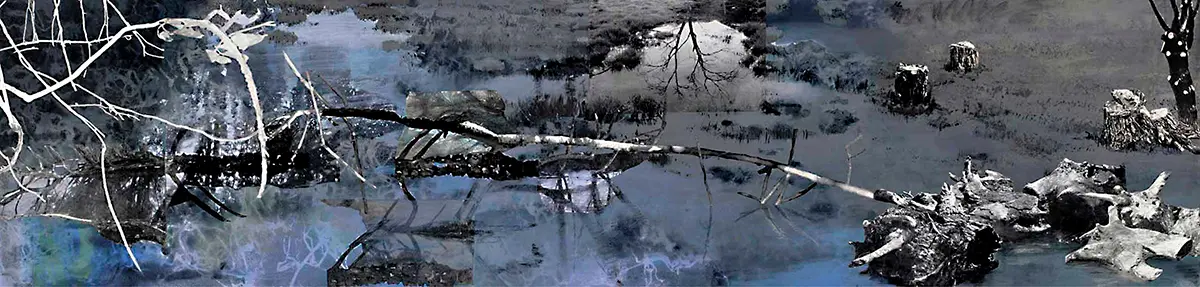
In other canvases, the landscape—if it can be called that at all—reminded me of surrealist painting because of the fragmentation of the forms. There are no horizon lines and the charred trunks float over a chromatic surface that bears little resemblance to any naturalist vision. Surrealism fragmented the body and the world; María Cristina Cortés fragments the landscape as she underscores her preoccupation with the disappearance of the natural world. Nevertheless, she is principally interested in the pictorial, in matters pertaining to the visual.
This exhibition continues the challenges she took on in her previous series titled Rastrojales. On that occasion, Cortés had also resorted to collage to construct images that reminded me of the complex vision proposed by cubism and David Hockney's joiners, as the landscape would multiply and break the unitary point of view. Nevertheless, in Quebrantos Cortés takes disintegration one step further. It is an evolutionary process that, in my opinion, merits a retrospective that offers a panoramic view of the evolution of María Cristina Cortés's vast work, from which to observe the changes that have occurred from one series to the next. It would be very interesting indeed to be able to look at a transformation that began with embroidered landscapes and ended with the memorable series in this current exhibition. It represents a leap, a visual moment in which something disintegrates, something creaks—the aspect of the branches, their dried and colorless appearance, evoke creaking sounds—as the images propose to new perspectives.
In the same manner that I have made references to cubism and surrealism here, in other occasions I have similarly used expressionism—and particularly Monet and his water lilies—to qualify her work, as many of us have also commented on that oscillation between the figurative and the abstract that is present in her work. This almost obligatory reference to art history is equivalent to being reminded of great works of literature when reading a compelling novel. In the same manner that a writer addresses the solitude, even the isolation from others that is required to write—here I am thinking about the autobiographical writings by Marai and Pamuk—painters must also spend long hours alone in their studios. A fact that confirms that the condensed time in María Cristina Cortés's images is the result of a disciplined and passionate commitment to the visual construction of the world, to the pictorial tradition that relies on photography as a way of investigating the visual realm. But also evident in her proposal is the gradual and unrelenting way in which we are destroying our natural surroundings.
MARTA RODRÍGUEZ