
Melanie Smith has once again collaborated with filmmaker Rafael Ortega in a new filmed intervention that involves locations in the town of Xilitla, a place located in the region of La Huasteca—in the Mexican state of San Luis Potosí—that became legendary because of the constructions left by Edward James, an Englishman associated with the surrealists, who spent 30-some years of his life in a useless, expensive, and yet fascinating venture: the creation of an architectural enclave that redefined and transformed, as a formal invasion, the lush natural landscape.
Influenced by artists such as Robert Smithson, Richard Long, and Gordon Matta-Clark—who projected their ideas onto natural environments, as representations of the landscape itself, through monumental interventions that often could only be fully appreciated from the air—Melanie Smith proposes a meditation on the territory, one that she constructs based on the visual revision of the elements contained in the landscape. With the help of Rafael Ortega's camera, Smith delves into a proposal of lines and contours that reveal—through a documentary approach guided by Smith's rigorous formal composition—the hidden, although always evident, nature of her object.
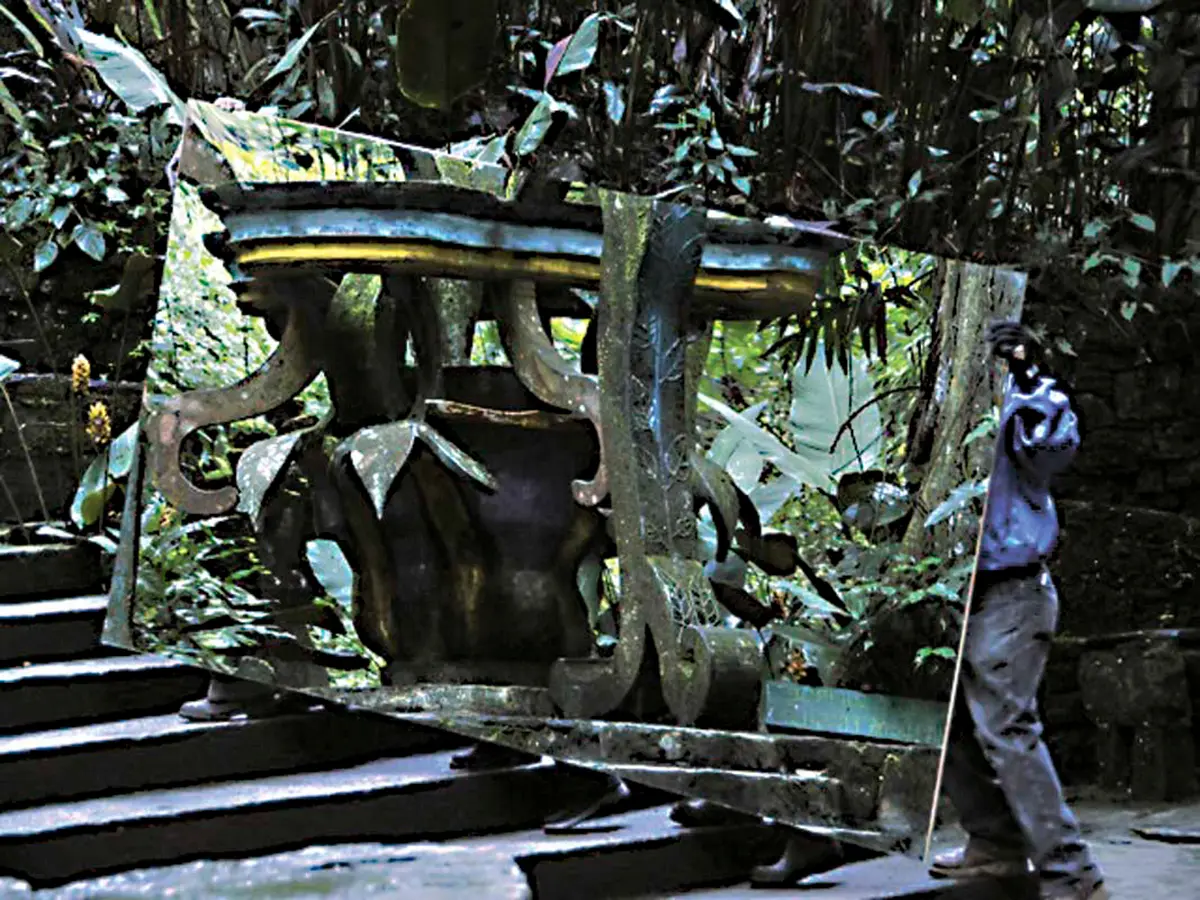
To create Ciudad Espiral (Spiral City)—in an allusion to Robert Smithson's Spiral Jetty—Smith rented a helicopter to film, also with the aid of Ortega, the organic environment insinuated in the apparent disorder of the urban layout. The city becomes a commentary on itself in a personalization that supposes a conquest established beyond the invisibility that implies its size, and the indifference from all of its possible witnesses in the aerial urban traffic. In the visit Smith pays to Las Pozas—an area with several constructions by James—she relies on a large size mirror to translate and evidence the profound significance of the location as an intervened space. The camera follows the wanderings of the mirror—also a mobile allusion to Smithson's arrangement of mirrors placed as compositional games across several terrains—as it is carried on the backs of two local gardeners who, like the tamemes (pre-Columbian bearers) who carried the third eye, are the stagers of the literal reflection of light—as a superimposed fold or open eyelid—that transforms and redefines the environment from a dialectic similar to that existing among worlds connected through a communicating vessel. It is a dual reflection—light, and concept—on the open architectonic space as a window to delirious symmetrical tensions.
The wonders of this mirror through the work-in-progress left behind by Edward James become the leitmotiv during the 24-minute short—that also serves as a notebook based on the object—projected into the exhibition space in Mexico City, itself no less a monumental environment, full of contrasts, twists, and turns that hide it in order to offer it as a completely different object, expropriated in an intimate, yet political, manner, in order to transform it into an experience removed from its reality—of the gaze and of the object—such as a new zygote. Relying on inflection and reference points that pay tribute to and disarticulate the elements that make Las Pozas a surrealist archeological site—the exuberant vegetation, the imposition of a monolithic architecture imagined after forgotten cultures—Smith turns this into a criticism of the magical tourism that relies on the same tools utilized in illusion and phantasmagorical acts.
In addition to the mirror, and notwithstanding the paradox of its being both the theme and the mechanism, Smith also employed lighting devices to reveal the appearances hidden among minarets, stairs, monoliths, and vegetation. The light explosions confer upon the architectonic body the quality of looking like an apparition. The addition and saturation of the artificial lighting generate a game of tensions and angles that serve as a new epistemology to manifest the object—but not so much one that can be revealed in the manner suggested by the small twists and turns of that other nature, which, from the limits of perception, senses what completes the deception of the apparent, in terms of its meaning and composition.
The exhibition is completed (or complemented) by a series of paintings created by Melanie Smith during the time that it took her to complete the film in Xilitla. According to the artist, many of these paintings were discarded, as a director would discard footage after the final edition of a film. This pointed absence invites speculation. The paintings—emotional and abstract transcriptions of colors, signs, geometrical dispositions, and filtered light—open a window for the viewers into the discarded works, in that they offer the same possibility that led to the resulting conceptual disarticulation of an intimately adventurous exhibition: the place of that which cannot be seen with the naked eye, the geography of the immanent.
RICARDO POHLENZ