
The language of the body, one of the earliest aesthetic and formal concerns for Nela Ochoa (Venezuela, 1953), has derived, as her work developed, towards multiple formal and aesthetic orderings, among them the exploration of the genetic codes of living organisms (humans, plants, animals) as a serious avant-garde proposal for any system of representation able to express the current times as they become history. Ochoa's work is art and it is political and social action; it locates contemporary Man in a cultural and social context that the artist deems unacceptable. Freedom, her only creative possibility, always sustained a certitude that the path to follow is "to reveal the notion of the body as a material and immaterial whole" (El cuerpo como altar Catalog. Retrospective 1981-2006, conversation with Julio Ortega.) Material: the object. Immaterial: the object's meaning.
From her important series Baleados (Carne de cañón, printed fabric with radiography of gunshot victim, 1998), starting in 2000 Ochoa reprogrammed her work, at the formal and conceptual levels, towards "genetic sequences" analyzed from several aesthetic standpoints. Not with any strictly scientific curiosity, but as derivations from continuous perceptible forms, in two and three dimensions, her objectual proposals waver between the abstraction and figuration of highly intellectual meanings. On the basis of visible perceptual results, Nela Ochoa "rediscovers" a visual expressive form that she also deploys as a vehicle for ironizing on and critiquing the situation of contemporary beings, as exemplified in Eco genético, 2006 (Homo sapiens SLC6A4 genetic sequence, related to fear,) a digital video showing her appropriation of Munch's Scream, which she repeats and identifies with expressions of different faces, evidence all of the political and social relationships in her context. Ochoa's subtle irony here is significant with regards to the topics she selects under the premise of "genetic codes": Pidiendo cacao was an installation in reference to the popular Venezuelan expression of being on the verge of anxiety or despair in contrast with the cacao fruit, a national symbol in the country.
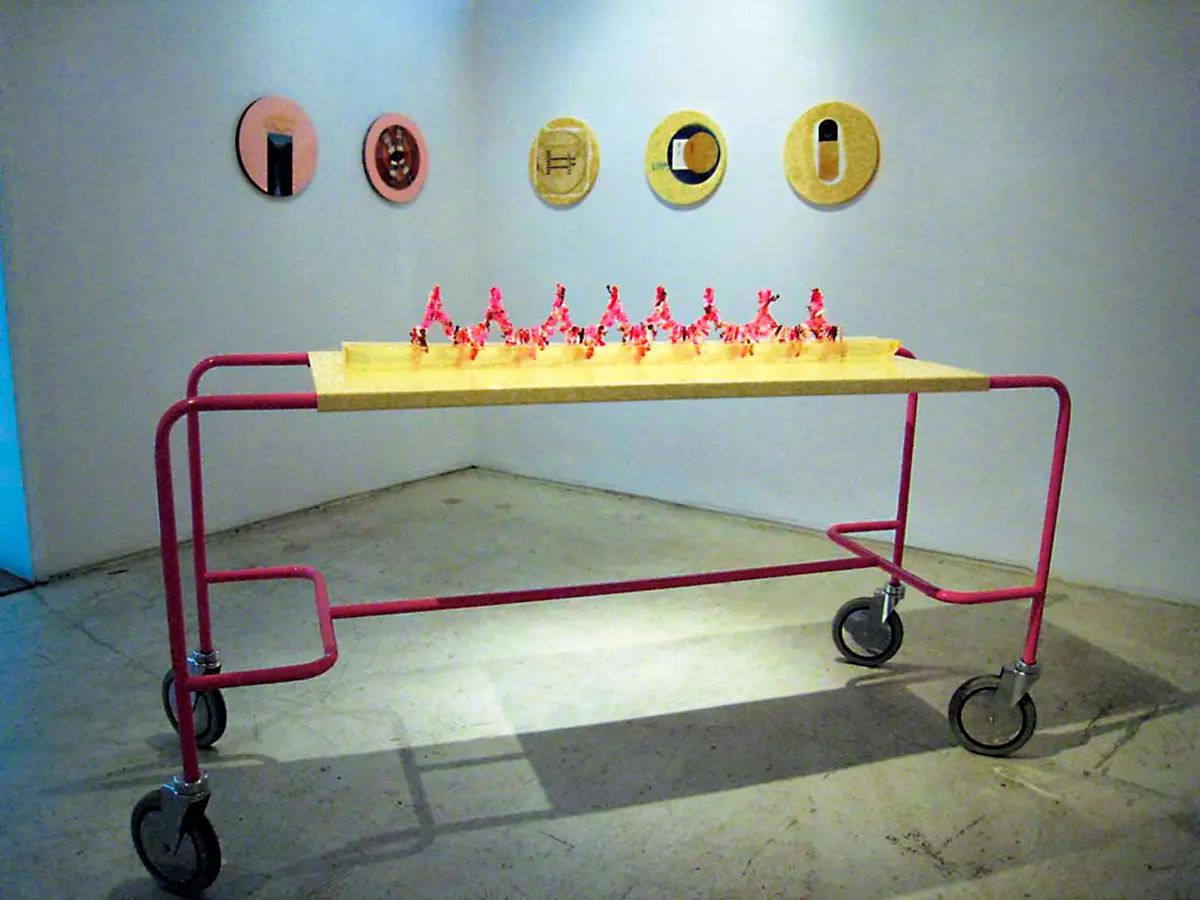
In Gen y Figura, a recent show, the symbiosis between meaning, medium, and form is effective in configuring a final work that explores the representative potential of DNA sequences, dubbed "genetic portraits." The titles of the works are significant expressions of the final result: Cerebro 3 (2006), a soft object in printed wool, acrylic paint, plastic rope, thread, and cotton stuffing; Anorexia Helix (2009), metal spoons arranged in a spiral and covered with metallic paint in four colors; ExTagua (2010), metal bars painted yellow, green, white, and red, forming a moving sculpture reclined on a base; and Fósil (2008), dancing plastic dolls, in intense red hues, arranged on the edges of acrylic rings resting on a rolling table, from an artist who has devoted her work to the interior and exterior auto-relationship of human beings with their context, nature, and the lives of others.
The superiority of the abstract-figurative object, an important aesthetic and visual duality in this new proposal of "body art," is not about direct use of the body, but of certain features of personal identity based on DNA. Built with a certain degree of irony, the genetic structure as the basic model defines the object, visually, as a reality in crisis. The chromatic intensity of the work connects with this reality and with the shapes selected, generally activated in an industrial way, bought in markets (spoons, plastic dolls, dissection table). The repetition of identical shapes, in the end, creates an imaginative baroquism filled with great powers of conviction and aesthetic force, bordering on the concept of the "new beautiful."
BÉLGICA RODRÍGUEZ