
When a notable artist dies at a young age, we are left to wonder what he would have achieved had he lived a long and productive life. In the visual arts, this has occurred with Van Gogh, Egon Schiele, Basquiat, and Félix González-Torres; early losses in the literary world included Rimbaud, José Martí, and Federico García-Lorca, and in music, Mozart and John Lennon, among others. At the local level, this is also the case of Puerto Rican artist Ralph DeRomero. He was born in New York in 1946 and died in Puerto Rico in 2000. For more than three decades, DeRomero had a very productive and eclectic artistic career prior to his unexpected and untimely death. A painter and sculptor, the artist was able to effectively establish a dialogue with the international visual arts of his time, and he also succeeded in developing his own aesthetic and ethic discourses that, in very diverse ways, reflect his existential and political reality.
Unlike other artists of his generation, DeRomero was never unconditionally backed by the art critics, and he never really belonged to any specific group—although his association and friendship with Rubén Ríos, Peter Gaztambide, and Luis Hernández-Cruz, among others, was well-known. Nonetheless, the Museo de Arte Contemporáneo de Puerto Rico decided to organize a retrospective exhibition that opened in October 2010 and remained open until January of 2011. It was an interesting and impeccably executed retrospective that was successful in projecting DeRomero's work to a wider and more diverse audience.
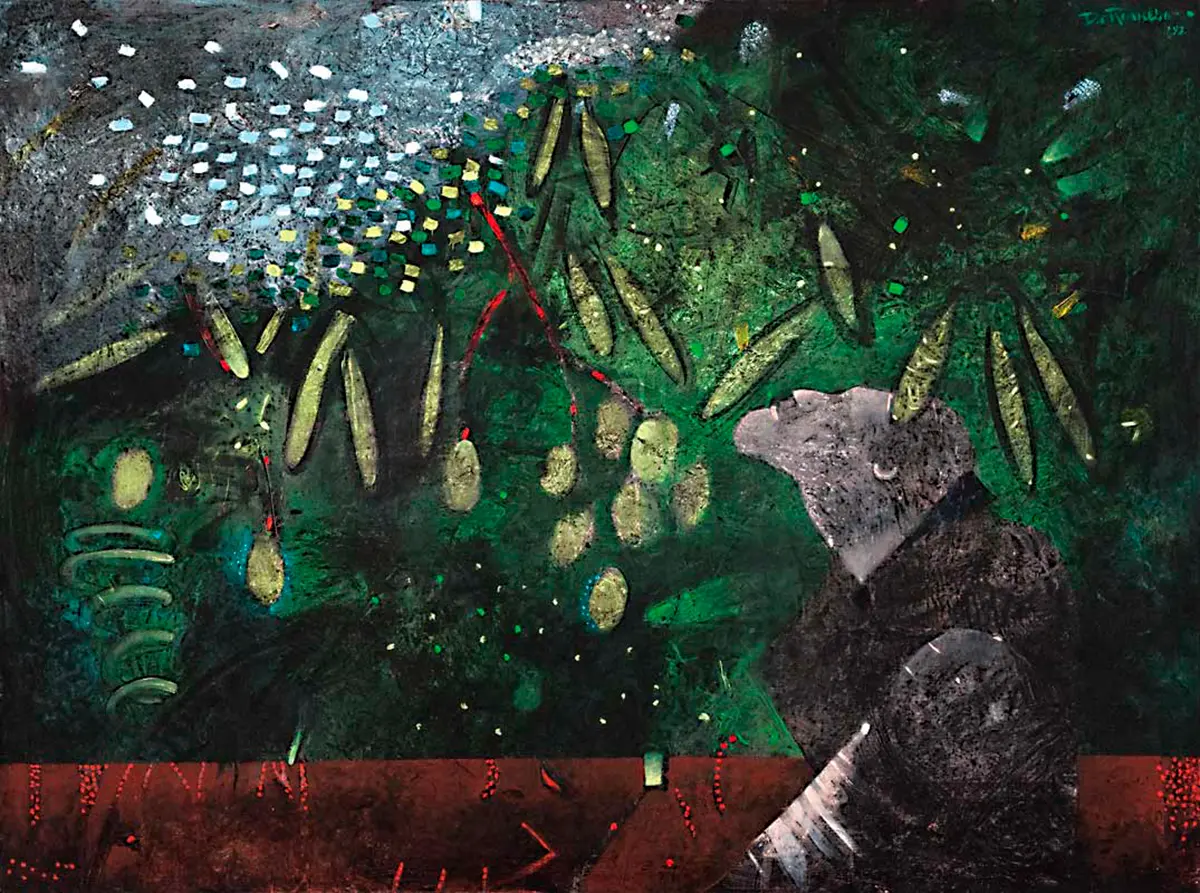
DeRomero was an artist who experienced his freedom intensely. He possessed a compelling combination of attributes, as he was both a bohemian and a conscious citizen interested in political justice. He chose to recreate or invent "his worlds" in many of his best compositions; he observed and interacted in environments as complex and contradictory as the island of Puerto Rico. He always fought against being classified; thus, any attempt to associate him with any style or artistic current would be impossible. DeRomero searched for "his magic" as he worked to "translate" elements from his surroundings and his imagination. In many of his works, he used any artistic means to convey enigmas, poetry, and challenges. In his diary, when the artist wrote about the importance of "dismembering things to then reassembling them...," he clearly stated the reasoning behind his body of work: "I have created many strange paintings. Sometimes, when I look at them again, I am amazed at how strange they actually are. But they are beautifully strange." Nonetheless, DeRomero was indeed influenced by international masters in the field of neo-figurative art, expressionism, and abstraction, by Puerto Rican figurative masters from the famous Generación del Cincuenta (Generation of the 1950s)—Carlos Raquél-Rivera, Domingo García, Rafael Tufiño, Osiris Delgado, Félix Rodríguez-Báez, Felix Bonilla-Norat, and Lorenzo Homar—and by the others that followed—José Rosa, Anaida Hernández, and Luis Alonso, among others—and also by the most prominent abstract artists—Julio Rosado del Valle, Luis Hernández-Cruz, and especially, by the best Puerto Rican abstract painter of the 1980s, José Roberto Bonilla-Ryan. On the other hand, DeRomero's work is characterized by the successful development, during the majority of the 30 years of artistic production, of aesthetic and ethic "games" that are notable not solely for their content, but also because they were constantly revised, something clearly observable in his drawings, paintings, and sculptures.
DeRomero is prominent for his portraits and self-portraits, such as his 1976 works titled Autorretrato (Self-Portrait) and El Men. In Puerto Rico, portraiture is an artistic tradition that gained strength during the 1950s, with Julio Rosado del Valle, Domingo García, and Rafael Tufiño, and later on during the 1980s with Arnaldo Roche-Rabell, Carlos Collazo, and Maria de Mater O'Neill. The female nudes he created, especially during his stay in Paris (1993-1995), also represent some of his best works. These are genuinely lyrical, passionate, and unrestrained images. The artist loved the physical beauty of women and the enigmas and surprises that it generated. Throughout his artistic career, DeRomero rendered the female nude through different approaches—realism, figurative expressionism, neo-figuration, and semi-abstract forms.
Although DeRomero has stated that "My painting is independent of anything that inspired it," the artist is nevertheless a reporter of his time who used humor and a sharp gaze to convey striking images. Speaking about his paintings, he said that these "must be about the human experience." This is the reasoning behind the fascinating scenarios that appear in works such as Noche de Barrilito (Barrilito Night) and Chesterfield, both done in 1985, in which DeRomero would "translate" a series of harmoniously phenomenal realities and fictions.
In the opinion of this art critic, the work that clearly distinguishes Ralph DeRomero is the series entitled Aquarium (1992). It consists of watercolors and acrylics of various dimensions—painted between 1978 and 1992—that aid us in understanding this artist's proposal. Throughout his artistic career, DeRomero relied on anything that would help him create his works. But in Aquarium, he decided to destroy, dismember, and deconstruct the images of various fish—their colorful or striped surfaces, fins, spines, gills, and even the magic of the waters that they inhabit—until achieving an abstraction full of life and movement that is very much his trademark.
In Aquarium resides the essence of a rebellious, generous, and unrestrained artist who demonstrated an unwavering desire to experiment and provoke, and who continuously challenged our propensity to accept certain notions because they are fashionable, or as a result of our ignorance or snobbishness.
MANUEL ÁLVAREZ LEZAMA