
The study of the space as environment, site, territory, or perimeter in which to perform the activities of human beings, is a recurring theme in Richard López's work. In the last few years, his compositions have acquired a panoramic dimension that expands to the urban circuit, as he approaches the landscape genre through the traditional oil on canvas medium. Aside from some exceptions to the rule, such as the series Centros de Poder (Centers of Power, 2009), since the beginning of his artistic career, López has favored unusual compositions in which there are usually no human beings. His proposals represent sites and places inhabited or visualized by individuals who do not appear in the scene in a relevant way. He began by describing indoor places that transmitted that stillness so common in paintings that rely on conventional themes, such as still lives. In compositions of this kind, it is possible to guess angles and crevices intercepted by everyday elements—even inconsequential ones—like lamps, furniture, doors, windows, etc. With these, space acquires a prominence similar to that of stage design. López's palette—tonally restrained but incisive when it comes to establishing contrasts—confers the images with a welcoming, familiar and peaceful feeling. An example of this is the series entitled Espacios Habitables (Habitable Spaces, 2004). Eventually, López abandons intimacy in favor of exploring the close surrounding, as he inquires in corners, sidewalks, façades until reaching the open spaces. He draws buildings, rooftops, fences, as well as architectonical details that are referents to the urban conglomerate, as observed in the series Tránsitos (Transits) and Ornatos (Ornates), from 2008, and Azoteas (Rooftops), Vistas de la Ciudad (Views of the City) and Vallas (Fences), from 2009.
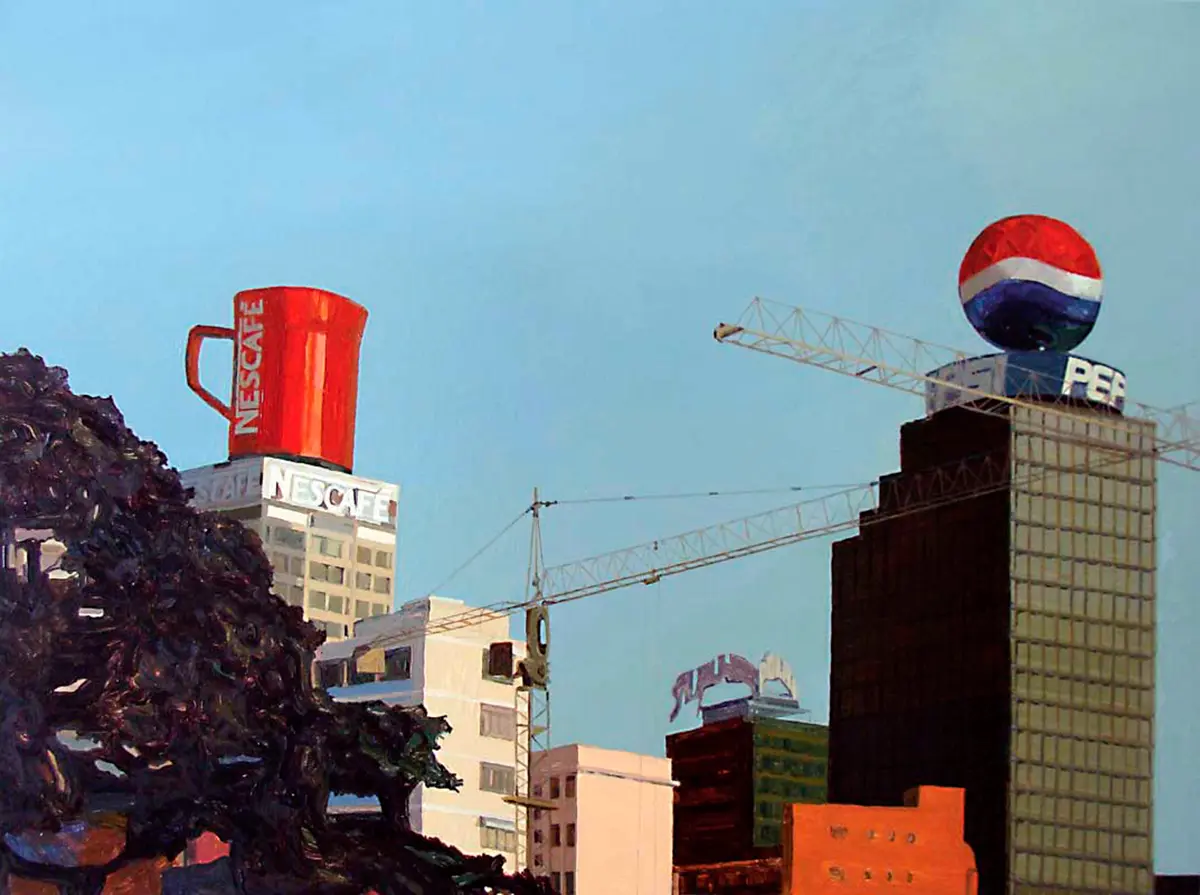
These inquiries are reaffirmed in the recent production by the artist entitled Richard López. Pictorial Caracas, exhibited at the Galería Carmen Araujo Arte, from November 14th to December 19th. The exhibition consists of a group of nine medium and large format works created during 2010. They render the architectonic, advertising, and atmospheric elements found in Caracas. With a realist brushstroke, the artist describes emblematic constructions and areas of the Venezuelan capital: the Torres del Centro Simón Bolívar, the Torre Polar, the residential area of Parque Central, Lecuna and Bolívar avenues, and Plaza Venezuela. Like in any other cosmopolitan city, such views include billboards that are part of the collective memory. In the series Vallas, for instance, the diaphanous atmosphere renders more vivid colors, while it also highlights the outlines and large-scale designs of the Nescafé brand with its huge red cup that contrasts the Pepsi-Cola sphere; as it can be observed in the works Torre Polar (Polar Tower)—one image represents the view from the northern side of the tower and the other the view from its southern side. Currently, both billboards have been removed from the structure that supported them. According to López, "The city and its urban landscape offer an endless supply of themes. Caracas is dynamic and in a continuous process of transformation; it is colorful, lush, and strident."
In the series Torres del CSB (CSB Towers), Vista Oeste (Eastern View), and Vista Sur (Southern View), López focuses his attention on those buildings that marked the beginning of modernity during the 1950s in Venezuela. Designed like two twin towers, it occupies a block that is an iconic landmark in downtown Caracas. It has been widely shown in books, postcards, and photographs throughout the recent history of Venezuela. Nonetheless, López is not afraid of recreating the typical compositions that characterize this traditional architectonic complex. But aside from representing the splendorous contrast that gives life to the city during sunny days, the artist has also wanted to capture the foggy shadows; that sort of light and invisible mist accompanying the intense luminosity that usually impregnates the city with a summery atmosphere. One that envelops the outlines of trees and the concrete structures projected through the light, in a game of crowded vs. empty elements interacting within the immediate horizon. This can be observed in the series Calina (Haze) and its several versions: Gris I (Grey I) and Gris II (Grey II), Av. Lecuona (Lecuona Ave), Sepia, Torres del CSB (CSB Towers), and Av. Bolívar (Bolivar Avenue). In these compositions, the chromatic bursts disappear in favor of a range of blacks, maroons, grays, and telluric sepias that converge into a scale of values and degradations. A painter above all, López commits to the contemplative vision of those variables. He knows how to look at the climatic changes, as he empathized subtleties, the ethereal, and the evidence. López transfers that collection of feelings that reverberate in his interior into the canvas. According to the artist, "the urban landscape is a visual event that incites the pictorial act. It is comparable to the pleasure of rendering an exquisite still-life, one served to be tasted, portrayed, and painted."
GLADYS YUNES YUNES