
The exhibition titled Traf by Roberto Noboa (Guayaquil, 1970) at the DPM Gallery (November 18, 2010 - January 10, 2011) represents a destabilizing and performative gesture that vindicates the deconstructive nature of painting. In the hands of this artist, painting is revived and illuminated. His treatment of the genre is exemplary in the way he approaches the themes and in the sensation of estrangement his works generate. Even the title of the exhibition—which alludes to the vitamins used by athletes to inhibit pain, and that alter the organism's immune response—Noboa attempts a perceptual game that questions our levels of information and the possible readings generated by the proposal. At times he appears to be making fun of us. His comments about the title: "It reminds me of that song by [Joaquín] Sabina titled Pastillas para no Soñar (Pills to Avoid Dreaming)," added to his provocative reading that animates his canvases, "because the artist is prone to keeping his cards close to his chest," convey a metaphor about the laxity and disenchantment of our Latin American contexts.
Traf unfolds into a long discourse that takes intricate paths. A friend of mine who participated in a conversation with us the other day, helped me choose the most concise way to summarize Noboa's frame of mind. My friend invited me to see the film La Ciénaga (The Swamp), awarded Best First Film at the 2001 Berlin Film Festival. Afterward, I had to agree with his assessment of Noboa's mysterious ways. A common denominator among Lucrecia Martel's characters in the film is the dense and inconclusive—in suspense—plot they participate in. An uncomfortable and conspiratorial narrative—we feel as if we are taking part in the story—pulls us in at the same time it makes us want to abandon it because of its contagious stupor.
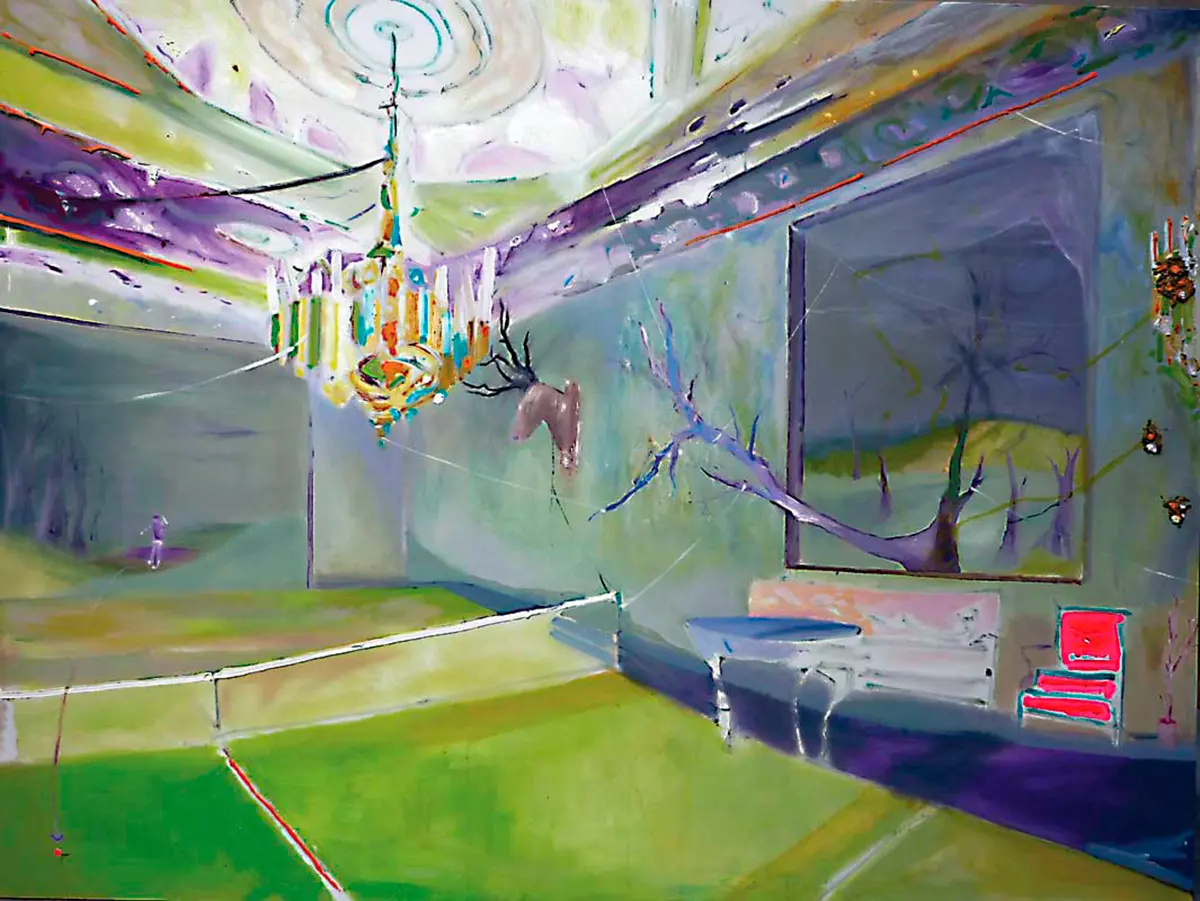
Roberto studied in the U.S.—he completed an M.A. in Fine Arts from New York University—and his narrative announces an atypical ethos. Nonetheless, I have come to realize that his work is not given the recognition it deserves. To Noboa, surviving—in the most basic sense of the world—has not been a challenge. But being recognized as a creator is another story, as he has encountered many obstacles precisely because of his dedication to undoing the frivolous environment and extreme apathy of the art world he is part of. For better or worse, he lives in that environment marked by his evolution there as a social being and as an artist. He has "rescued" himself and has been able to survive as an artist, despite being considered a misunderstood artist—which is actually true—by those less involved in the art scene that he is part of. While the recurrent elements of his earlier works involved images of tennis courts and people playing in them, in his most recent images he similarly introduces Ping-Pong tables and people playing golf1; as these are the preferred sports of the upper class, or simply because such activities represent symptoms of the disdainful attitude toward the truly relevant. He has also brought back the tennis courts, but now these do not have the protagonist role of earlier works. It would appear that the thread these are part of has been increasingly becoming more complex.
Neo-expressionism, bad painting, dripping, conceptualism, and neo-avant-garde, are some of the revisited languages Noboa relies on to involve us in an annoying languor. His poster boards and canvases contain absurd situations like the ping-pong tables that are either placed in the middle of nowhere or can be found hanging from ceilings; a swimming pool inside a room, the cypresses, hangers that do not hold anything, animals that can graze in any place—and in some occasions are not that recognizable—and that are equally arranged in altered perspectives, superimposed planes, and surrealist atmospheres that are veiled at the same time. I think that Noboa's painting could be summarized as a decompensated neurosis, as the mind of a neurotic patient who says "yes, but..." His work represents a diagnosis of societies doomed to misunderstand their histories, their past, their strengths and the complexes their weaknesses cause them. As long as our societies lack the ability to self-criticize, our republics will continue to wander aimlessly in a dead-end street. Recognizing it would be the first step toward finding a cure. It is a condition that the artist conveys through washes, translucencies, blurrings, and titles such as Ellos Estaban Ahí, se Habían Escondido (They Were There, They Had Been Hiding), Perros Finos Pero Re-brutos (Purebred but Really Stupid Dogs), Se Fueron Dejaron Todo con Iluminación con Timer (They Left, They Left Everything Behind with Timer illumination), Pensando en las Oficinas de Algodón (Thinking About the Cotton Offices). These add to the sense of being in a nowhere land, and to the increasingly unsettling feeling of being asphyxiated by unanswered questions. There is barely any space for human figures. The sets consist of rooms and exterior spaces in which everything appears to occur in a scenographic time under a dense calm. There, one can perceive signs that allude to affluent lifestyles: hunting trophies, sophisticated lamps, large living spaces, and vast properties. The texts Noboa uses suggest continuous migratory processes, a delegation of powers, utopias, and evasion or responsibilities; all symptoms that have led to burden the destiny of a subject who has arrived late to every encounter. Unlike Noboa, whose work has descended upon the art world just in time.
NOTE
The tennis court has been a constant element in Noboa's poetic. It represents a way to convey a frivolous world that is indifferent to the timely decision-making our societies require.
AMALINA BOMNIN