
The photographic work by Alex Dorfsman comes from a patient and honest gaze inspired by a question whose answer, although always on the verge of being enunciated, is never quite posed because it is being continuously reconfigured.
Currently being presented in a second venue—it was first exhibited at the Centro de la Imágen, in Mexico City—at the MUSAS, in Hermosillo (Sonora, Mexico), the exhibition showcases a rich visual body of work under the guidelines of an unsettling narrative: This Mountain collapsed and became a bridge, a phrase from Dorfsman’s past that alludes to a mockup created by a kid that the artist saw at a summer camp in Marfa, Texas. Decontextualized, the phrase—narrating the apparently impossible event—suggests highly potential literary-philosophical images that impress upon us borgean and metaphysical interpretations rooted in the East. Placed in the neat surroundings of the white two-sided pages from which the exhibition unfolds—like an expanded artist’s book—the idea of the collapsed mountain-turned-bridge is a present element in all the compositions throughout the show, and Dorfsman reveals page by page as if he were about to tell us a secret. This is one weird—almost ontological—a symbiotic relationship between the exhibition’s title and the work presented. The imaginary tone initially imposed in the inflection of the words, eventually reveals its outlines and specific weight as the walk through the exhibition progresses.
The two-sided page format—or open-book format—chosen by the artist as the reiterative frame in which to structure this exhibition of photographs—most of these taken during his recent stay in Berlin—allows him to arrange his images into triptychs, diptychs, and a couple of single images, as he effectively recaptures the original essence of the first project exhibited in 2009, during the International Artists’ Book Fair at the Centro de la Imagen. The recovery of this rendition across walls enables the emergence, from within the constellation of images, of echoes and reverberations that sometimes are so intense that it becomes indispensable to separate their individual existence from the interconnected state Dorfsman has suspended them in. Viewers soon get a sense of the prevailing state that enables the work’s formal and chromatic additions: everything is in a perpetual state of waiting—searching for confirmation of its condition as a shared sensibility; as an improbable suspended state.
In the philosophical inquiries confronted in his “fragmented novel” entitled Awaiting Oblivon, Maurice Blanchot unknowingly explained the rhythm that brings together Alex Dorfsman’s photographic inquiries in this exhibition: “To wait, to make oneself attentive to that which makes of waiting for a neutral act, coiled upon itself in tight circles, the innermost and outermost of which would coincide, attention distracted in waiting and returned all the way to the unexpected. Waiting, waiting that is the refusal to wait for anything, a calm expanse unfurled by steps.”
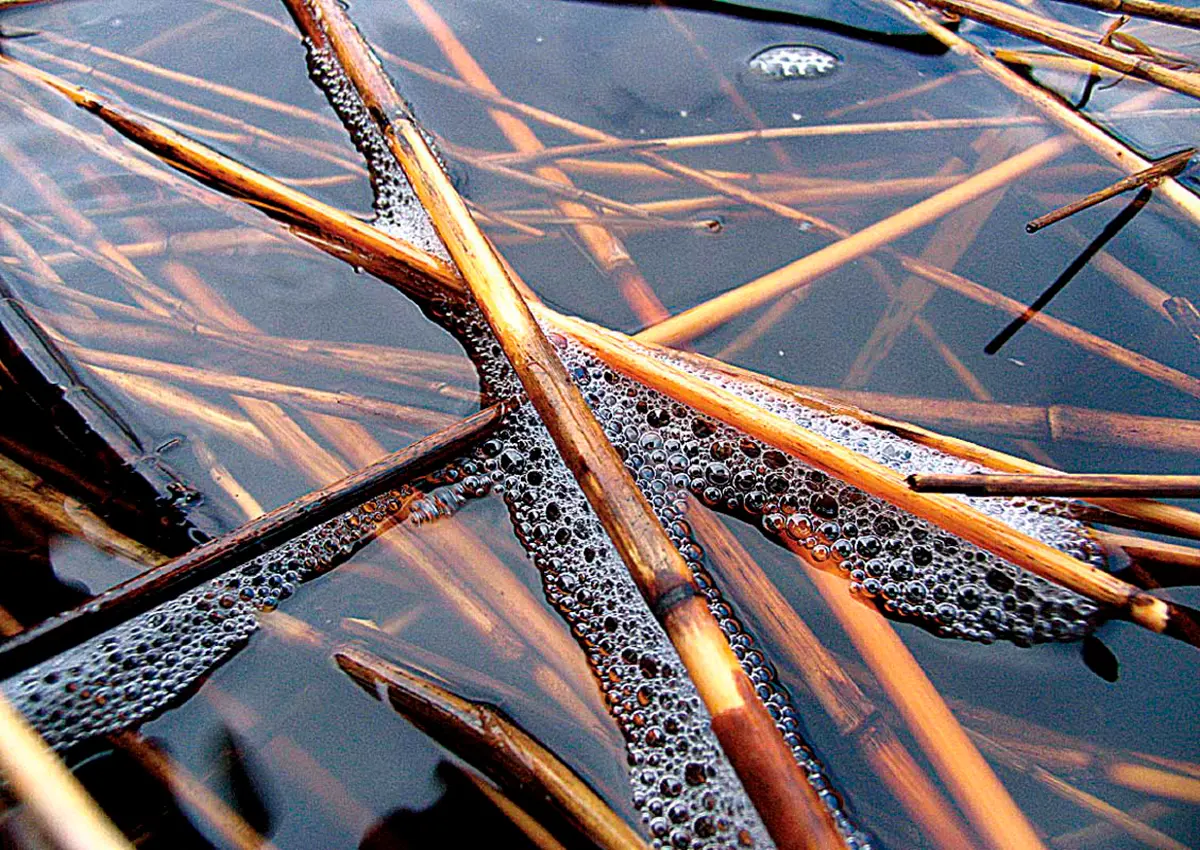
Like small confessions, the artist ties one by one his small encounters, between the cracks of a Dutch baroque oil painting and the surface of a lake wrinkled by the wind; between the reflections of the hat covering an Egyptian pharaoh’s profile and the design that tears out the skin of a coral. His are minimal and yet infinite themes: plants, animals, architecture, mundane objects, fossils, paintings, sculptures, etc.; everything that can be captured to understand the suitability of the transformations that occur in water, during its stagnant, hazy, bubbly, fluid, frozen, evaporated and drizzled states. The perceptive gaze inhabiting these images takes us back for the disconnected discourses of their fragments and borders into a space of pure continuity. It also occurs that, amid the sparkles, surfaces, textures, forms, tonalities, shadows, smoothnesses, and opacities, one forgets the essential discontinuity that makes photography the fragment of the visible archive of the “livable.” Without the referents, the discontinuities—that in all likelihood physically and temporally kept the figures separated—are forgotten. One forgets, for instance, that a giraffe’s neck perhaps does not have “anything to do” with broken glass on a musician’s photograph or with wet sticks in the chants of the aqueous body. We decide to follow Blanchot’s suggestions about the fractured reading: “Let’s remember that, despite everything, a discontinuous form can continue to be a form and carry the intention of an uninterrupted movement.” We decide to believe that, from the collapsing of a mountain, a bridge will inevitably arise.
MARCELA QUIROZ