
For the third time in Paris1, Álvaro Oyarzún (Santiago, Chile, 1960) is present in two important exhibitions. Without forgetting the two great drawings on tracing paper of the interesting collective by La Maison Rouge on the theme of cannibalism in the art (All the Cannibals)2, in this text, we center on his individual exhibition of sketches, some with paint. The Galerie Catherine Putman, specializing in works on paper, presented the unedited works of the Chilean artist whose observation and analysis require sustained and permanent observation. In effect, Oyarzún’s specificity lays the application of a system of correspondences, fusion, and dialog between text and image, between image and text. To obtain this discreet clarity of form, he utilized the Rotring technique and black China ink with freedom and virtuosity of execution that allowed him to infuse the space with light and delicate drawings in an obsessive and unending whirlwind in which there is as much to read as there is to see. Thus, sense and form are unable to be disassociated in it, impregnated as it is with humor in which emotion (sadness, desperation, anguish, etc.) – with an entire phraseology of daily sentiments – such as, with the numerous literary and artistic reference of which he took advantage, as an intermediary, to enunciate his tastes, his displeasures, and his choices, as well as his permanent reflection on art (“Painting is nothing other than distilled thought”). Thanks to his domination and ease of gesture, much akin to automatic writing, he distributes on the surface of the paper an entire prolific and anarchistic maelström of images that bring to mind, in this instance without color, the graphic volubility of an Antonio Seguí.
In the first salon, two ensembles confront each other: an installation, and a series of ten drawings. This presentation in the dialog was selected by the artist himself, thinking of those who would be contemplating it. The nearly one hundred fifty drawings of different sizes supports (colored papers), and techniques (collages, sketches) that are juxtaposed on small informal paintings constitute a broad “constellation” (approximately 6 m in length by 3 m in height). In this unnamed ensemble, nothing is free; everything is minutely calculated by the artist, who constructs a visual space to arouse esthetic pleasure in the observer. There are also many sainetes (vignettes), with one, two, or three personages: small designs rendered in pen in which each is expressed by means of text bubbles. Although eminently visual, Oyarzún’s work is very narrative, and the text, delicately traced, serves as a conductor of the senses. The artist needs to make his drawings intelligible; thus, he includes much to read. The paintings that appear here and there, in palpable and sensual concretions, can be taken as the formal, dense, and colored transpositions of his spider-like drawings, almost immaterial, which make up the essential plot, which is as much art as existential.
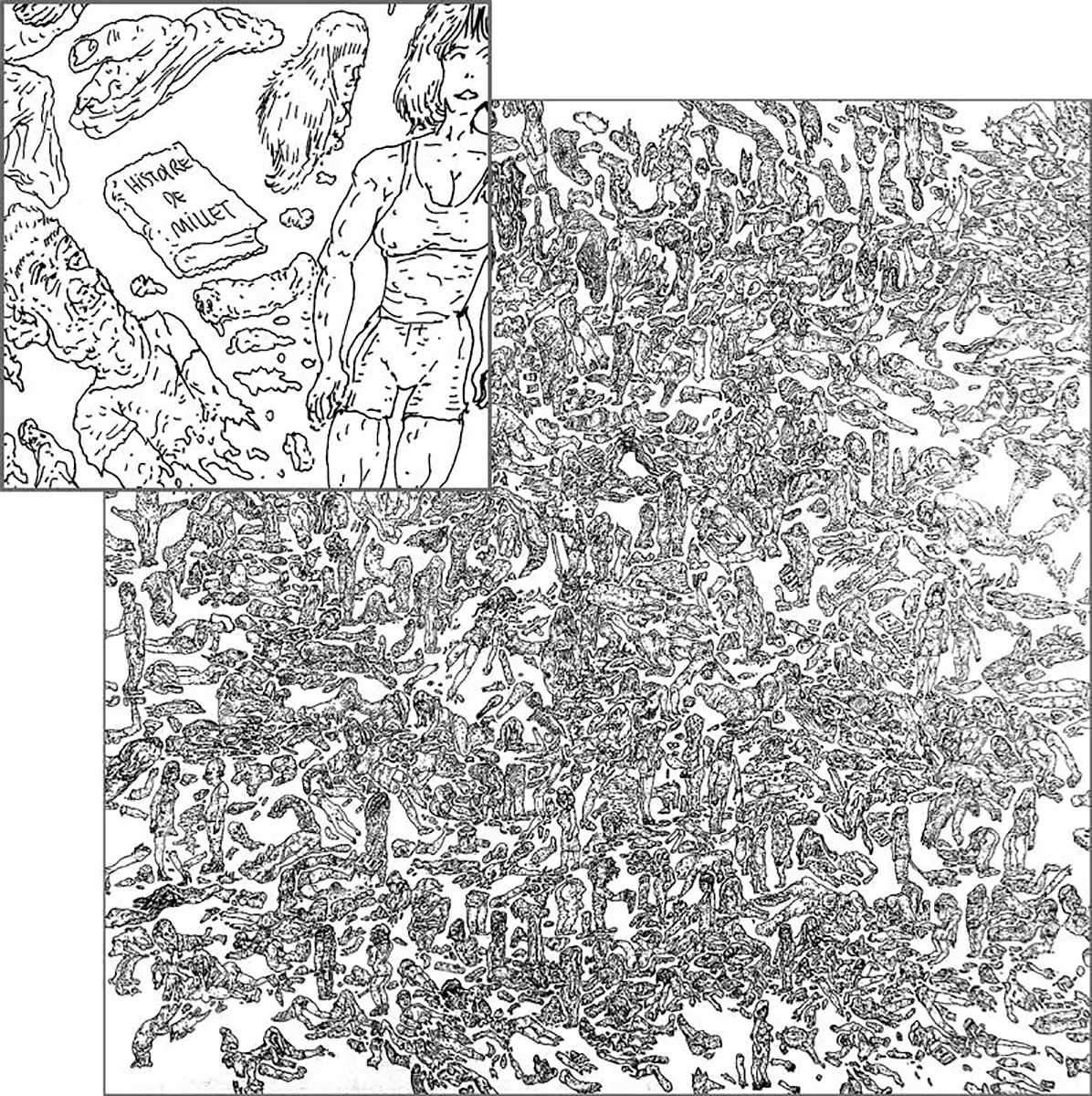
On the front wall, ten black-and-white drawings make the forms burst and disperse. Some of these continue to show the fragmented figure, reduced to a thousand pieces; others are attached to some of the artist’s recurring abstract deformations, phallic or vaginal forms, torsions in knotted wood, an evocation of nature and of sex, dominated by the constant justification of the text. Space, always neutral – white on the support paper – is a vacuum that serves as the drawing’s counterbalance, both symbolically and esthetically. The “informed” figures are like plant roots or protuberances, a species of “specters” that afford a tragic and dramatic vision of the world, but one in which humor, sarcasm, causticness, or irony are present. A desperate world, but one that permanently regenerates itself. The quivering of the stroke is also a symptom of this fragile world, never static, always in movement. Time is required to capture the connections, to understand that the fragmentation of the forms should be assimilated as a whole and that this constitutes a coherent whole, in permanent revolution. Everything is born and dies at the same time. There are no programmed beginnings or ends. The work titled Composition (china ink on tracing paper, 2011, 103 x 106 cm) is symptomatic of this phobia of the vacuum where monsters and human fragments confront each other in a macabre dance, anthropophagical or cannibal, after Bosch and Brueghel or the deformed and terrifying sculptures of Roman architectural capital.
The second salon presents essentially what the artist calls his “Thematic cartographies.” Organized around a great nebulous coloreada(painted) piece, semi-liquid, semi-cottony, the texts unfold in the white space by means of visibly identical and numbered sequences, in an order that joins them through a light stroke to the central “body.” Whether these are concerned with diseases, floors, art, or parasites, Oyarzún proposes an organization/disorganization of the world that the metaphor of the nucleus concretizes visually and conceptually. From origins to destruction, from yearning for love to their fragility and loss, of the evolutions and changes in art, nothing is constant, and it is perhaps in this parable, apparently desperate, that the perenniality of the ephemeral and of an eternal renovation is drawn.
NOTES
1. Collective expositions in 2010: at the Foundation Louis Vuitton (from February to May) and at the Galerie Catherine Putman (from March to May).
2. From February 12 to May 15, 2011.
CHRISTINE FRÈROT