Scenes to Avoid Nightmares is the title of the individual exhibition by Medellin-born artist Angélica Teuta at the Galería Casas Reigner in Bogota. It consists of a large installation on paper that proposes three-dimensional alternatives to the light and shadow proposals she developed in earlier exhibitions.
Angélica Teuta, the dweller of social networks and intermediate scenes, has constructed a career characterized by a solid language based on romanticism. The work of art is understood from the perspective of light, an apparently anachronistic concept, a formal commitment to shadows, and, above all, a way of being sensitized to contemporary art so romantic that it even feels like some adolescent longing for his/her first love. Her work is truly inspirational. So much so that there are infinite ways to describe it: delicious, structured, clear –in spite of the undefined space– reflective, present, and verbalizable. It is work conceived as installation, as sequential inquiry, and as the exteriorization of intimate processes.
Scenes to Avoid Nightmares is an exhibition that presents a sequence of circumstances that belong to the dark world of dreams. Although there is some degree of literalness in their structure, the result maintains a homogeneity achieved through a vast three-dimensional forest in which all the scenes are conceptually intertwined like a creeper.
The first sequence involves a nightmare in which a child runs after a rhinoceros –Dürer's rhino– without being able to catch it. The frenzy, anxiety, and desperation involved in going after the desired object also inscribe us in the realm of lovelessness. A desperate struggle to attain something that is out of reach; a commonplace that causes shudders and flashbacks one would rather forget.
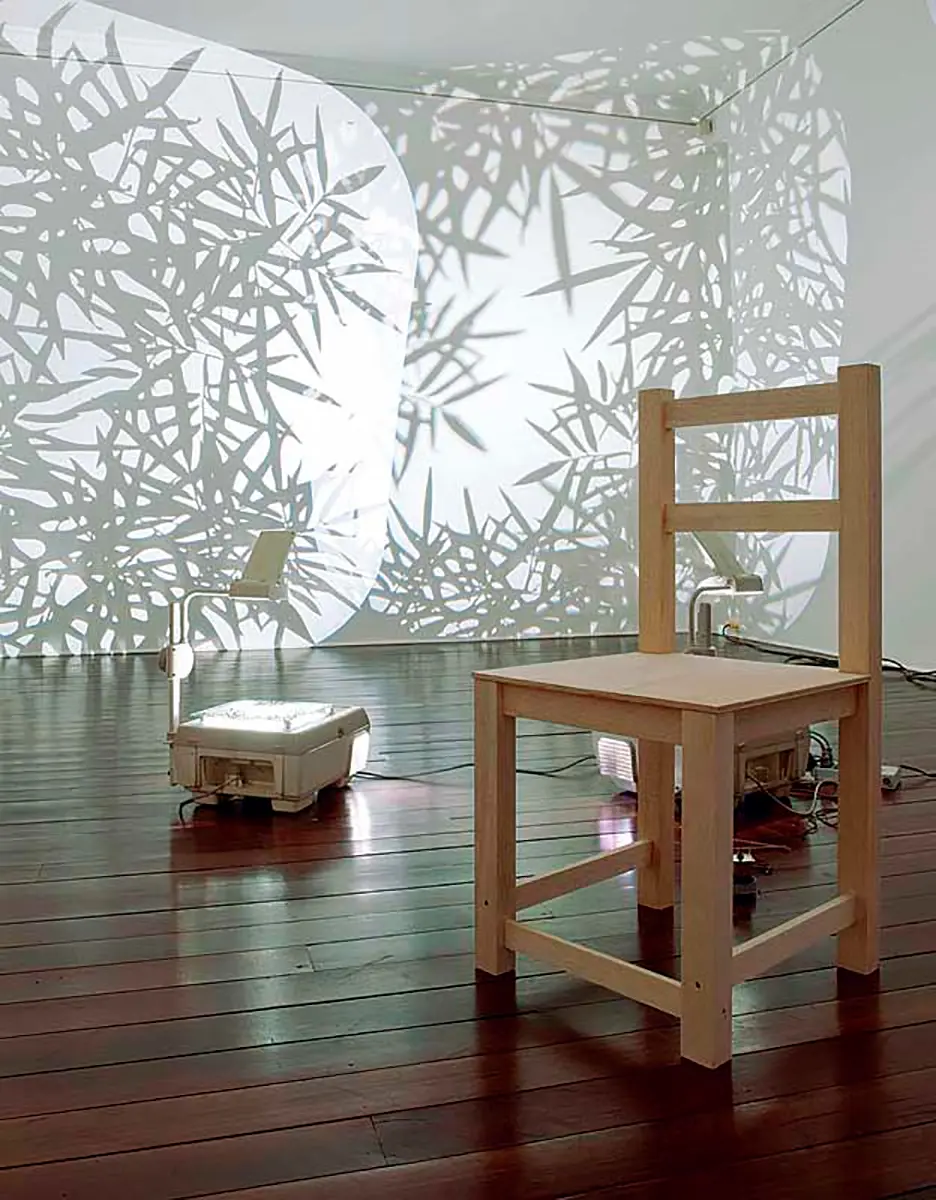
The second scene appears to have been taken from one of the Alice in Wonderland books by Lewis Caroll. There are a giant table and a small chair rotating on one of its legs. It depicts a frustrating situation involving things out of reach and failed attempts, which once again elicit anxiety, desperation, and lovelessness.
The third scene –an incredible bamboo forest constructed with light– constitutes a space for reflection very much in the manner of Teuta: exposes the power of the machine, the fragility of the paper within one's grasp, and a simple mise-en- scène that overwhelms the senses.
Scenes to Avoid Nightmares is a place to keep us well awake, as the nightmares occur regardless of whether or not it is time to sleep. In the end, everything leads to a language that avoids the discomfort of an unwelcome dream, just like one tries to avoid being hurt by unrequited love, disillusion, or by knowing that something could have been avoided if one's actions had been different –all conjectures to enter the complacent world of comfort– where things shine with their own light and harmonize with the environment as if they have been there forever. But this is not reality, and the actual reality that was dealt with us is a much more complex matter. Nightmares exist because we live day after day confronting our dissatisfactions. There is lovelessness because there is no magic bullet to avoid it. While nobody is perfect, there are seemingly ideal situations. In conclusion, Teuta takes us into her forests of fiction to remind us that there are parallel universes inhabiting our souls and that regardless of where we live, our economic status, or race, nightmares are homogeneous, plural, and democratic territory where the scenarios are great conceptual tricks that our mind plays on us.
ESTEFANÍA SOKOLOFF