
Interest in supernatural magic and kingdoms from other worlds are some of the themes artist Christiaan López-Miró has been approaching since 2007, through a research, documentation, and exploration process that he presents to the public through photographs. Originally a process to capture the world more vividly, this work has evolved into a depositary of memories, into the physical representation of experiences and creative possibilities, and into the generator of a new language.
This fascination with the occult, the supernatural, and the touch of mystery can infuse in a work, led to the exhibition All Roads Lead to Cassadaga, curated by Jane Hart, at the Art and Culture Center of Hollywood, in Miami.
The series of 21 photographs—created with a 6 × 6 camera—was photographed in a small community that dates back 115 years and that belongs to the National Register of Historic Places. It is located in the central area of Florida called Cassadaga Spiritualist Camp. There, López-Miró spent time capturing various elements, spaces, situations, and rituals that occur in that place, such as a temple or a church, healing sessions, or personalities from the community, among other things.
The people living there are regarded as spiritualists, mediums, clairvoyants, and healers. Because of this, the community became a place of interest for the artist. Although it is not a very open and accessible community, López-Miró convinced the people there to grant him access for close to three years, as he was exposed to rituals and other experiences that originated in this place.
The artist’s gaze revealed through the photographs transforms something that is mysterious and occult for most people, into something that becomes interesting through the details. The artist is able to convey through the camera lens that photography has the ability to reflect elements—of intrinsic connotations—in the form of sensations or feelings. His images are characterized by the combined utilization—as an indispensable means of communication—of details, description, and expression. Through their combined use, the artist studies several relationships between the real and the “impossible to photograph,” the photograph and the “possible to photograph,” as well as the real-photo relationship.
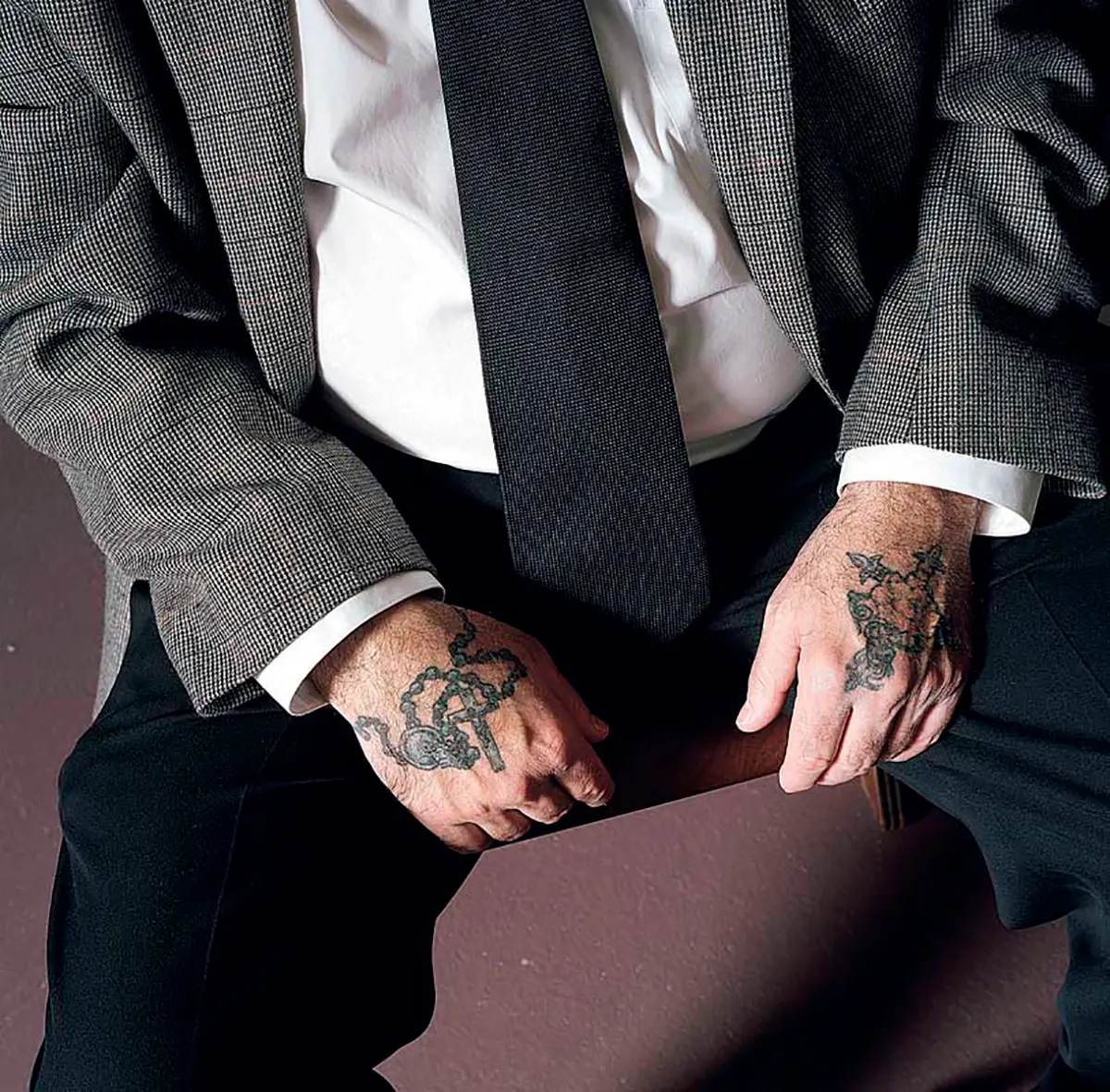
Healing Hands is perhaps one of the most compelling photographs of the exhibition. There, a seated man appears in the foreground with only a section of his body—from the chest to the knees—appearing in the frame. The artist describes with great detail the man’s clothes—a suit with a black tie—and his tattooed hands—a series of religious and spiritual symbols.
As a result of this work of exploration and coexistence, López-Miró obtains images of simple and mundane objects, landscapes, spaces, and rituals. The artist does not pretend to show proof of the existence of a supernatural world. He is actually interested in portraying the faith experienced by the members of the community. The experience of the places is conveyed through a selective correspondence between the images and the moments originated by them.
López-Miró invites viewers to look beyond the place where the images were taken and to focus their gaze on the details that are often overlooked. None of the works reflect just the record of a particular reality. The subjective gaze constructs an unexpected topography of the place represented. Landscape and the intimacy merge into the revelation of a timeless present, where representation is combined with interpretation and identity with identification.
DIANA MARCELA CÁRDENAS