
The game of El Gallo (The Cock), an ancient ritual and point of departure for the video installation entitled Juegos de Herencia (Heritage Games), attracted the attention of Clemencia Echeverri ten years ago, while she was traveling across Colombia. During a particularly bad period for exploring Colombia, Echeverri along with a group of artists visited hard-to-access regions where they followed and witnessed several traditional festivities and carnivals. The result of such exploration became the work entitled Chiasma: Audiovisual Experience Through a Tense Territory (2004).
Around July 20 of 2008, Echeverri returned to El Valle (Chocó) accompanied by a new group of collaborators. For a week, she photographed and recorded the development of El Gallo festival and performed a series of actions –having to do with behaviors and gestures associated with the event– with parents and students from this community.
Juegos de Herencia is a 24 minute-long multi-channel video-installation created with video and sound (Dolby 5.1) and put together with takes recorded during the visit to El Valle. In the dark rectangular hall of the gallery, visitors find eight projections on 5.90 × 3.93 feet wood panels arranged in groups of four on the parallel walls of the exhibition space. The images are projected sequentially and at various speeds from one screen to the next. In the back of the exhibition room, there is an approximately 78.74-inch circular projection on a section of the floor covered with sand. Such an arrangement allows viewers to follow the projection through each wall or to concentrate on either one intermittently while having the projection on the floor as a counterpoint. Multiple sounds that originate from several speakers, are complimentary and, on occasion, independent of the images. They help to generate a tense and expectant atmosphere. Additionally, an alternate exhibition room displays the digital photographs that also allude to the game.
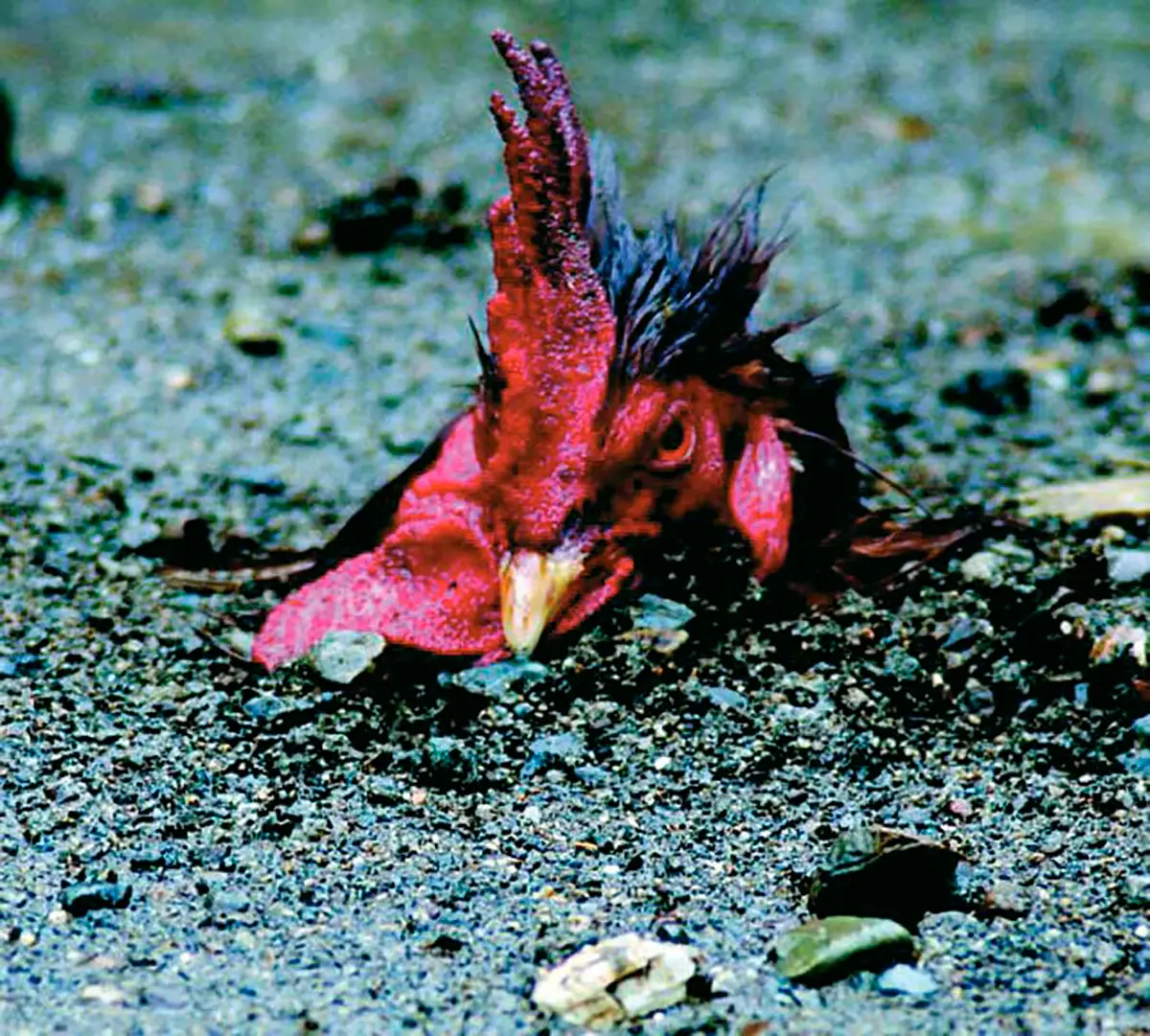
The group of works is inquisitive and revealing about the gestures and attitudes through which it is possible to recognize the seeds of violent behaviors. As a college, the work presents images and sounds that are connected to each other, but that is also open and suggestive in terms of the possible interpretations that can be drawn from them. Such openness can be explained through some of its basic characteristics: first of all, because of the selective –non-linear or narrative–fragmentation and decomposition of images and sounds that come from, or that are associated with, the game; the head and eyes of the cock still alive, the bandages on the eyes of some participants, the opening of holes, the hand prepared to hold the machete, the foot that steps on the cock, the sound of drums, the sea, the excavation, the machete, and the people.
It can also be explained through the conscious selection and edition process –apparently contingent and discontinuous but discriminating nonetheless– performed by the artist. The things that can be observed and heard are as meaningful as those the artist decided not to include.
Likewise, an understanding also comes through the viewer's perception of the successive, rhythmic, superimposed, repeated, and transformed images and sounds. The manner in which the work is presented makes its perception a fact in on itself that must be reconstructed based on the viewer's personal experience.
Finally, the work can also be explained by the questions it proposes with regard to the possible reasons behind the things that are observed and listened to; such as the burial of the living cock and the processes associated with the bandaging; the selection and presentation criteria used by the artist; the purpose of the machete and holes; the meaning of the drums and the aggressive –and yet careful– gestures toward the rooster.
Are the animal and the bandaged persons victims of the same game? Are there strong connections between the abuse the rooster is subjected to and other forms of violent expression? Does the work exclusively allude to a ritual turned into a game, or does it address a context and implications that go beyond it?
The associations made based on the images and sounds –both by Echeverri and the viewer– imply a process of deconstruction of the game, of its recording and of society. Such a process elicits a desire to understand the deep meaning of the attitudes and activities selected, as these reveal radical desensitization in the face of violence that is not exclusive of El Gallo festival but also appears in equivalent and equally recurrent gestures in other parts of Colombia and the world.
Thus, the work allows for the adoption of a self-reflective perspective that turns attitudes and gestures, assumed in familiar or everyday occasions, into questionable, unsettling, and disturbing manifestations; as result, the work incites us to recognize and assume a critical understanding of the undercurrents of our individual and collective behavior, as well as of the altering conditions –historic, economic, cultural, and affective– in which such behaviors are rooted.
MARÍA MARGARITA MALAGÓN