
French-Venezuelan sculptor Colette Delozanne has created a three-dimensional work that challenges the expressive medium that supports it: ceramic. Through the years, she has perfected her technique and has succeeded in overcoming the possible technical limitations inherent to this particular medium to create large-scale works, something never before achieved. She is now able to produce pieces integrated into landscape art that rise imposingly and that are, surprisingly, created with clay and stoneware. Her secret is to burn the pieces at high temperatures, after a complex modeling process in which the artist demonstrates her rich personal iconography.
Everything began with a utilitarian approach to ceramics. Eventually, being the sensitive artist that she is –as well as a student of philosophy, Literature, and Art History– Delozanne soon needed to go beyond the functional aspect of the piece and began a search, in the 1970s, for increasingly more complex solutions involving: scale, the interrelationship between, not forms, but also between several modules (sculptural complexes), the space as an expressive element of the piece, as well as the relationship between the work and the exterior space. It is also important to point to the complexity of meaning in Delozanne's work, as there is a sacred component to it that is immanent to the form. It is this spirituality that is one of the defining aspects of her work.
These aspects were thoroughly developed in the very important anthological exhibition organized, in December of last year, at the exhibition space of the Corp Banca Centro Cultural. The curator of that exhibition, Bélgica Rodríguez, gave it the appropriate title of Tiempos de Devoción (Times of Devotion), as she divided each of these "times" into spaces: Espacios Primarios (Primary Spaces, 1973-1977), Espacios Sagrados (Sacred Spaces, 1977-1985), Espacios Emblemáticos (Emblematic Spaces, 1986-1995), Espacios Rituales (Ritual Spaces, 1996-2002), and Espacios de Creación (Creation Spaces, 2000s). This classification allowed her to clearly organize the exhibition in a manner that, not solely underscored the inherent values of each of the pieces exhibited, but that also allowed viewers to reconstruct an artistic trajectory that expanded fifty years.
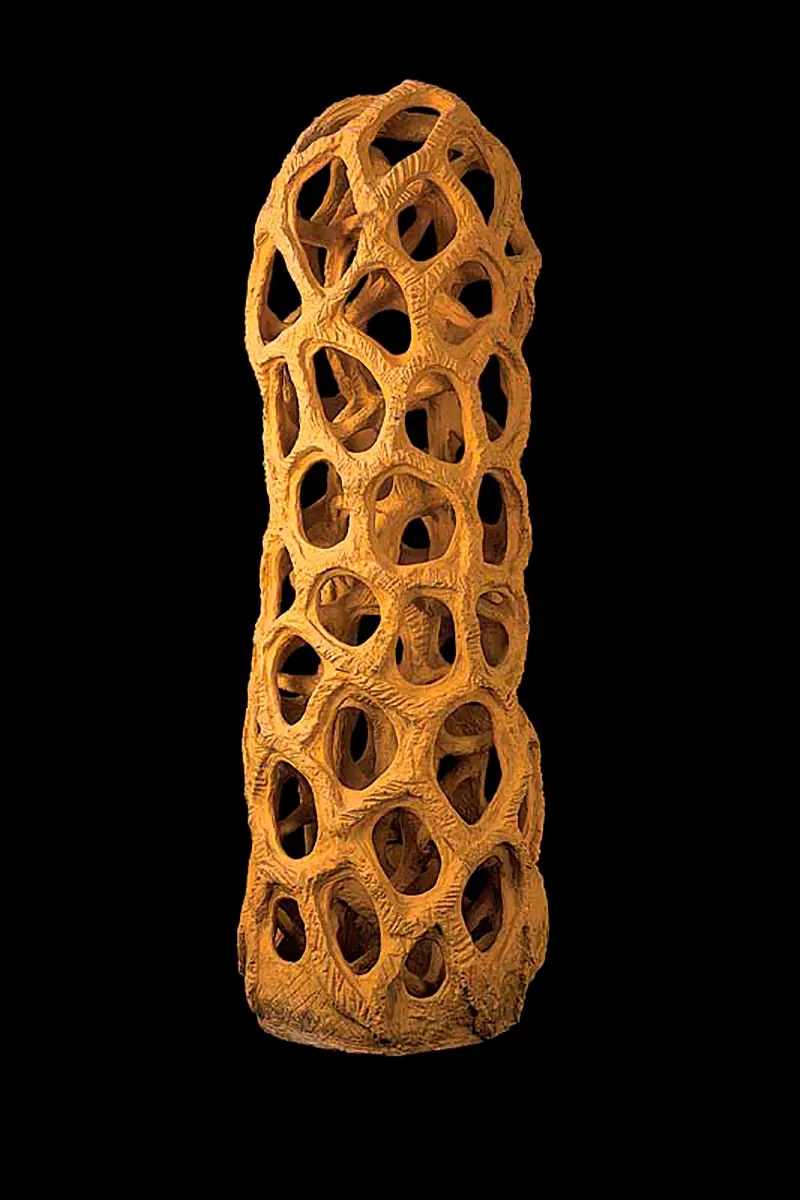
There are two apparently antagonistic aspects in Delozanne's work that she nevertheless is able to reconcile. On one hand, there is a solidity that sometimes alludes to architecture –the towers, strictly speaking– while other pieces resemble developing organic bodies: a coral, a vegetal species. In both instances, verticality becomes an essential element and this generates interesting considerations. In terms of language, the distinctions between figuration and abstraction become ambiguous to the viewer. But regardless of the way in which we choose to view the piece, there is always a sacred sense that holds it together. Delozanne's work is full of mysticism. Some are mandalas or towers that become centers for contemplation.
The combination of opposing elements also results –as the curator correctly points out– in the combination of the two cultures this artist is from Celtic and Latin American. Because of their verticality, some works like Torres (Towers, 1970s) and Tiempos de Devoción (Times of Devotion, 1998) allude to architecture and appear to suggest the presence of a gothic cathedral. It is no accident that Delozanne has said that the medieval castles from her country of origin are embedded in her memory. Other pieces, particularly those from the period of the Espacios Primarios (Primary Spaces) during the 1970s, are inspired by pre-Columbian constructions in Latin America, particularly those by the Incas. They would design their walls by superimposing large stones; a practice also presents in sculpture through the superimposition of blocks, as well as filled and hollow elements. Nonetheless, in most cases, Delozanne combines both cultural references.
On the other hand, organic sculpture –which remits to germinations, fertility, and developing vegetal or coralline organisms– has been a constant element in Delozanne's work. We can observe works like Como un Tejido Encantado (Like an Enchanted Weave, 2004) that appear to be petrified. In them, solid and hollow areas form a weft and a variety of textures that are rich in visual and tactile elements. Thus, we can summarize by saying that symbolic figuration –contained in the towers, cities, and mystical centers of contemplation– is reconciled by an organic abstraction in such a manner that the work becomes either a developing organism or a petrified element. The interesting thing is that both sides of this visual spectrum are merged into a single image when sculpture becomes the "domain of ancestral spirits linked to nature."
Large-scale works by Delozanne are displayed in several places across Venezuela and are also documented in photographs. Likewise, the anthological nature of the exhibition was strengthened by the display of the beautiful sketchbooks used by the artist to conceive her sculptures and write her thoughts. The sculptural narrative and the writings considerably enrich the exhibition experience, as they reveal her creative process. In other words, they showcased the manner in which sculpture can be assumed as a way of life.
Colette Delozanne, Tiempos de Devoción received the AICA-Venezuela Award in the category of Best Exhibition of 2010.
SUSANA BENKO