Artistic reflection about urban spaces have been a constant of recent years, to the point of being included in the curricula of many art schools and institutes, or to materialize in concrete proposals that intervene a city’s architecture and spaces or turn it into an object of representation in drawings, paintings, and videos. Artists today gaze upon the city not because they are interested in responding to ways of constructing urban space through temples, murals, and graffiti, as in the past, but because the city itself is now open to new ways of understanding and of being understood, and also because the relationship between city and citizen is different in our times, as is the relationship between the work of art and its viewer.
Urban spaces feature many forms that reveal the city’s polyvalent visage, where polyphony, synchronicity, utopia, dystopia are all possible; this is to say, the open and critical shapes of a space where both encounter and misencounter are possible. Puntos de fuga, arquitecturas posibles speaks to all this; it tells of the territorialization and deterritorialization of space, the conquest of place, and the tumbling of walls, as the city finds vanishing points that go from engineering construction, architectural reference, and social practices, to the critical accumulation of a universe of doubts in which contemporary people close the borders of their gaze and open up space to a different understanding.
This exhibition, conceived and curated by Oscar Roldán-Alzate, curator at the Museo de Arte de Medellín, brings together 18 artists from Colombia, Ecuador, Cuba, Venezuela, Romania, USA, and Spain, and seeks to examine the configuration of urban space and the social dynamics interwoven in a contemporary city. The intent is not as much to show the organizing principles, functions, and workings of urban societies in our times, but, rather, to make visible their cracks, their folds, their imaginations, their fluctuating status, their vanishing points. Thus the show’s visual variety, where visitors encounter video, sculpture, installation, photography, drawings, and literature.
The exhibition joins internal and external space, the city revealed in the façade’s gesture or the urban in the ever-shifting architectures of the informal constructions erected by those marginalized by those very devouring dynamics of a space that is often hostile and inhospitable. Hence the fact that the works speak to us not as much of the owners of certain portions of the cities, the slippery owners—although the possession or architecture is questioned in many senses—as of the ways in which the city begins to be represented thanks to the uses its inhabitants make of its spaces. In several ways, there emerge critiques of the utopian idea of the city’s architectural space and of its immediate providers, as in Sin título. From the series El valor del suelo, by Jorge Yeregui, where, as in many of his images about pre-ruins (the frustrated illusion of an architectural project), the artist speaks of a possible place, a possible construction that, like any utopia, always remains unfinished.
But it is not only the unfinished that speaks of utopia; that which is finished does it too, since in what is already made we find an indomitable future charging against the prevailing ideas about what we see. This is the case of Jaime Ávila’s installation Diez metros cúbicos which posits, on the one hand, a measurement that alludes to the concepts of area and volume in urban territories, and, on the other, the complexities of geographical expansion, the growth of cities in a vertical direction—aerial cities—for which reason their ways of measuring are unthinkable, as is their control since the development of a society is traversed by economic and not only political and urbanistic factors. We could also think of the sinister intentions of powerful economic groups that result in an urban expansion that is blind to the context and needs of citizens and to the aesthetic field as it applies to urban development. In that sense, the tension between the internal and the external forces the slow death of the dialog between the new and the old city.
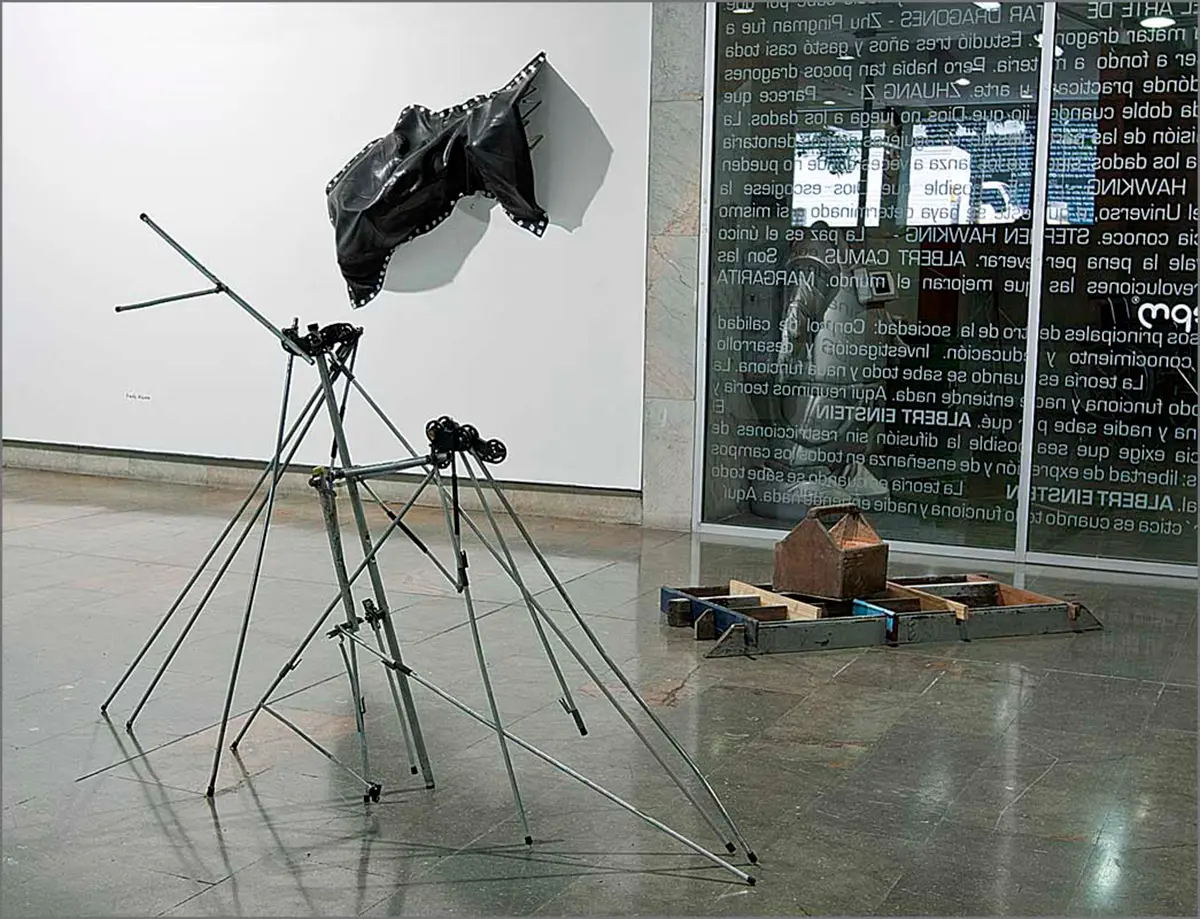
Yet, as Manuel Delgado says, the city’s exterior space belongs “to those who take it over to use and only while they are using it since their property is—or should be—inconceivable and only appears as an unending dynamic of temporary colonization.” Urban space is colonized by the use that subjects make of it, and to that degree, it is also given away or destroyed when the interaction between the subject and the inhabited site is suppressed. There is, however, a different way to think of such temporariness, having to do with lightweight and fragile architectural constructions, as in Fredy Alzate’s sculptural objects. What is more transient than a lightweight, fragile space where a man seeks a home, more than mere shelter? The Colombian artist’s proposal evokes the constructions found in neighborhoods that, isolated by a river or an imaginary strip of land, appear as a different city, or at least as a different face of the city. In that face, houses are built using wood, thatch, and tin, and are supported by rocks that provide balance and harmonize with the rest of the materials. Alzate uses this to propose poetics of lightness and contingency as determining factors in the construction of a “real” place to be made into a home. What we have here is a dystopia, the perversion of the ideal of a society that dominates the imagination of many of its denizens.
This is why dystopianisms, or anti-utopianisms, propose light-weight, unresolved, undefined, unpredictable structures in a move from the transitory to the precarious. As the show’s curator says, one of the meanings of the phrase “vanishing point” is “a technique of representation of perspective in architecture,” and another relates to “literally vanishing, to flee, to leave this space and move into a mental space.” In consequence, the exhibition does not idealize the city, doesn’t present it as a utopian horizon towards which we march, but as the possibility of seeing and proposing different realities and situations to occupy urban space and to define the way in which we inhabit it.
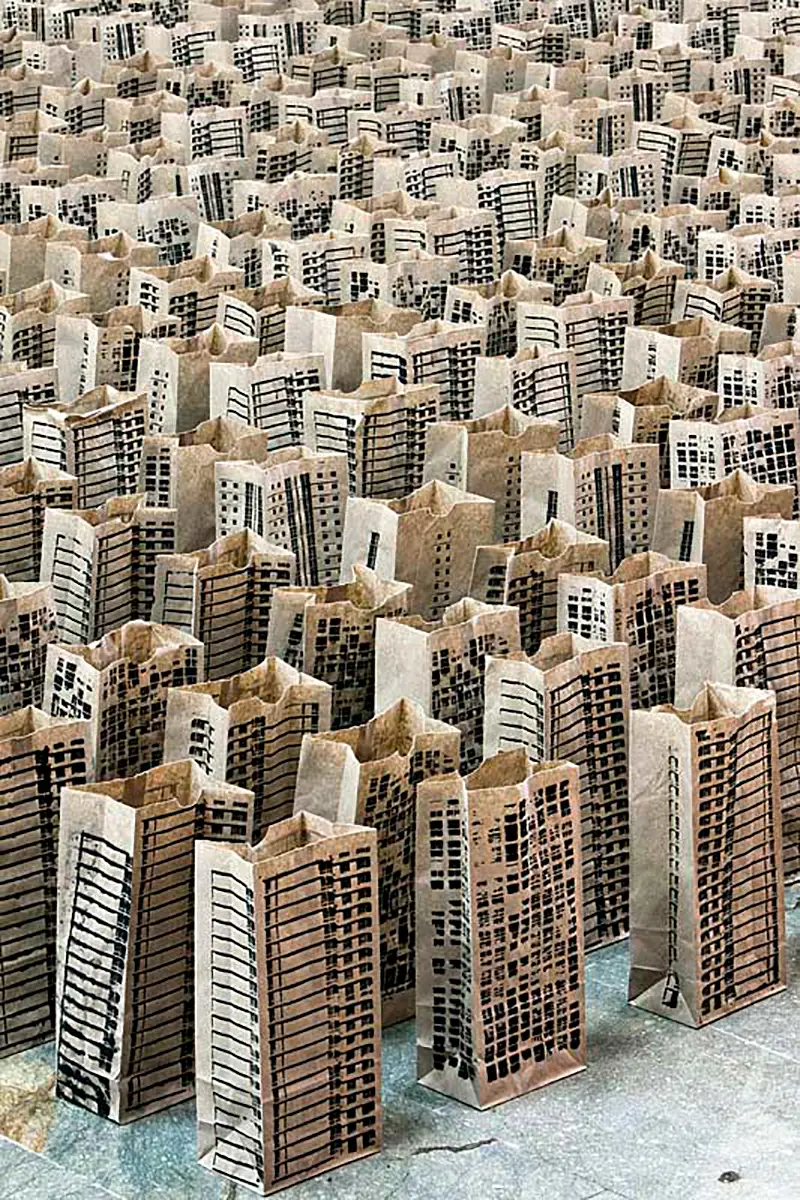
Urban space offers us the beautiful paradox of being both territorialized and deterritorialized; the city presents us with grandly colonized spaces where routines transform the contemporary subject into a subject that is devoured by the ruins it has built. Thus, Juan Raúl Hoyos’ work and installation of 513 paper bags with the façades of buildings from various cities throughout the world silk-screened on them, refer to the repetitive, cold, crowded landscape of the contemporary world.
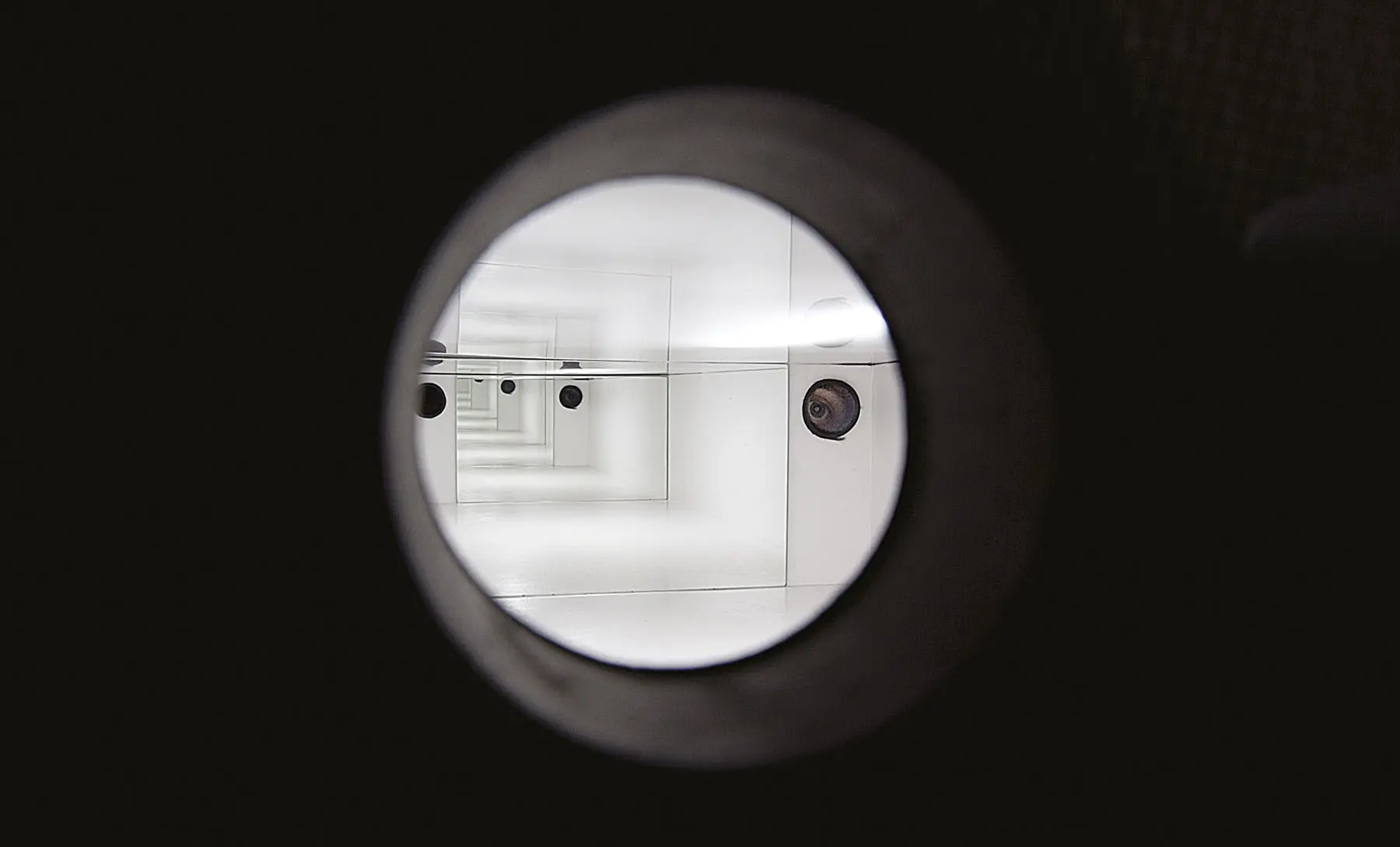
For his part, Edgar Guzmanruiz proposes a different reflection about space. No longer utopia or anti-utopia, no longer light-weight and fragile, and much less a repetitive, monotonous, territorialized place, but the non-place that Marc Augé spoke of. In that sense, his work Transit, a perforated travel bag that allows us to see its interior, reveals an infinite, extended space, like a long, empty, and aseptic hallway. The allusion is direct: in contemporary cities, non-inhabitants (passengers, subjects in transit) are forced to wait in such non-places as bus terminals, railway stations, and airports.
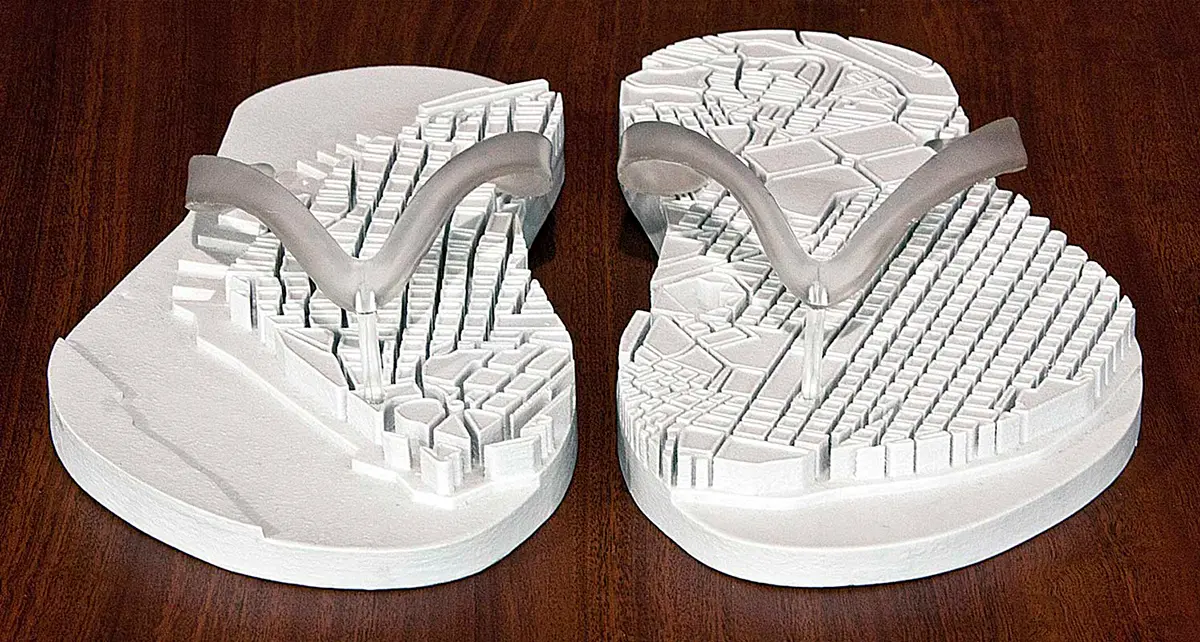
Other artists and other works await the attentive gaze of the viewer. The gallery does not constrain our visit, although it does open up a way of reading the exhibition geographically and visually—a kind of map—and in this, we can also read a gambit in favor of positing an ideal structure that can be subverted by the observer’s curiosity. The show contains that intention, but it is undone by the suppression of linearity. In the body that moves inside the museum space, as in the body that traverses the street, resides the inhabitant of the city, and the city, as Richard Sennett asserts, always speaks of the subject’s modes of understanding. But the city opens up its own cartographies, its own slippage.
Puntos de fuga, arquitecturas posibles is traveling to several cultural centers in Latin America and Spain. In its journey, it will continue to sketch a way of turning space into an alternative for the contemporary subject to ponder itself; showing, through photography, installation, and video, that the very means we use to express and reflect about the contemporary city also speaks of the lost territories, the spaced conquered by the image in the Twenty-First Century. These points dig into the horizon of our understanding, breaking the uni-semantics of the city and render it polysemic, thus framing a new, revealing space for the perspectival representation of architecture and for the vanishing space of the city we imagine and the city we build.
PEDRO ANTONIO AGUDELO RENDÓN