
Artist Ivana Ferrer presents her sixth solo exhibition entitled Textures Instant (because images are matter, texture, and are dependent on time, on a fragment of time).1 Including two images of walls, the exhibition also showcases large-format oil on canvas works. There are other pieces like one of a chocolate foil wrapper shaped into a small ball and placed on top of a worktable, or one, next to a lamp, of a desk with a pile of newspapers on it; and yet another piece—the more controversial one—that involves ants.
One of the works, a concrete wall, shows the erosion caused by the passing of time, as some of the concrete fell from it and left behind a hole that reveals the stones—some of which are painted blue, green, and brown—used as filling. I realize that while she based the piece on the idea of the wall, Ferrer’s final intention is accentuated by such touches of color. Besides conveying the passing of time, the piece also addresses memories and every day. The artist succeeds in transforming the banal into a work of art, and that is the most admirable aspect of her work. A good work of art is after the viewers’ response; it wants to move and/or challenge spectators. But, can a wall actually be a challenge? The answer is yes it can. This is precisely the magic in art. The aesthetics of the work and the way it is rendered are also important—everything counts. One can determine whether or not a work is good, and whether or not one likes it during the first two seconds of looking at it. Ferrer’s work is about the passing of time, memories, and the observer’s ability to recollect.
Although the works are untitled, the artist could have very well named them, as every single one has a story to tell, a banal one, but a story nevertheless, of things that occur in the world and in our lives. Had she chosen to name the pieces, the element of memory would have been erased, as one could have referred back to a specific name. In another work—which could be described as the one occurring on a desk—there is a pile of newspapers, a crushed bottle top, a lamp base with its attached electrical cord, and a piece of colored paper. What could be more mundane, casual, or unimportant than this? But such elements nonetheless play with our emotions and memories.
In some of the works, Ferrer paints the walls like camouflages, as she achieves something unique and special with each image. In Ferrer’s own words, “In separating the colors as if I was rendering the image of a map, my intention is to create an interaction with viewers in which they will either observe patches of colors or discover the image as a whole, depending on how close or far they are from the work.”2 Therefore, when observing one of Ferrer’s pieces from very close, it is not possible to see what it is. So in order to appreciate the image properly, it becomes necessary to move away from it. This is an aspect of the work that makes it more interesting. One example of this type of interaction occurs in the image that depicts the design patterns printed on a paper towel, as only from afar it is possible to tell what the piece is about. In spite of the patchy rendering—required to achieve the desired effect when the image is observed from afar—the work surprisingly captures the details found in the original relief patterns of the paper towel—its symmetry, and flow—as Ferrer’s brushstrokes highlight the beauty of the design and make it interesting. The work with the ants was created one day the artist saw them on her kitchen’s floor and decided to paint them. The ants are depicted forming a circle as if they were engaged in conversation.
Ferrer paints in a representational manner but makes the images more interesting by changing reality through the subjective use of colors. While the artist bases her images on photographs, one could say that she only takes the ideas these convey. Ferrer’s art is conceptual because the passing of time can be perceived in most of her works.
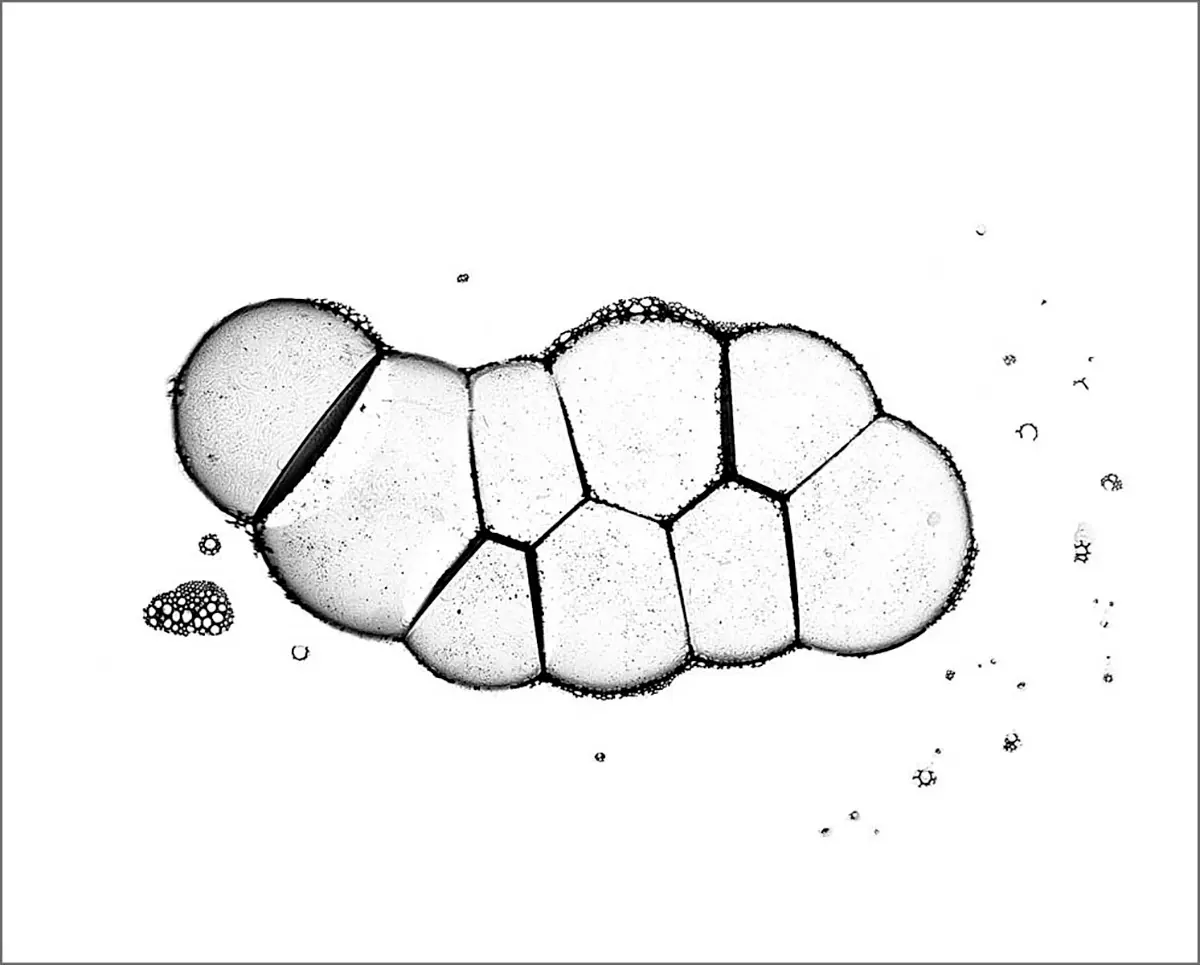
Other works by the artist are photograms—beautiful and masterfully rendered—memory-eliciting images that resemble drawings and give us the sensation of having already seen them somewhere else. And it does not appear to matter that they depict microbes, broken glass, doodles, or glass bottles. These drawing-like photograms are imposing. They were created in a series of three. Concerning this process, Ferrer had this to say: “The photogram is one of the techniques used in photography that is created in the darkroom or laboratory, in which colors are directly placed on photographic paper (photosensitive) that is then exposed to the light and goes through the developing process. The result is a negative that, if desired, can eventually be turned into a print.”3
Ferrer’s work is about the memories of the observer elicited by the images she created. She achieves this through paintings and photographic drawings rendered with the naturalness that is present in all of her works. The impressive thing about her approach is that she successfully relies on mundane elements to bring back memories and to convey the passing of time. Her surprising choices of techniques and themes are lead to effective results and aesthetic proposals.
NOTES
1. Interview with the artist, April 2011.
2. Idem.
3. Idem.
AUGUSTO CHIMPÉN