
There are valuable lessons inscribed for us in the 70 plus projects and objects from the world’s largest collection of Luis Camnitzer’s work on loan from the Daros Museum’s Latin America collection in Zurich. Yet they were not lessons I’d expected from a historical survey of an intellectual whose conceptual art, writings, and social consciousness has influenced so many of us. I found myself relieved when I read Camnitzer’s responses in the catalog interview. The question is not whether we are all fools on this planet—we are—but whether we know it and operate accordingly…eventually. As Camnitzer once wrote when addressing the dilemma and dangers facing the artist, there is always the danger of the ideological platform escaping the artist’s control.
Most of the readers of Art Nexus are familiar with the several basic themes of Camnitzer’s work, much of which parallels the emergent so-called postmodern critique of modernism in the post-formalist age of the 1960s that have dominated considerations until these past few years: originality and its doppelgänger the copy; the artist as a font of original creativity; a belief in the necessary relations between cognition and concept, and, (to a far lesser extent with postmodernism) between that of art and personal ethics. So stated, a tension is immediately apparent between the distancing irony and poetics of the polysemic strategies in conceptualism and the concrete engagement demanded as an agent of ethical response. One could argue that in-between space is what Camnitzer sometimes refers to as his “expressionism” or as Marcel Duchamp’s famous “art coefficient”1 but it also bespeaks a faith—one unjustified for this author—in enlightened consciousness. The bridge Camnitzer has us dance (and not merely walk) across is humor.
As a printmaker Camnitzer was one of the earliest artists to be aware of the possibilities of copies as a concept, thus a vehicle for critique in object-oriented cultures (capitalism and art-ism), especially as extended to words and the self: a presence erased and now present as a post-structural trace. The front cover of the exhibition catalog has a series of adhesive labels under Camnitzer’s name with copy and original stenciled in irregular applications of red ink.
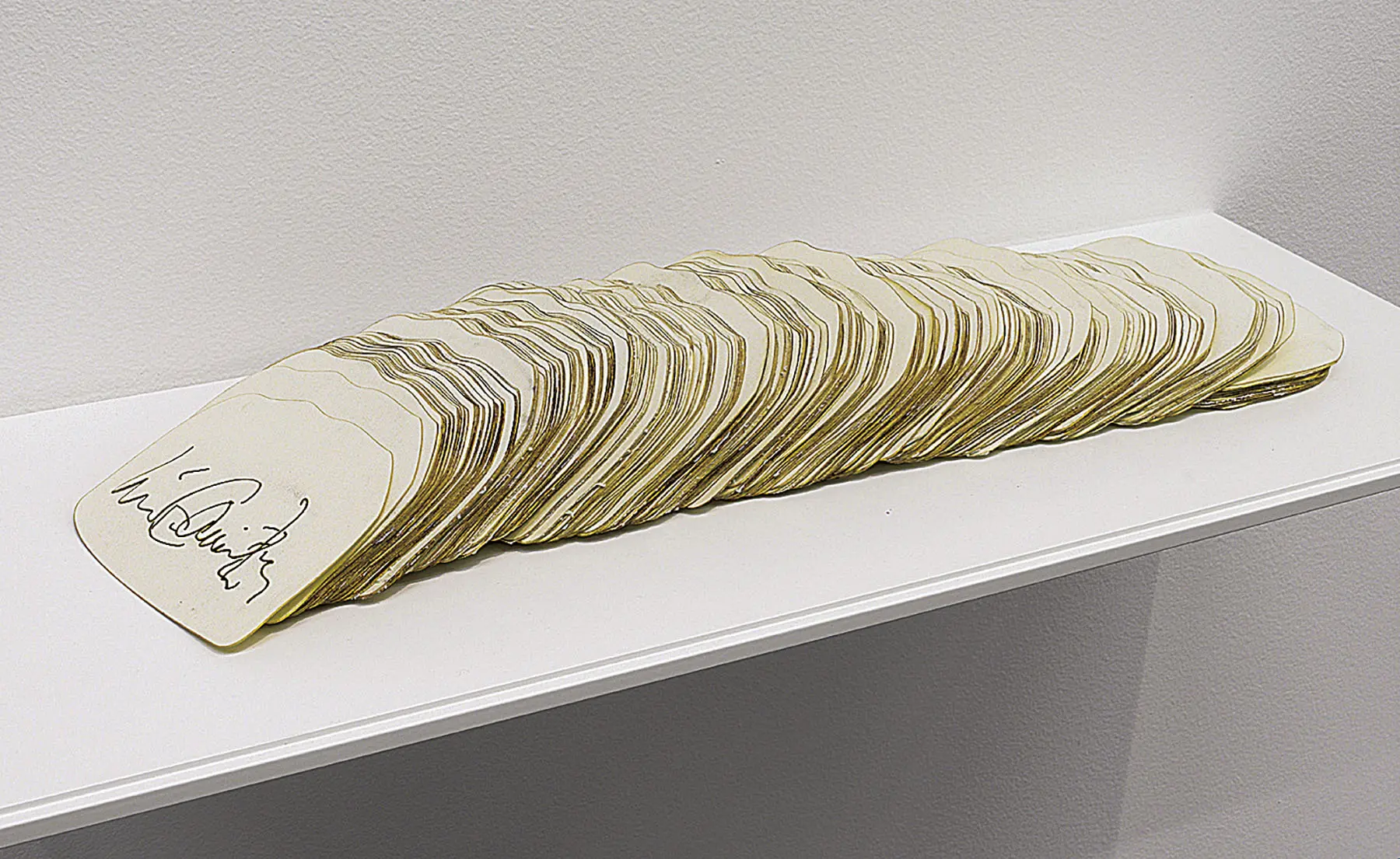
His most frequent use of the copied concept is in the place of the accepted signifiers for the presence of the artist, the indexical referents for authenticity and creativity, such as signature and body. My favorite has long been Selbstbedienung or Self-Service (1996/2010). I and Tatiana Flores now own six different pithy statements by Camnitzer, each laid out in stacks atop pedestals for the taking. We paid $0.25 to stamp the artist’s name on each sheet, a concept that goes back to at least his mid-1960s use of rubber stamps. In a wonderfully absurd moment, we tried to get the best, most authentic, rubber impression of the artist’s signature. What delightful fools we are and how hard systemic values are to erase. But such reliance on signature values, no matter the direction in which they are pointed, also signal Camnitzer’s roots in the older belief structure of avant-gardism.
Camnitzer relies on equivalences between word, image, and object—a long-standing belief found in world-historical cultures as guarantors of posterity and renewal—a relationship we Westerners consider today as non-rational and signal through our grins and laughter when standing in front of the many disjunctures provided by Camnitzer where you, and he, become words or mental images, present through absence. Among the first of Camnitzer’s so-called conceptual works was the 1966-9 preformed polystrene sign that reads: “This Is a Mirror. You Are a Written Sentence.” But this also suggests a reading of the artist as a healer rather than the more singular view of him as a mere critic or wry humorist; the other side to the ever-present Warholian double-bind of critique/celebration.
Camnitzer has consistently made a case for understanding Latin American conceptualism as different in its greater concentration on a local context of social problems rather than the US/capitalist focus on the loss of the object or dematerialization. Thus much of his work relates to the political, defined as the consequence of an ethical perspective turned into world conditions rather than as political art. But that art is not well represented here, despite all the textual claims in the exhibition. Here the 1970s dictum of the personal as political seems strongest and perhaps that is historically appropriate. In his catalog interview and not for the first time, Camnitzer’s realizations differ from his political orientation of the 60s and 70s. He admits he was blinded by the optimism of youth (and, I would add, avant-gardism) as we all have been since we learned the revolution will not happen. It is not simply that older humans learn that our impact will be less than first imagined, but also that ideologies of power and culture are slower to change and perhaps the best path is personal, one to one, as Camnitzer (among others) now argues. This is an important inversion as we stand to look at today’s far more interventionist and social art forms derived from far less an individualist aesthetic and ask of them what is naïve.
NOTE
1. Duchamp’s essay The Creative Act was first presented as a paper in April 1957 and first published in 1959 in Robert Liebel, Marcel Duchamp (New York: Paragraphic Books, 1959): 77-78.
RICHARD LESLIE
Contributing Editor, ArtNexus.