
The display of photographs that Luis Márquez—an artist, folclorista, producer, and all-around impresario—took of the dancers he brought with him from Mexico to perform at the World’s Fair in 1940 on view at the Queens Museum raises new, productive questions about how and why Mexican art and culture became so enormously desirable to audiences in the United States during this era. In pictures of dancers wearing traditional costumes posed amongst the imposing, modern architecture on the Fair, Márquez frames the folk culture of Mexico as unequivocally current, recasting picturesque “old” Mexico as up-to-date consumer products and entertainment.
The display of costumes from Márquez’s collection in the first of two galleries—which, fittingly, are not exhibited as ethnographic artifacts but rather as fashion, on the same kind of mannequins used in department stores—conveys how the material and visual richness of these costumes, and of the kinds of “traditional” Mexican products featured (as we see in photographs in the second gallery) in the Mexican Pavilion, must have appeared all the more striking set against the aggressively modern architecture of the Fair. It is the many photographs Márquez took of architecture (without models or figures), in Manhattan and on the Fairgrounds that are displayed in this first gallery on the walls surrounding his costumes.
The obvious pleasure Márquez took in the modernity of Manhattan’s skyscrapers and the Fair’s pavilions is beautifully conveyed in this first gallery, where the curators hung three walls with photographs Márquez took of New York and the Fairgrounds while he was there working for the Mexican Government during the summer and autumn of 1940. Almost entirely devoid of horizon lines and human figures, Márquez’s pictures present modern architecture as smooth surfaces and dynamic angles unhinged from the landscape and/or human scale. In the Manhattan photographs, we feel the photographer’s point-of-view intensely as we peer up with him through the Atlas sculpture in Rockefeller Plaza at the art deco skyscraper reaching up into the clouds. In the pictures of the pavilions and the Trylon and Perisphere (an architectural focal point of the Fair), Márquez dissolves the temporary-architecture of the Fair into shimmering surface effects, floating geometry, and disembodied corporate logos. Nighttime views of the neon and fluorescent-lit General Electric Building and the tower of the Westinghouse Building help us imagine how arresting it must have been for Fair visitors to gaze up at these architectural symbols of progress.
That the authenticity of folk culture was embraced as the necessary partner of these forward-looking visions of modernity during the 1930s is widely acknowledged. The presence of mannequins in costumes of traditional Mexican clothing cues us theatrically (and sumptuously) to Márquez’s photographs in the adjacent gallery of women and men in traditional Mexican costumes posed in various locations on the Fairgrounds. They also remind us of the inability of an exhibition to simulate the remarkable spectacle of encountering a Tehuana in the modernist, white plastered context of the World’s Fair (although there are no doubt many contemporary situations that simulate similar experiences of a Disney-museum-like manufactured encounter with a racial or gendered Other). And, they remind us of the proximity of ethnography and museums, and commerce and entertainment.
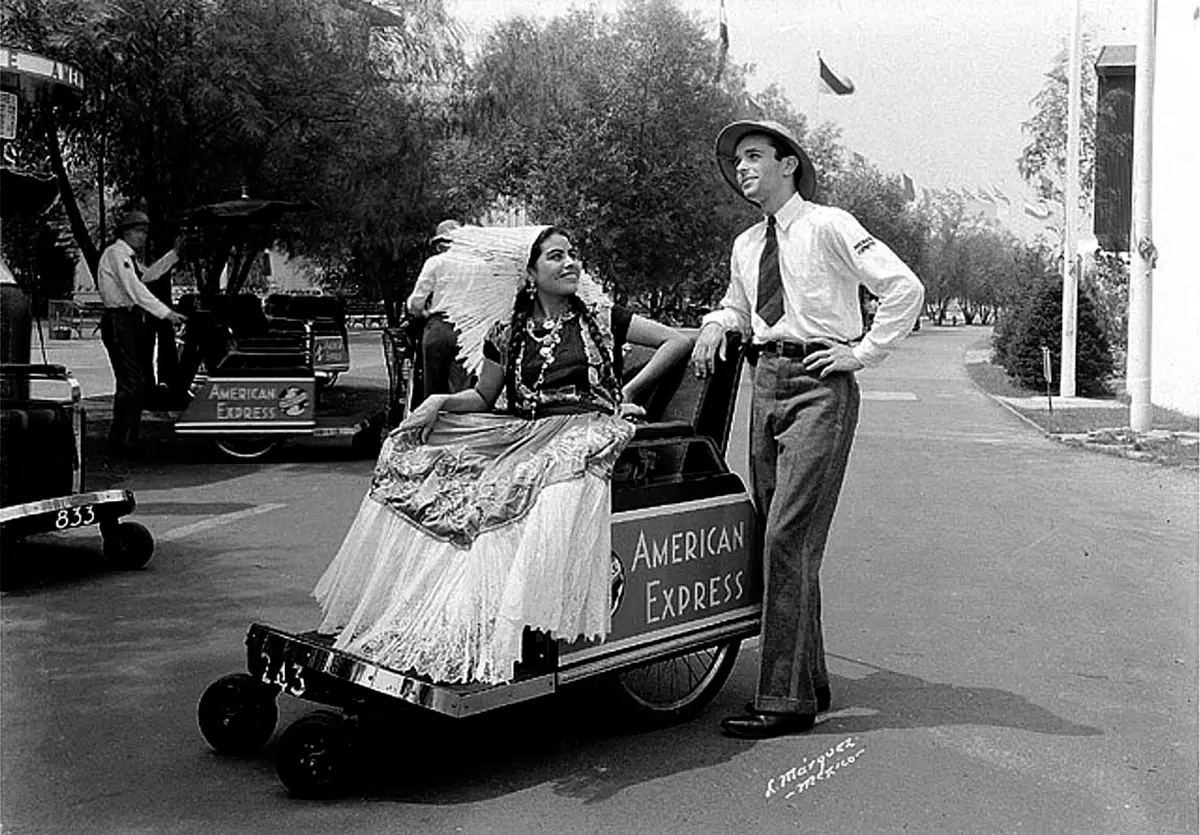
The second gallery in many ways is the thematic focus of the show, even though the photographs in the first are arguably the stronger group of Márquez’s production, with their extreme sense of modernist refinement and drama. In this gallery we find Márquez’s dancers photographed in costume in various points in the Fair. A Tehuana appears posed by the reflecting pool, and again looking up at an enormous statue of Ben Franklin in the U.S. Pavilion. A man in a Huichol costume sits with his staff and hat in hand before the Trylon and Perisphere, and lounging in front of the General Motors building. Posed to show the clothing they are wearing, the elaborate costumes of these models look modern and dramatic against the eclectic, white plaster and gilt architecture and sculpture of the Fair. Márquez’s skill as a theatrical producer is evident in the range he exhibits here. In another series, Márquez photographs his models posed with Sailors and tour guides for American Express (young white men in military-looking uniforms); and in a series of more intimate shots, Chinas Poblanas pose in the gardens surrounding the Japanese Pavilion, flirting with U.S. sailors in their crisp white uniforms or in dramatic poses with a man outfitted as a Mariachi, all poses that are somewhat hokey and melodramatic, taken from the movies and celebrity magazines. In yet another series, an entire class of Westpoint Cadets is shown in formation, as rows and rows of tiny figures, in front of the U.S. Pavilion.
The scholarly questions posed by the show’s curators, Itala Schmelz and Ernesto Peñaloza, are considerable. It seems obvious that slippery and complex notions of gender and race contribute to Márquez’s enigmatic images of national identity and that this is an issue that merits further study. It also seems incredibly important, from the perspective of the U.S. (which is where I write from), to consider how the commercial popularity of Mexican culture coincided with a wave of racial violence in the U.S. that, among other things, resulted in the first wave of the Chicano civil rights movement. That said, the question of culture as a fantastic antidote to real social problems is beautifully and provocatively raised by bringing Márquez, in all of his complexity, to light.
HARPER MONTGOMERY