An exhibition of more than 100 artworks selected from the Isabel and Agustin Coppel Collection, one of Mexico’s most comprehensive contemporary art collections, was presented jointly at the Museum of Latin American Art (MOLAA) in Long Beach and the Museum of Contemporary Art of San Diego MCASD.
Responding to the provocatively elusive framing of Mexican contemporary art in Mexico Expected/Unexpected, this review proposes a historical reading of the subject and tries to square it with the works and the framing of the exhibition.
Modern and contemporary art from Mexico (and from Latin America, and from the “periphery”) has historically been given an extra burden by the “centers” and mainstream art criticism. It has to show how it transcends its cultural boundaries not to be seen as folkloric, regional instinctual, and alienated.1
Early in the 20th century, Mexican art’s divergence from the dominant universalized discourses of the time was attributed to a cultural limitation and/or lack of development. For example, It was supposedly by alienation and not by design that Diego Rivera used local color, narrative, and mimesis in his Cubist works. His distance from mainstream Cubism and abstraction was seen as the very measure of his regional limitation.
What could Rivera have done to show that it was not some pre-discursive locality, something that was in him regardless of him that was keeping his art from the overall geometric truth? He could have produced the objective conditions of his encounter with Mexico, and somewhat make them evident in his cubist work, which ostensibly he did not do. Good for him. It is in part this lack of foundation that gives works like his 1915 Paisaje Zapatista its arresting, subversive poetry.
Today the suspected regional constraints of contemporary Mexican art (and Latin American contemporary art, and “peripheral” contemporary art in general) are measured against a modified, structuralism-infused critical mainstream. It is the relative capacity to generate and/or document “real,” “sited” experiences, unstable meanings, de-stabilized categories, and unpredictable outcomes that are seen as the very measure of provincialism.
To be fair, the critical paradigm that links concrete facts with meanings in constant flux affects contemporary artists everywhere, but much more those erroneously thought to be living in the past (although “There are no people in the present living in the past,” as the semiotician Walter Mignolo brilliantly pointed out) and those thought to be culturally determined (even though everybody is, particularly the ones who believe in objective “facts” and fluxes). So the model has two pernicious effects: (1) it is discriminatory, it provides a detecting mechanism to identify and disqualify people living in the past (nobody) and people who are culturally determined (everybody or nobody). And (2), it clips the poetic wings of art production in general. After the objective experience of exteriority has been established as the condition of possibility and founding instance of the work, these and all the multiplicities, fluxes, and possibilities have no substantial drift or poetic range, they operate within a field that has been already decoded and laid bare.
How do the works in the exhibition and their framing intersect these concerns? Let us start with some works.
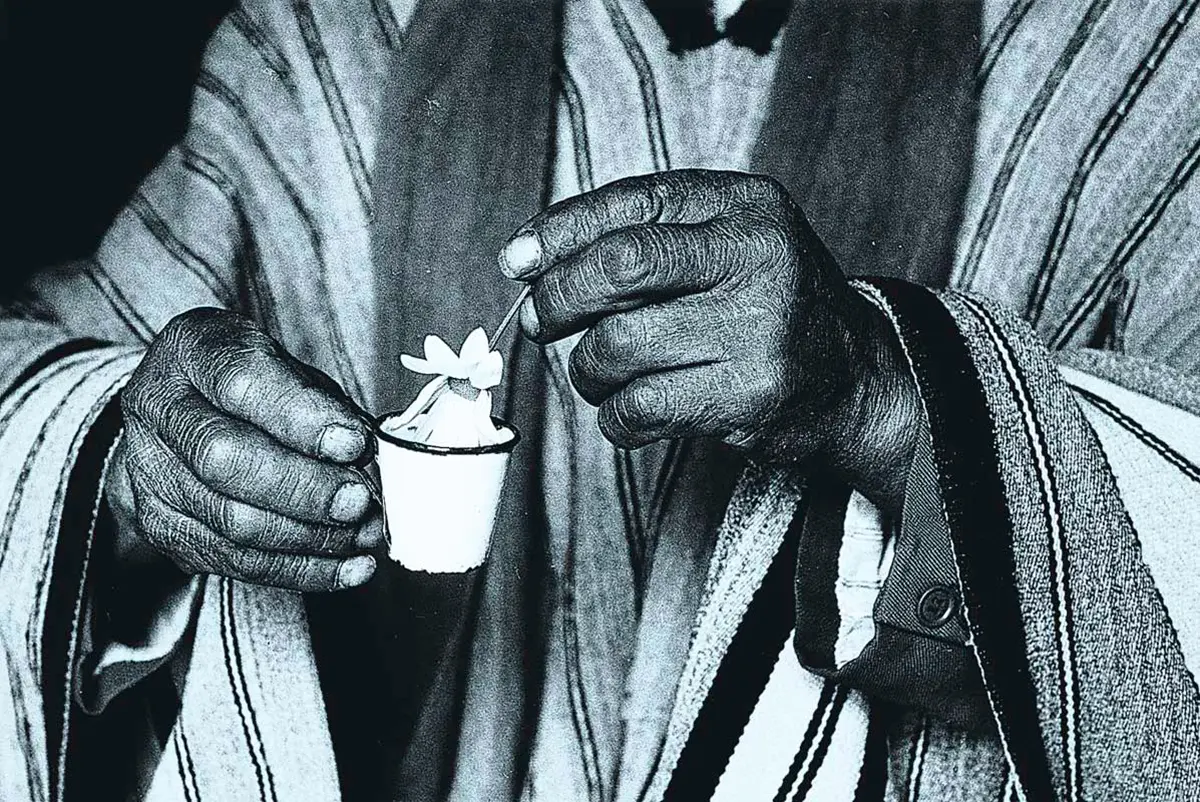
Two splendid works in the MOLAA location—Flor Garduño’s 1989 photograph La bendición, Isla del sol, Bolivia (The Blessing, Sun Island, Bolivia); and Eduardo Abaroa’s 1989 installation BCIN (Nódulo de esquina) (BCIN [Node in a corner])—present themselves as good starting points since Garduño’s has a refreshing disregard for the “danger” of being cast as folkloric and Abaroa has a refreshing disregard for the “danger” of not producing conditions of possibility.
Garduño’s La bendición, a black and white silver gelatin print, announces itself, like a Rembrandt, with a luminous center of attention. It catches your eye from far away, draws you in, and sustains its vibrancy through the close observation of the image. The almost iridescent white comes from a small white flower that the hands of a mature man deep in a small, equally white cup, presumably to use the flower as an aspergillum. The precious moment is heightened by the framing of the image that does not include the face of the man and shows little more than the dark hands, the flower and cup, and his warmly clothed upper torso that displays the layering of urban suit and poncho that is the norm among Bolivian indigenous people. The position of the left hand, similar to that of Velazquez’s right hand in Las Meninas, has a striking immediacy; it is in the act of raising the already loaded flower. All these theatrics make for a reverential, unapologetically mystical image of the flower, the man, and the light.
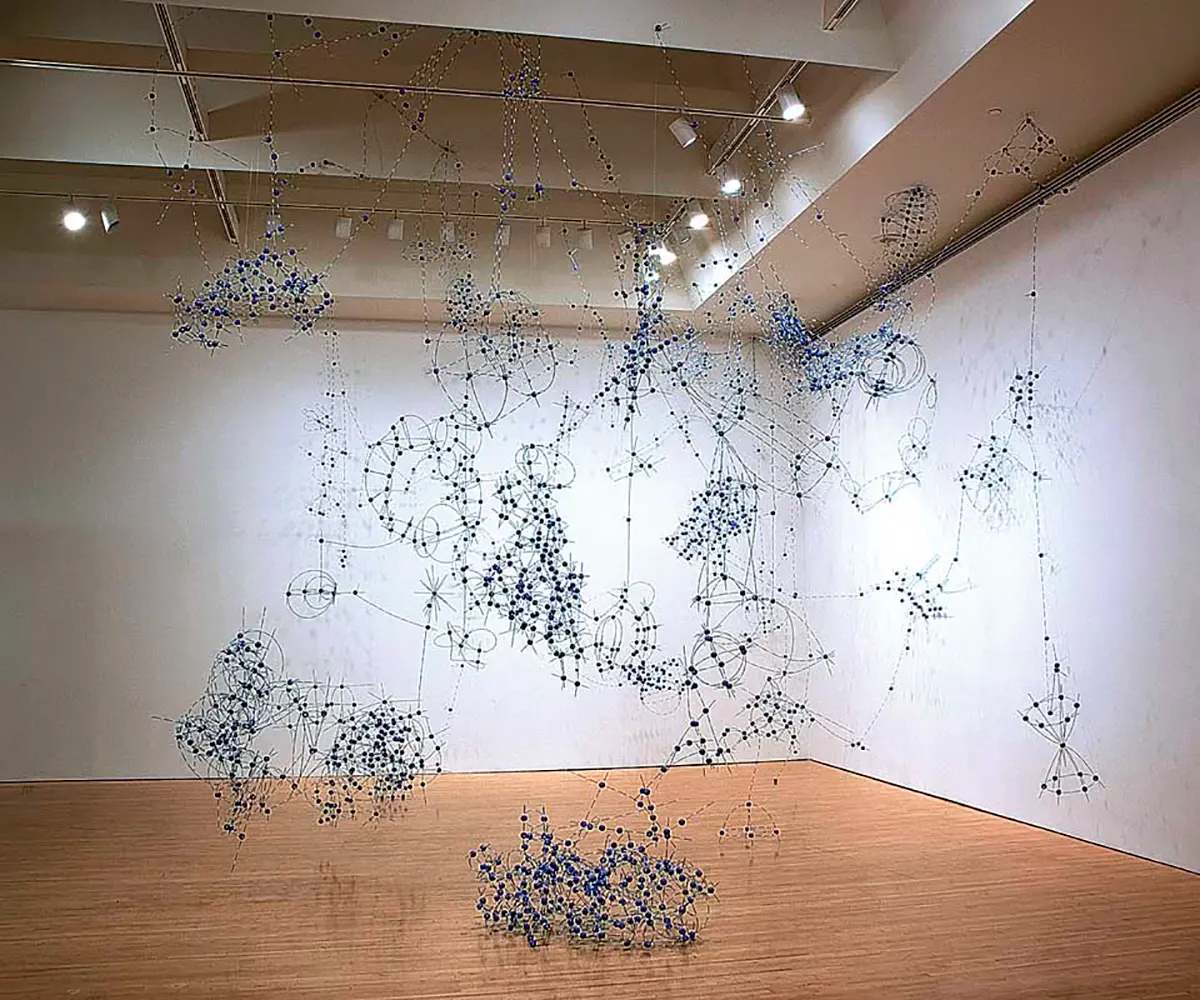
The work BCIN (Nódulo de esquina) (BCIN [Node in a corner]) by Eduardo Abaroa is an installation that consists of thousands of blue cotton Q-tips, linked by blue plastic balls, wire, and white-hot glue. Its dimensions are listed as variable and in MOLAA it traveled from the ceiling to the floor, with an intricate stop in one of the walls. Flexible but strong, the work responds with delicate bobs to the steps of visitors. From afar the work looks like a playful galactic fantasy. A closer look delivers more untidy associations. BCIN stands for Body Cavity Inspection Network, which acknowledges the Q tips’ everyday job, reflects the generative proliferation of the building method, and assigns a counterintuitive severity to the unthreatening, wobbly maze. More than anything, though, the title announces, with its farfetchedness, the wide associative range that the work can receive and generate. Like a spider that evokes creation myths as it spins its web out of nothing, BCIN’s meandering semantic drift presents no anchoring facts. No foundational truth.
The works by Francis Alÿs, Gabriel Orozco, and Melanie Smith, which the catalog identifies as key figures of the Mexican contemporary art scene, don’t display the same unencumbered position regarding locality and truthful origins. Let us see.
Zócalo, Mayo 22, 1999 (Zocalo, May 22nd, 1999) by Francis Alÿs in collaboration with Rafael Ortega, is a 12-hour real-time video that shows how constantly changing clusters of people form a slow-moving linear pattern as they gather under the shadow of the colossal flagpole and Mexican flag that dominate Mexico City’s Zócalo to block the sun. It is illustrative to compare it with the painting Oh, Santa Bandera (1977) by Mexican artist Enrique Guzmán, which also tampers with national iconography, engages the Mexican flag and is shown, like “Zócalo,” in the MCASD location of the exhibit.
Why do we need to know that this is in fact the Zócalo? The role of casual people making collective funny patterns as they hide from the sun, the role of “actual unrehearsed actors” could have been played by anybody anywhere. But the exacting of the actual, demonstrable place and time of the encounter, stresses truth value. The real-time filming stresses truth-value. The concentration on the contingent, collective pattern making, in the most emblematic site for demonstrations (which are collective patterns made by design) stresses truth-value. In Oh, Santa Bandera, by contrast, there are no traces of an actual encounter. The painting is a naturalistic rendering of a Mexican flag in which the expected watered-down Aztec pictogram for Tenochtitlan has been replaced by a fleshy wide-open mouth. Guzmán subverts national iconography not with discursive actuality but with symbols that dispute (in the words of Osvaldo Sanchez) “the dominion of the nation-state over the representation of the body…”
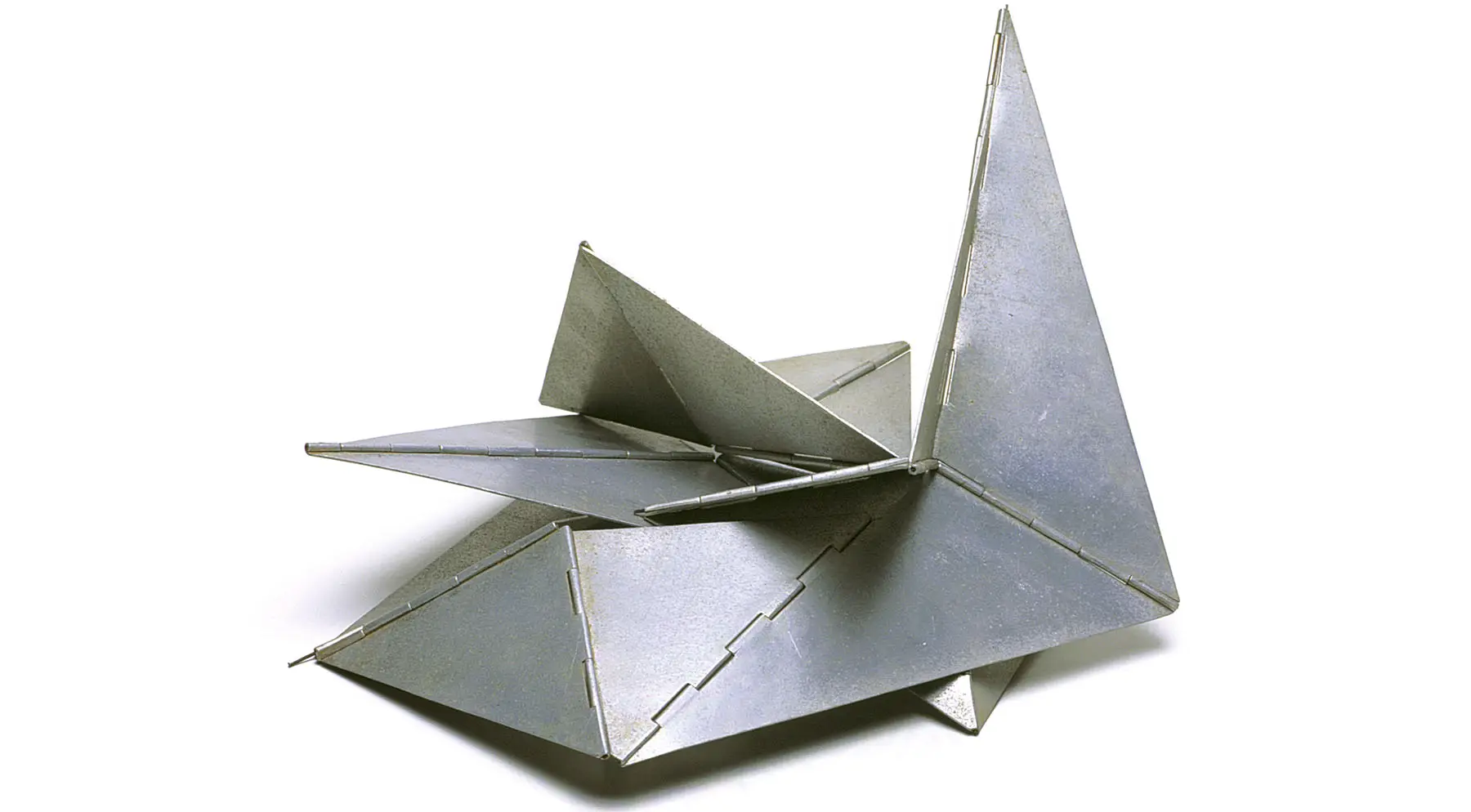
In Vertidos Multiples (Multiple Pourings, 2003) by Gabriel Orozco, like Zócalo, the work Vertidos Multiples provides information about its origin starting with the title. It is illustrative to compare it with Bicho (Bug, 1960) by Brazilian Lygia Clark which is right next to it in the MOLAA portion of the exhibit. Like Vertidos Multiples, Bicho is sculptural and geometric. Both works undercut the remoteness of abstraction with gestures towards reality. But in such different ways! Clark’s Bicho is a modular aluminum piece made of movable geometric flaps connected by hinges. The largest dimension is 15 inches. Its gesture towards reality is not organized around an objectified past but a dreamy future: the direct involvement of the spectator as an active participant, which the hinges announce. The piece lacks solidity and concision. Its contours and position are not settled. Its participatory plea is more than an invitation to exercise the options of an already constituted object. Vertidos Multiples is a hollow, 19 inches diameter incomplete sphere cast in black polyurethane. The pouring of the plastic was stopped before the whole spherical mold was filled so the process and the physical qualities of the paste used are quite evident. The sphere is shown in a stage of formation that is a prelude to the logical completion of an already assigned form.
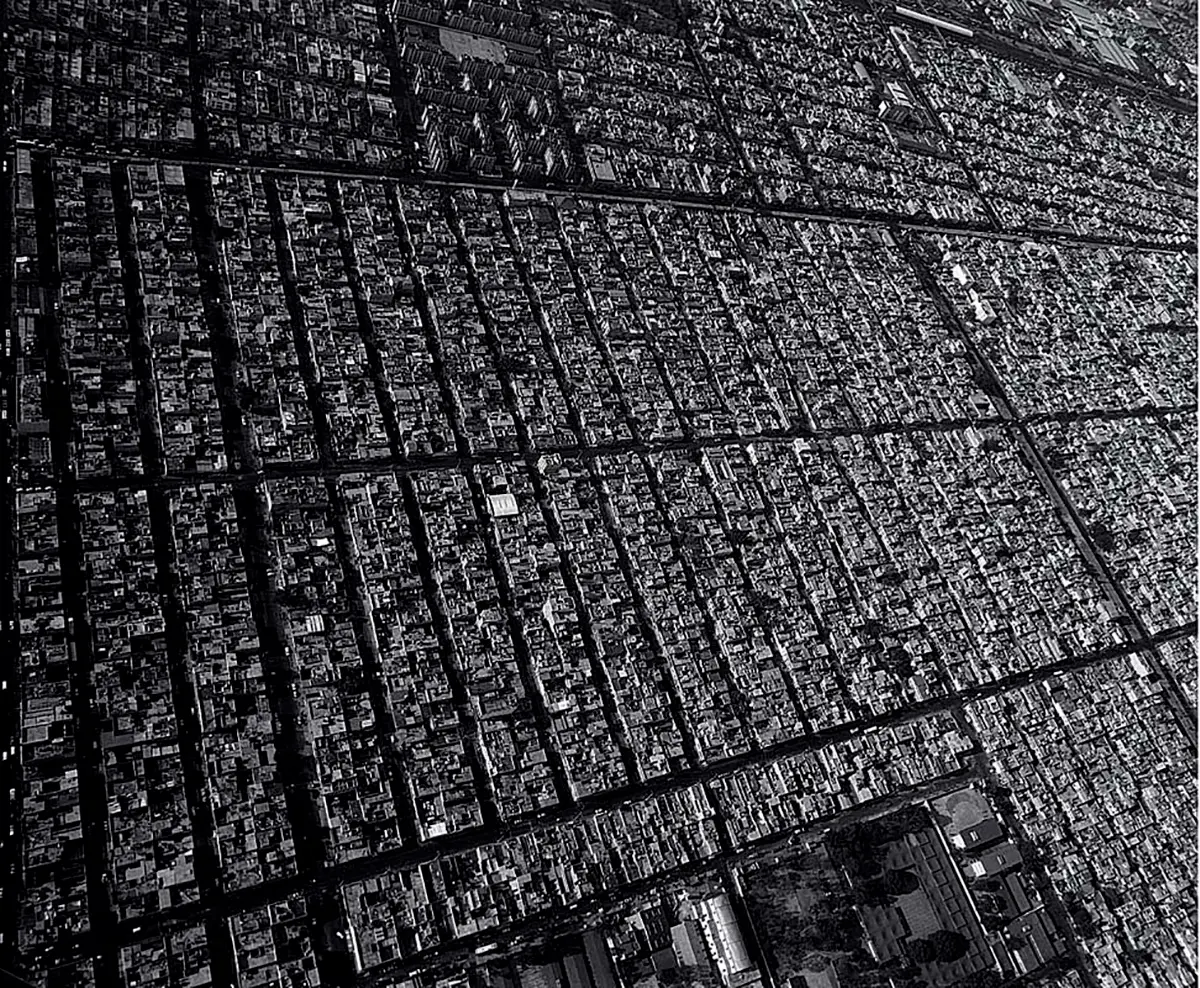
Melanie Smith’s three photographs, Spiral City II, III, and IV (2002) also produce a documented “present” of a “real” encounter with the city. The black-and-white gelatin prints presented in the MCASD location are stills from the real-time, 6-minute video Spiral City, which was shot using a camera attached to a helicopter circling above Mexico City. The title is a concrete allusion to Robert Smithson’s signature earthwork Spiral Jetty, made in the Great Salt Lake of Utah in 1970, which included the building of a gigantic spiral shape, comparable to the flight pattern of Spiral City, but it engaged a natural environment without people or people-made elements. The images instantiate and exactly account for the meeting of the patterned flight and the endless proliferation of grids and geometric profusion Mexico City looks like when seen from a circling helicopter. In the video (which I had the chance to see elsewhere) the lack of editing and repetitive movement enhances the sense of a disciplined search for a truthful experience
Zócalo, Vertidos Multiples, and Spiral City approach the public with the discursive authority of an already gained trueness, after detouring through objectified exteriority which diminishes their scope.
I don’t think that the exhibition can be said to subscribe or be guided by the exclusionary principles I describe above. There are too many artists (like Abaroa, Garduño, and Guzmán) who don’t conform to that mold. But I do think that the misleading urge to measure the relative capacity to generate and/or document “real,” “sited” experiences, unstable meanings, de-stabilized categories, and unpredictable outcomes played an important role in defining the “key” artists the catalog mentions and in excluding many excellent artists who don’t go out of their way to produce the objective conditions of their encounter with Mexico.2
NOTES
1 MOLAA and MCASD have in the past shaken and expanded the narrow frame of Mexican Art in the US with ground-breaking exhibitions like TRANSactions: Contemporary Latin American and Latino Art, Strange New World: Art and Design from Tijuana, Siqueiros: Landscape Painter, Manchuria: Peripheral Vision —A Felipe Ehrenberg Retrospective and the upcoming MEX/LA: Mexican Modernism(s) in Los Angeles 1930-1985.
2. I would include among this group Ruben Ortiz Torres, Yvonne Venegas, Marcos Ramírez (ERRE) There are no artists from Tijuana and no Chicanos.
FABIÁN CEREJIDO