
After several important awards, a successful exhibition at the Museo de Arte de Puerto Rico in 2010, titled Out of Oil (an experience consisting of the outline of a closed sugar plantation in Puerto Rico, made of lights and accompanied by sound), with an excellent education at the University of Puerto Rico (BS) and a Masters (MFA) in Photography and video from Madrid’s Universidad Complutense, and with a solid reputation as one of the most promising emerging artists in Puerto Rico, Myritza Castillo (San Juan, 1981), recognized for her refine and provocative oeuvre framed within an original and provocative gaze, has decided to follow her desire and, in her most recent show (March, 2011), titled Writing Stories, returns with passion and joy to the art of drawing.
In Writing Stories, at Espacio 304 Gallery, the artist presented with great success 15 seductive/suggestive drawings of typewriters from the 1920s to the 1960s (10 drawings, 9” x 12” on paper and 5 drawings on fabric, 36” x 36” and 60” x 46”), where each one of the 15 machines comes in a different color, which brings them to a present where information technology uses colors as hooks, thus launching one of her games with chronology.
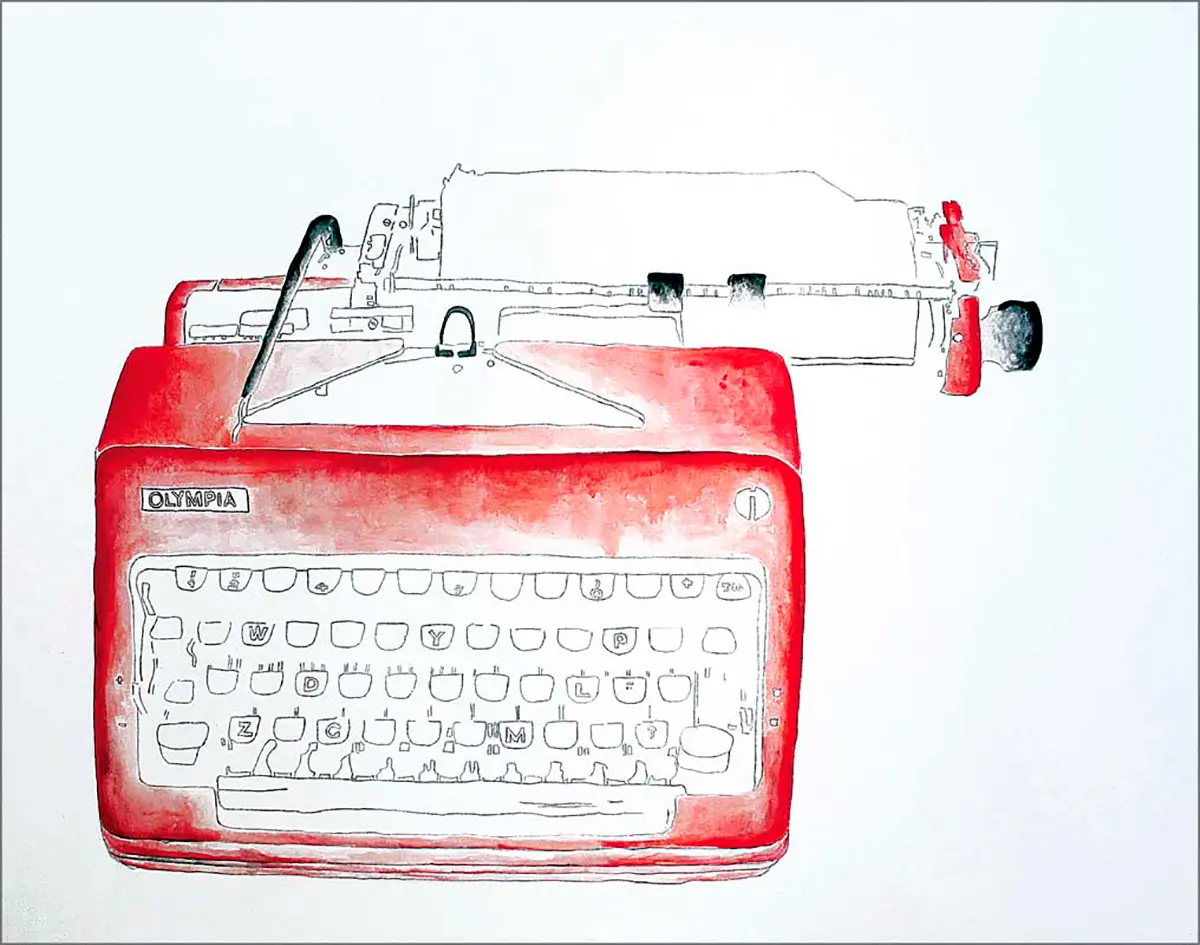
Conceptualized as a fetishistic ritual and executed with great subtlety and lyricism in a combination of postmodern minimalism and graffiti—at times, these beautiful machines seem to be floating, to be ethereal—these complex instruments not only remind us of a still-recent past—the time before the new technologies and the cybernetic world changed the lives of a portion of the world’s population, the portion with greater power—but history itself: the beginnings of writing on clay tablets during the Urban Revolution, papyruses, medieval copyist-monks, Guttenberg’s invention of the moveable press, and, of course, the invention, democratization, and, obviously, literary, political, and existential importance of the typewriter during and after the Industrial Revolution. For Myritza Castillo, “typewriters refer us to a kind of catalog of the period between 1920 and 1960, and the history that each one of them contains inside,” approaching what we could denominate a “techno-intertextuality/referentiality.”
It is well known that old typewriters have become collector’s items because, as in the case of old phonographs, their intrinsic beauty, a fantastic ready-made where aesthetic asserts itself loudly. They are also objects of curiosity—remember the importance of the typewriter used by Hemingway in his house outside Havana, or the one used by Jack Nicholson in his great role in Stanley Kubrick’s The Shining. But for Castillo, they are also magical items, invested with extraordinary powers. They produce manifestos, love letters, and text that changed—and continue to change—our lives. “For a machine to spit out stories, letters, poems —that is wonderful to me,” she says. “Remember that I have worked with the issue of stories in my photographs, the way in which different readings are always there. Different possibilities.”
This is why, besides being a “rest” from the complex and ever-shifting production of aesthetic and ethical discourses in photography, painting, video, constructions, and installations, Writing Stories is a tribute to an object—a combination of insect, skeleton, conspirator, Aleph, and God—that has greatly helped the survival of the word, in itself a powerful form of the immortality we all seek.
Inexhaustible, filled with projects, Myritza Castillo has already moved on from draftsmanship and is now working on a series titled Objects of Disconnection-Association, having to do with “how each object created has a particular function but I change the object’s function and use it in different ways, I carry out a series of actions with it, record them, and then a new interpretation of the object appears.”
We are thus witnesses to a great creative force in the context of globalization, who, under the influence of Olafur Eliasson and others, prods us to ponder the issues of change and permanence—like Parmenides, Plato, and Aristotle did. And also the fact that we at once are and aren’t, as we are always in flux.
MANUEL ÁLVAREZ LEZAMA