
The Lowe Art Museum of the University of Miami recently treated us to the retrospective exhibition titled Rafael Soriano: Other Worlds Within. Under Jesús Rosado, the curatorship of the exhibition procures a panoramic view of the prolific career of the Cuban-US artist, while also being a well-deserved homage to more than sixty years of an unrelenting commitment to painting.
Rafael Soriano (Matanzas, 1920) studied art at the Academia de San Alejandro in Havana, where he graduated as a painter and sculptor in 1943. Leopoldo Romañach and Juan José Sicre were two of his teachers there. Once he completed his degree, Soriano returned to his hometown, where he played a leading role in the creation—and then as a teacher—of the Escuela de Bellas Artes de Matanzas, where Roberto Diago also once taught.
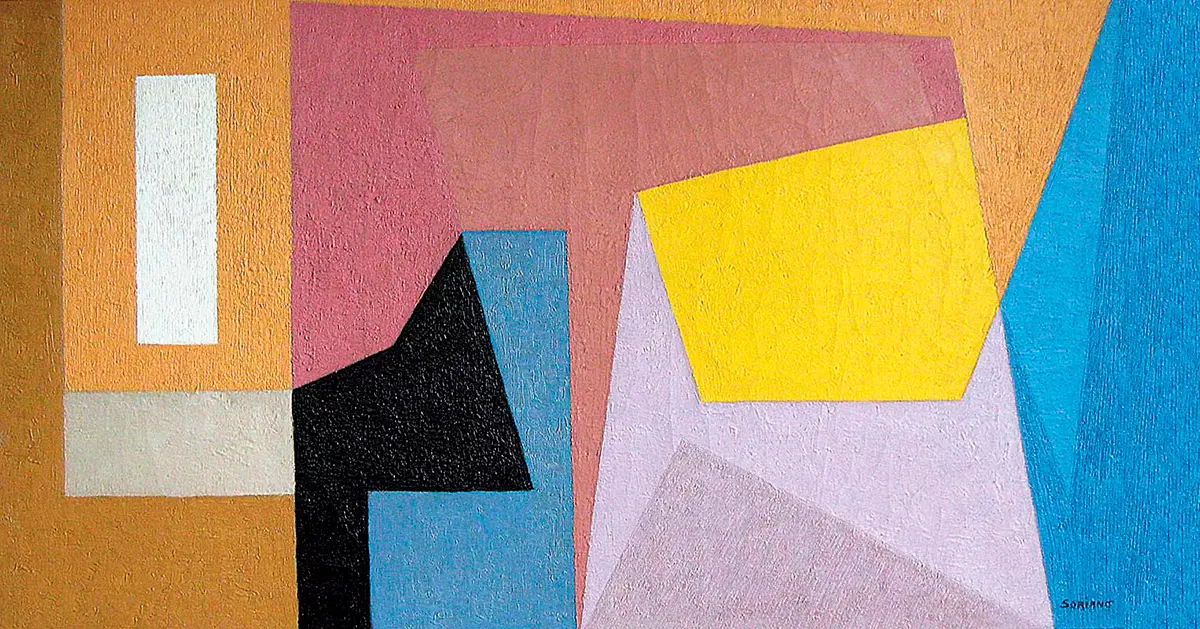
While Soriano’s early works revealed a desire to experiment with organic and metaphysical forms, by the 1950s his artistic universe opened to concrete art. The paintings from this period are wonderful; their geometric power and the interplay of dynamic color planes work toward structuring the pictorial space.
Soriano’s experience in Matanzas was enriched with the return from Paris of Lolo Soldevilla, the explorations by figures like Corratgé and Sandu Darié, and by 1958, the Grupo Diez Pintores Concretos (Ten Concrete Painters Group), integrated by Pedro Álvarez, Wilfredo Arcay, Salvador Corratgé, Sandu Darié, Alberto Menocal, José Mijares, Pedro de Oraá, Martínez Pedro, Loló, Soldevilla, and Rafael Soriano. Together with the group Los Once, the Ten Concrete Painters Group achieved for the first time in the history of Cuban art the assimilation of an artistic proposal from the island into the international art world.
The exhibition includes several magnificent works from this wonderful period in Soriano’s career, in which textures, color contrasts, and angular compositions are prevalent. Invariably untitled, the works from that period were subdivided into two main groups. The first group relies on luminous colors and avoids the use of lines, as the yellows, the limes, and turquoises are articulated over earth colors to gracefully render geometrical universes. The second group uses black lines to outline the plane as well as a more dramatic palette.
Soriano moved to Miami in 1962. Leaving the motherland behind—and the artistic context in which he developed as an artist—meant a great loss to him. Without a support system, he abandons painting altogether for a period of two years. The existential silence that grabbed a hold of him eventually turned into an inquiry of the pictorial space and the reconciliation—through painting—with himself.
During the sixties decade, Soriano’s work suffered an intense process of experimentation. The artist appeared to be drawing from his past—perhaps as a refuge from reality—as he resumed his interest in the metaphysical world and the organic forms that had excited him in the past.
Then Soriano renounced to the plane in order to experiment with depth, as he searched within, into the soul. This introspection process led him into a new period: one that defined his work in exile and where light became an element that shaped hard to recognize organic structures that, nonetheless, seem familiar to us.
His work eventually became more cryptic even as his universe had somehow begun to flirt with figuration. The invariably black backgrounds became the proper framework in which to experiment with light—by then, the central character in his work.
Soriano is a master of light. By combining it with translucencies, he turns light into a shaper of ethereal elements: watery forms, indescribable glops, nightmares, fantasies, chimeras, and desires.
His technique is quite unique. Without previous sketches or preconceived ideas, Soriano immerses himself in the dark canvas and begins—like an alchemist— to work in an energetic central area from where light emanates. The process is slow, and that is the reason the artist works in several projects at once. Successive translucent layers are superimposed until the light becomes an entity, and once corporeal, it becomes alive in the canvas.
It is important to clarify that Soriano’s technique works contrariwise to the renaissance technique of sfumato, where shadows dilute the line to create the illusion of volume. On the other hand, Soriano’s technique is a sort of burnished process in which the artist’s precise brushstroke works to restore the light.
Based on this new formal turn, the titles emerge with evocative force: Nave Flotante(Floating Ship), Torso, El Recuerdo(The Remembrance), Vuelo Astral(Astral Flight), Ninfas del Alba(Dawn Nymphs), and Lamento del Crepúsculo(Twilight Lament) are some of the poetic names that guide us through the depths of this journey that Soriano invites us to embark on.
Noteworthy among the accompanying activities running currently to the exhibition is the screening of the documentary titled La profundidad del silencio(The depth of Silence) by Jorge Moya.
Rafael Soriano: Other Worlds Within is a well-deserved tribute to the lonesome endeavor of this tireless master of Cuban art.
JANET BATET